And it burns, burns, burns

Based on Johnny Cash’s own autobiography and developed with considerable input from himself and his wife June up until their deaths in 2003, James Mangold (Girl, Interrupted) tells the first part of the story of a legendary life in music with astonishing power and sensitivity. Superficially, Walk the Line follows the same, tried and tested tracks of other musical biopics, but perhaps because many musicians have the same story to tell; hard times, the struggle for success and recognition, drugs, alcohol, rehab and redemption, their stories can’t help but resemble each other.

Although JR Cash’s poor childhood in rural Arkansas is quickly told, Mangold does manage to establish three key elements of his subject’s troubled personality. We discover the impact the tragic death of his beloved older brother had on his life, that his alcoholism was likely hereditary and that his father's lifelong animosity towards him scarred him deeply. “The Devil did this,” Ray Cash (played with devastating meanness by the excellent Robert Patrick) shouts. “He took the wrong son.” And you wonder why he wore black? After a tour of duty with the Army in Germany, Cash returned to the US to marry his sweetheart Vivian (Ginnifer Goodwin), and raise their daughter. It’s just as Cash is unhappy with the direction his life has taken, and struggling to establish himself as a musician, that the film kicks into life, in an altogether rattling scene that sustains the momentum through to the finale in Fulsom Prison.

When a combination of luck and desperate persistence gets Johnny Cash and his part-time back-up band an audition at Sam Phillips (Dallas Roberts) legendary Sun Records in Memphis, things don’t go according to plan. The trio pick out an uncomfortable, altogether amateur version of an old gospel standard with Cash yodelling away like coyote. Phillips, unimpressed, asks them if they have anything original for him. With the other two following his lead, and with a nervous cough, Cash sings Folsom Prison Blues, a plaintive country song he’d written when stationed in Germany as a GI. It’s in the process of delivering this sad song about regret, with his dreams of a musical career disappearing over the horizon and an angry wife at home, that Phoenix undergoes a stunning metamorphosis. He shifts his stance a little, addresses the microphone with a jutting chin and grips his guitar with a new fervour. It’s like he hates it, and himself for playing it. The young Cash’s desire to perform and to touch people with music has embarrassed him again, but maybe for the last time. Phoenix starts the song as JR, a broke door-to-door salesman and ends it as Johnny Cash. An immortal.

After signing with Sun, Johnny and the boys set off on a seemingly endless town to town tour of the American south, along with Elvis Presley and Jerry Lee Lewis, driving a caravan of cars filled with amplifiers from town to town, popping amphetamine pills to keep going. Also on the tour is June Carter, one of a famous family of country singers, with she and the intense Cash quickly sparking a mutual attraction. But Johnny is married, and June is recently divorced and unwilling to get involved. Despite his frequent declarations of love, June keeps him at arms-length for years. At its heart, Walk the Line is a love story, as sizzling and passionate on screen as it was in real life. Perhaps his story ends in 1968 because the two stayed devoted to each other for the remaining 35 years of their lives, but Mangold draws out this tangled relationship beautifully, without ever becoming mawkish or sentimental.

Despite being an outstanding musician, Cash was also an adulterer and an addict. To the film’s enormous credit, Mangold doesn’t pull his punches for the sake of audience sympathy. This is entirely fitting for Cash, a man who sang about his troubles and the trouble he caused so directly and so eloquently and so simply. In his autobiography, Chronicles, Bob Dylan paid homage to Johnny Cash and his music, saying that the Man in Black’s throaty growl “was so big, it made the world grow small.” In taking on that voice, and approximating the man who held it, Joaquin Phoenix delivers a startlingly good performance that never once turns into an imitation. He is note-perfect, but the film’s energy and heart come from Reese Witherspoon as June Carter Cash. She positively lights up the screen with every scene, matching Phoenix’s furrowed fervour snarl for snarl. The chemistry between them is palpable, which Mangold uses to fashion an immensely believable and compelling story. Like that startling instant, when Johnny Cash finds his voice, (“steady like a train, sharp like a razor,” as June later described it), this is a film full of riveting thumbnails; a bass guitar with the chords written on the fretboard, the first time Phoenix slings his guitar back on his shoulder, Jerry Lee Lewis’ leopard-skin collars.
Two scenes are particularly memorable, sketching the time and place with a keen eye and heart. An encounter the twice-divorced June has in a rural shop with a sharp-tongued bigot is powerfully written and brilliantly performed. Later,
Cash wakes up on a tour bus and in stumbling past his sleeping guitarist Luther Perkins, plucks a cigarette out of his mouth. In real life, just months later, Perkins died in a fire in his Tennessee home, having done the same thing again.

Famously, both Phoenix and Witherspoon sang all the songs and played their own instruments, with the supporting cast playing legendary rock and rollers likewise performing their own music. Mangold employed the talented music producer T-Bone Burnett (who worked on O Brother, Where Art Thou?) to record these performances, uncannily capturing the growling voice and wild mood without ever feeling like karaoke. Although the songs (including Ring of Fire) have gone on to become familiar country standards, Burnett and the cast give them a revitalising new snap and tremendous naturalism, with Witherspoon in particular coming to life when she takes the stage. Phoenix is hugely impressive as Cash, a man often called inimitable, and Mangold stages the many musical performances with energy and meaning. Although the story itself occasionally walks the line between audience-pleasing convention and damn-them-all rebellion, in the end it is the combination of great music and phenomenal performances from both leads that makes it unmissable. It is a fitting tribute to the life and music of an immensely talented, but all too human, cultural icon.

Brave New World


Idyllic images of swimmers coursing through sparking waters open American director Terence Malick’s new film, The New World, only his fourth in a career spanning thirty years, but a beautiful and wholly individual take on the familiar Thanksgiving legends that surround the establishment of Jamestown in Virginia in 1607, the first stage of what became America. That the music accompanying the swimmers is Wagner's ‘Das Rheingold’, German chamber music, will indicate to attentive viewers (and you have to pay attention to Malick) that the director is laying the ground for the head-spinning clash of cultures the exploring English encountered and exploring the way those two worlds collided until, as we now know, one engulfed and destroyed the other.

Malick frames his point in a triangular love story, with the pivot being the Native American princess Pocahontas (although she's never referred to by that name), played by the astonishing teenage newcomer Q'orianka Kilcher, and the two very different settlers she loves. On one side is the bedraggled Captain John Smith (Colin Farrell), among the first arrivals and a proto-Renaissance man who quickly learns to respect and admire the “naturals”. Politics and society however, conspire to separate the two, just as their relationship offers hope of peace and mutual assistance between the starving settlers and the suspicious native people. With Smith otherwise occupied, by order of the King, Malick introduces John Rolfe, played with tremendous delicacy by Christian Bale, a wealthy tobacco plantation owner, who Rachel, as she is now known, marries and bears a son by. Various fleeting subplots surround the central story, represented by crazed priests, politicians and starving settlers. As with The Thin Red Line, the ensemble of actors pop up here and there, some barely registering in their couple of scenes while others disappear altogether into the background. Nothing is explored in too much depth, because the thing would be three days long if they were. Better to use short scenes and moments of metaphysical poetry to communicate the chaos on both sides.

Splitting the worlds, and the heart of the cast, is the ethereal Kilcher; a tremendous, wide-eyed presence, brimming with heart and youth, and soul when required. When lathered in Disney's anti-bacterial soap, Pocahontas became little more than a cute metaphor for an unspoiled land, a kind of Earth Mother totem pole; but Malick, a philosopher as much as a filmmaker, allows Kilcher to deliver a remarkably assured and natural performance as a real person, not only reclaimed but re-animated from the popular cartoon. For her more seasoned co-stars, this cannot have been an easy film to make, but Farrell and Bale both provide sterling support, with the Dubliner delivering his most natural and compelling performance since his debut turn in Tigerland. Around them nature, light and sound, is as much a character, with the physical landscape literally breathing before us through a beautifully judged ambient soundtrack.

Although some story elements are entirely fiction, Malick has gone to tremendous efforts to ensure his film is absolutely as it was 400 years ago in every other regard. He filmed along the Chickahominy River, very close to the original Jamestown settlement. His rough-hewn, hand-built sets, realistic costumes and armoury help to ground the carefully constructed atmosphere and dreamlike mood. Visually, Malick and his ace cinematographer Emmanuel Lubezki present a deluge of arresting and original images, brought to the screen without the aid of electric lighting. The results might not have the same heavenly glow of his other pictures, but it was a brave move, totally in keeping with his requirement for realism. Malick can make a kennel look like a cathedral, and his film is a masterclass in crafting a story from little more than light and magic.

Maybe it’s just as well its beautiful and absorbing, because there is very little spoken dialogue. I didn’t mind the silences (not least because there are very few real silences - there's a gentle ambient sound track throughout). I found it oddly dreamlike, as I expected, but entirely involving, which I didn't. As he does, Malick also fills his gaps with murmured voiceovers; snatches of thoughts or diaries that might not tell us much more about the story, but drag you into the characters head, adding a rich complexity to what we do know.

The film builds to a fascinating last act, with Rachel and Rolfe summoned back to England to meet the King. This development provides the film’s emotional heart, with Rachel wandering through a finely realised London, it’s wet, grey streets and heaving crowds with the lush forests. Those who know the story know what happened next, with Malick choosing devastatingly effective shots of a freshly made, empty bed and a still, darkened Native face to represent his conclusion, a moment that sings off the screen with heart and wisdom and genuine emotion.

As in the similarly themed WWII morality tale Thin Red Line, where humans fight a vicious war against the backdrop of a shrugging natural world, Malick is telling a traditional American cinema story in his own, decidedly non-traditional way. In allowing the camera to linger unhurriedly, occasionally for longer than the viewers gaze can hold, or in cutting to a random scene of brutality or madness, Malick is making his film exactly as he wants to. Bitching about its exorbitant running time and narrative longueurs is to miss the whole point. If it was any different, it’d be another man’s film. Something else altogether, and a lesser thing at that.

The way commercial movies are constructed now, the unfamiliar attention a film like The New World (and Micheal Haneke's Caché) requires can split an audience right down the middle. Impatient viewers might baulk at another shot of distant birds flying in formation across a huge, bruised sky or a series of composed visual haikus on the way water falls on rocks or how leaves fracture sunlight into rainbows. Malick’s approach might strike you as either totally immersive and rewarding or maddeningly dense and boring. Or somewhere in between. Personally, I loved it, but seeing as it might be another five years or more before we see anything like it again, I'm prepared to debate it for the sake of argument.

Seoul Assassin

Death comes dropping slow in Korean director Kim Jee Woon’s (A Tale of Two Sisters) new crime thriller A Bittersweet Life. For seven years, loyal Sun Woo (Lee Byung-hun) has acted as a mob enforcer for a mafia syndicate led by the elderly President Kang (Kim Young-chul), under the cover of managing the swanky ‘Dolce Vita’ bar. One day, Kang asks Sun Woo to do him a personal favour: He must go out of town for a few days on business, and needs someone to keep an eye on his young mistress Hee Soo (Shim Min-ah), who he suspects might be seeing another man behind his back. If she is indeed cheating on him, then Sun Woo must use his considerable killing skills to settle the matter. Sure enough, Sun Woo catches the girl in her innocent deception, but rather than murder her in cold blood as per orders, he allows her and her terrified lover to live, as long as they swear never to see each other again.

It's this simple act of mercy, wholly out of character, that will ultimately cost Sun Woo dearly.

A poignant, molasses-black and aesthetically flawless revenge story, Bittersweet is another top-notch film from the hugely impressive Kim Jee-woon whose expert touch leavens the frantic and bloodsoaked action with moments of comedy, physical bravado and touching silence. Lee Byung-hun, better known in Korea as a classic romantic male lead, is a terrifyingly internalised and psychopathically remote presence here, playing the handsome, ruthless gangster with an assured confidence and calm that gives tremendous grit to his bloodsoaked adventures. He is, oddly, very likeable. Shim Min-Ah offers the perfect mix of naivite and sexuality with Kim Young-chul’s duplicitous leer perfect for the vicious mob leader; a preening pecksniff doling out punishments or reward with a wave of his cufflinked hand. The remainder of the ensemble cast are uniformly marvellous, making scenes that might appear derivative or stale seem fresh and exciting again when redrawn through the broken prism of the new Asian cinema.

Throughout, the film contains sly, perfectly judged homages to David Lynch, Martin Scorsese, Quentin Tarantino and even the frantic 80s bullet ballets of Arnold Schwarzenegger; all filtered through the individual eye of the director, who has crafted another memorable, visually splendid film that holds untold riches for the growing legion of Korean cinema fans, and fans of noir cinema regardless of origin. Technically flawless, narratively fluent, boasting an impressive soundtrack, a grinding sound mix and some wonderfully staged and genuinely stomach-turning violence, Bittersweet is the work of a master filmmaker at the top of his game.

*** It occured to me as I was posting this review that I never got round to talking about how almost every major character in the movie ends up with major damage to their left hand - usually the effects of a shotgun blast. Did anyone else notice that and has anybody any idea what it might mean? I'm thinking "if your left hand offends you, cut it off", like in the Bible, except here there's a bad guy with a bowie knife to save you the trouble...***

Sayuri, We Hardly Knew Ye

Memoirs Of A Geisha, the picture-book new film from Chicago director Rob Marshall doesn't pretend to be a complicated drama, but the source novel, Arthur Golden's best-selling 1997 potboiler, never had pretentions of depth either. Instead, both book and movie provide a lush, immaculately detailed and visually absorbing portrayal of a peculiarly Japanese world, that of the special class of paid female companions, artists, musicians and, to be blunt about it, chatteled sex workers: the geisha.


The film opens with an almost silent sequence that highlights the considerable talents of young actress Suzuka Ohgo playing the frightened young Chiyo, taken from her impoverished family
in 1929 and sold to a renowned geisha house in Kyoto. Here she is subjected to cruel treatment from the owner Mother (Kaori Momoi), who works the little girl to the bone, with Chiyo’s slavery made even more unbearable by the malignant attentions of Hatsumomo (Gong Li from Raise the Red Lantern). The reigning queen of the geisha house, Hatsumomo realises the threat the newcomer represents, not to her present, but to her inheritance, and cruelly engineers her isolation, especially from her only friend, Pumpkin (Youki Kudoh). She frames Chiyo for a minor crime, which leads to her being sold to Mameha (Michelle Yeoh, also from Crouching Tiger, Hidden Dragon), a beautiful geisha in her late thirties who is the companion of the Baron (Cary-Hiroyuki Tagawa) and his friend, the wealthy Chairman (Ken Watanabe from The Last Samurai). With Mameha’s careful tutelage, the shy and withdrawn Chiyo becomes the radiant geisha Sayuri, the talk of the town and a famed entertainer. The girls have been carefully drilled to realise that love has no role in their new world; that these men are clients, not potential husbands. The distinction between these women and prostitutes, and the geisha and a wife is made clear, with politically motivated flattery replacing the honesty of romance. Nevertheless, Sayuri falls in love with the Chairman, always keeping his dropped handkerchief and a newspaper photograph in the folds of her kimono.

The casting is excellent throughout, although there was some controversy about casting Chinese actresses in the lead roles of what is absolutely a Japanese story. Ken Wanatabe is the only Japanese actor in a major role. All I can add to the debate is the observation that whatever rivalries exist between nations today can’t inform how films are made, or for that matter, reviewed, and that far more troubling to me was that the film is made in in English, rather than Japanese. But subtitles would limit the box office potential of a film like this to a mass audience, so the occasionally indistinct and far less subtle lingua franca of international finance wins out in the end.

Regardless of how she delivers her dialogue, Ziyi Zhang (House Of Flying Daggers) has the face of an angel, sometimes blank and serene but always filled with subtleties and tiny human gestures that add tremendous soul to her performance. For his part, Watanabe’s Chairman, representing an idealised concept of love for the innocent Sayuri (his dropped handkerchief becomes her prized possession) plays a storybook romantic ideal, capable, brave and kind. But their gradual coming together takes a back seat to Sayuri’s own coming of age, which, once achieved, leaves the remainder of the broadly drawn, essentially formulaic Cinderella melodrama with nowhere to go. Still, it is a lovely thing to look at, and sometimes that's enough.

In one way, the painstaking approach to the first two-thirds of the film, the precise and painstaking recreation of this complicated world, is to be applauded; it’s slow unravelling setting a totally immersive, captivating tone. However, the film as a whole never recovers from the brutal intrusion of the Second World War and the subsequent occupation of Japan by the beer-swilling, skirt-chasing Americans. A subplot running through the film that highlights how these young women were cast against each other as rivals falls flat in it’s clumsy resolution, with the viewers attention taken more with where they are (and how gorgeous it all looks) rather than what they are saying to one another or what it means to Sayuri’s desperate love. Marshall has conjured up a lost world with considerable fluency, but the magic of the film is in it's recreations, almost alien in their exoticism, and not its uninvolving emotions.

One of the primary reasons to recommend Memoirs is the beautifully composed, opulent imagery of rising Australian cinematographer Dion Beebe, who takes his inspiration from Japanese woodblock prints and the Shinto belief of Suijin, or water-worship, to create deep, graduated landscapes, swooping perspectives and moments of breathtaking visual poetry; like a sequence representing the end of the war, a stream running with what appears to be blood becomes images of Sayuri hand-washing a red obi. You won’t see a better-looking film this year, it’s a triumph of photography and production design and costuming, but once these images fade, you might be left wondering what happened to the story, which never achieves the same level of careful detail and, well, cinematic craftsmanship.

Trading Places

Anand Tucker's Shopgirl is the adaptation of Steve Martin’s popular but essentially gloomy novella, his first work of fiction, which has more life on paper and in the mind of the reader than it does when played out on the big screen in three dimensions.

Country girl Mirabelle (Claire Danes) is a shy, withdrawn retail assistant, new to LA, who works at the quiet glove counter of a big department store, but spends her days mostly staring off into space, dreaming of love and escape. One evening, while washing her smalls in one of those Laundromats beloved of screenwriters, she meets Jeremy (Jason Schwartzman), a random, completely uninhibited and rather scruffy wannabe musician and amplifier salesman. They go on an awkward date, gingerly feeling one another out (rather than up) but there is little spark between them. However, Mirabelle is just lonely enough to call him again, and they start a clumsy, uncomfortable physical relationship. So far, so awkward.
Enter the other side to the potential love triangle, the wealthy middle-aged businessman Ray Porter (Martin himself, who looks like he's had some sandblasting done to his face, especially around the eyes). Mirabelle and Ray start to see each other, and before too long their relationship escalates into something more substantial and rewarding than Jeremy had to offer. But for all his impoverished stains and filthy hair, Jeremy was a young man with a heart, which might be worn on his sleeve, but is undeniably still beating. Ray, for all his money and the freedom it brings, is shallow, self-obsessed and faintly creepy, something Mirabelle gradually comes to realise.

Shopgirl has tremendous potential, being a fragile and undeniably heartfelt film about lonely and isolated individuals struggling to find purchase in an oblivious and uncaring LA. But realising a wholly compelling feature film from Martin’s slight, 120 page book is a task that proves beyond director Tucker (Hilary & Jackie). What starts out as a quirky, bittersweet romance becomes an almost static minimalist tapestry, with too little of the comedy that Schwartzman is keen to provide left to lighten the mood. Most disappointing is the statue-like central performance from Daines, which has plenty of heart and wrinkle-browed yearning but is overly controlled and precise. Most of the time it feels like she is just sitting there.
Tucker does employ his keen visual sense on occasion to break the mood with some assured and delicate photography, but the film’s determined anti-romantic point of view never really admits us and is altogether far too downbeat and mopey to make any real connection. It’s not much of a watch, but when compared to Martin’s other recent offering, Cheaper By The Dozen 2, it’s a fucking masterpiece. Modern love isn’t the only thing that’s not funny anymore.

Full Mental Jerk Off

“Are we ever going to get to kill anyone?” asks a soldier at the start of British director Sam Mendes' new film. No, they’re not, and it’s the lack of events or purpose that makes Jarhead a different kind of antiwar film - a war film without a war. In it Tony Swofford, played well enough by Jake Gyllenhaal, enlists as Marine, the title comes from the corps nickname, and after training is seconded into an elite division of snipers. Paired up with a spotter, played by Peter Sarsgaard, the 20 year old Swofford is sent to Kuwait in 1991 as part of Desert Storm. But the soldiers don't get to do much of anything when they get there, other than conduct patrols through the desert and perform drills and demonstrate their fancy equipment to uninterested journalists, with the gradual disconnect from home, from government and from the business end of the war itself driving them close to a kind of madness. Their cold-eyed tormentor in the desert is Staff Sergeant Sykes, played by a macho Jamie Foxx, who maintains a rigorous sense of discipline combined with a juicy sadistic streak. Once the actual conflict begins, the troop spends their time mopping up the burning oil fields or on patrol along the burnt-out cars on the infamous “Highway of Death”. Crucially, they never get to kill anyone; an impotence and lack of purpose that builds slowly into frustration and anger.

Mendes is certainly building towards saying something; that war isn’t just stupid, it’s dumb. That modern warriors are likewise, a dumb lot of undereducated teenagers fooling around with dangerous technology, just like their real heroes on the PlayStation. But Mendes never fully captures that cocktail of adrenaline, testosterone, cordite and disappointment in anything other than a baldly literal sense. In bleaching his story of colour, glamour, jingoism and irreverence as thoroughly as his photographer Roger Deakins washes out his widescreen desert images, Mendes throws the juice out with the bones. Unfortunately for moviegoers, random events and haphazard situations that lead nowhere doesn’t make for much of a movie, and despite a good handful of these scattered moments being both funny and horrifying and pretty faithful to Swofford’s memoir, they don’t add up to anything like a film. For all his awkward name-dropping and ironic posturing, Mendes achieves nothing like a coherent tone or a meaning - not that I’m looking for an explanation for the war or a discussion about American militarism or for the director to propose a reason why men go to war, but a meaning for the film itself. Jarhead doesn’t mean anything. Swofford is pointedly reading The Stranger, with Mendes attempting to capture the same tone as Camus’ narrator, who knows what has happened, but not why or what it means or why it has happened to him. Maybe it’s supposed to be like an absurdist Beckett play; Waiting for Saddam, perhaps. If it is, then Mendes has spent his down-time watching a whole lot of other, better war movies. In sifting through the dust of a genre that has already been well served, Mendes, unsurprisingly, finds nothing at all new or all that compelling to say. When there is a nation that has lost everything, including its freedom, at the heart of your story what sympathy can there be for a boy soldier who is bored and going through a bit of an identity crisis? Swofford and his fellow Marines complain bitterly because the methods of modern warfare means their lives are never in danger and they get to go home safely. How disgusting a notion is that? Those of us old enough to have watched the news in the early 1990s already knew about the Highway of Death and the burning oil wells and the buried troops. It doesn’t add much to see them recreated in a desert in New Mexico. What does it add to either film to have us watch Gyllenhall and his whooping buddies watching the Ride of the Valkeries scene from Apocalypse Now? I get Mendes' point that anti-war films can be misconstrued; that which is supposed to repell us can excite us instead, but other than that? Not a whole lot.

Much like Stanley Kubrick's Full Metal Jacket it's the first half of the Jarhead (the arduous training segment) that says most about the process of preparing for war, with the second half descending into a chaotic, random, anti-linear stream of events. Mendes consciously and repeatedly recalls Kubrick’s film, similarly made on painstakingly recreated locations on the other side of the world and featuring a story split between the process of turning young men (conscripts in his case) into soldiers and sending them off to do the killing. Except Kubrick was talking about a different war in different times, and had a different opinion. He saw Vietnam as being an inevitable extension of political ideologies, but also as part of the innate split in the human personality; ‘the Jungian thing’, as he describes it in the unforgettable grave-side scene between Pt Joker and his commanding officer. But to take this down from the clouds for a moment, Kubrick also had a script, dialogue, events and personalities. He had a point to make. Kubrick’s grunts too were brainwashed, over-drilled fighting teenagers, engaged in a war the filmmaker opposed, but he never forgot that they were also characters in a movie and that there would eventually be a paying audience of people requiring entertainment and food for thought. Mendes, for all his artfulness with the camera and facility with the actors, forgets.

If the director and his screenwriter Broyles (a Vietnam veteran himself) felt the need to add their tuppence to the arguments for or against the decade of war and sanctions in Iraq, why use other filmmaker’s words and images in order to make their point? Swofford’s book was praised on publication as being a unique voice that related the truth as one soldier saw it, a blistering peek behind the curtain of official military propaganda and news journalism. Why wasn’t it good enough for Mendes, or is he incapable of anything other than ironic detachment? His take on the story is just a pretext for photography. To drive home the true obscenity of war the movie needed something like the stomach-churning sequence in the book in which a fellow Marine finds an Iraqi soldier’s corpse and systematically mutilates it for several days, until Swofford finally steals the body and buries it in the desert. There is nothing as strong or as clearly morally defined in Jarhead, and it’s to the film significant disadvantage that Mendes didn’t have the courage to include it. By ramming his influences down our throats, Mendes only highlights his own film’s lack of anything interesting or novel to say about the mistakes that US administrations repeat again and again perhaps or, if that’s beyond him, offer any real insight into those young Americans buying KitKats at Shannon Airport this morning.

Jarhead’s scenarios are supposed to recreate the bemused atmosphere of what it was like to be a gun-toting soldier readied for action in a war won in the air, a war they were never likely to take an active part in, a war that was over in a couple of weeks. The overwhelming sense of frustration his plot brings about might well be Mendes’ avowed intention, but it makes for a pretty tedious movie. He is a smart, energetic director, and willing to take on something new in each of his three films to date, but in the end Jarhead is just as coldly beautiful and unfeeling and inhuman as his duff gangster movie Road to Perdition. And if that’s the whole point, well, you can go tell it to the marines.

(the image above is 'Guantanamo' by British artist Banksy and is his copyright)

Interview: Neil Jordan & Pat McCabe The Rocky Mountain News

I’m laughing at a story about an actress on a short film misreading the stage direction ‘hovering’ for ‘hoovering’ when Neil Jordan pokes his head around the door and asks where he can smoke a cigarette. “Outside? Oh, Jesus”. I go with him, half wondering if I should take my recording device (I don’t) and as we smoke we talk about how the whole country got all worked up over Willie "Oh'Dear" O'Dea being photographed pointing a handgun. “What’s that all about?” asks Jordan, by way of introduction to a minor rant about the insular nature of Irish Sunday newspapers, which, according to the director, have no idea that there’s a wider world out there. “The Rocky Mountain News has more in it”.

I don’t encourage the thread of conversation simply because I don’t read Irish Sunday newspapers (or The Rocky Mountain News for that matter) and am slightly worried that if I make agreeing noises he might ask me for an example and I’d be stuck. I mutter something to the effect that the country is reeling under the weight of endless tribunals, sleazy scandals, bad politics and paranoia, and that we’re playing catch-up with ourselves. Jordan gives me a hard look, grunts, and his attention is suddenly taken by something opposite. He steps back a bit, then leans forward and peers down the side street. “Nice alley” he says and pops his butt in the ashtray on the wall. As we saunter back up the stairs, Jordan shows me an email he received that morning, claiming to be from the CIA and warning him about some hacker having gained access to his computer. Sounds like a scam, I say, although as with the Sunday papers thing, I’m edging towards the fullness of my knowledge on the subject. He calls the number at the end of the email. It is a real phone number for the actual CIA, and a computerised voice tells him that, yes, the dire warnings in the email are part of a moneymaking scam and not to do anything else but delete it. “That’s that”, says Jordan, “excitement over”.

The al fresco cigarette, the ironic politician, the scam spam email and the pocket computer itself are so startlingly modern they throw the greasy scrabbling of early 1970s Ireland, when the kaleidoscopic Breakfast on Pluto is set, into sharp relief. Moving between a small country town and the bright lights of London, the Butcher Boy director’s second collaboration with Monaghan writer Patrick McCabe follows, Candide-like, the random exploits of Patrick ‘Kitten’ Braden, played by Cillian Murphy. Kitten is the result of an affair between a young woman (Eva Birthistle) and a priest (Liam Neeson), who once he's old enough, searches London for his mother and looks to make peace with his father back home. A capricious, clever and deceptively tough young transvestite, Kitten creates elaborate fantasies to escape the drudgery and pain of his isolated existence before the real escape of emigration. As Jordan gets up to close the window, I ask McCabe, who has joined us for our conversation, if he could think of another Irish filmmaker who could have taken on his novel. “No, no, it’s all too ah…too particular. There’s definitely a mood that carries from the Butcher Boy directly into this film”. I ask how they first became interested in each other’s work. “Well, we’re two Irish writers, and we’re coming off the same page in many ways”, says McCabe. Jordan pipes in, “I read The Butcher Boy basically and that was the first time I came across Pat’s work. And Pat wrote this immediately afterwards and I read it as soon as he was happy for me to see it”. McCabe comes back, saying he knew Neil’s work “for years before he had ever heard of me, ever since The Crying Game”.

Neil Jordan is just about the only pure Irish filmmaker, in that he sets out to make a different movie every time and somehow ends up saying the same things over and over again, finding new and original ways to reflect on his obsessions. Since his first film Angel in 1982 to the smash hit Crying Game in 1992 and Interview With The Vampire in 1994, he’s been inspired by childhood fairy-tales, outsiders, oblique symbolism and, ultimately, survival to redemption. Also a writer (although curiously, he has never adapted one of his own books for the screen), Jordan is enjoying a particularly juicy creative burst as he enters his mid-fifties; his new film follows 2003’s The Good Thief, producer duties on two recent Irish films, Intermission and The Actors, the publication of his fifth novel ‘Shade’ last year and the news that The Borgias, his long-delayed film about the notorious Italian family will finally go into production next year with Scarlet Johansson and Colin Farrell attached to star, although that announcement came too late for me to discuss with him. He lives in Dublin with his second wife and five children. On the day I met him he was just off the plane from the US leg of the Pluto promotional tour, had a new copy of Robert Fisk’s ‘The Great War for Civilisation’ under his arm and was wearing a speckled shirt with an interesting collar.

Patrick McCabe looks a bit like Jordan’s younger, weirder brother. Similarly stocky and direct, the Monaghan novelist and playwright is a stone-cold original with a considerable reputation. His five whirling, surreal, pop-culture books read like the 1975 Jackie annual chopped up with the Book of Revelation; featuring extraordinary, individual people in strange and uncomfortable places. They are also frequently hilarious. His 1992 book, The Butcher Boy, a black comedy narrated by a disturbed young boy in small town Ireland, was filmed by Jordan in 1996. He lives in Sligo with his wife and two daughters. Both Butcher Boy and Breakfast on Pluto were short-listed for the Booker Prize and his latest novel, Call Me the Breeze, was published in 2003. Bearded and bluff, he had no weighty tome about international relations with him that I could see, and was wearing a blue crew-neck woolly jumper.

When it came time for these two writers to write a screenplay, how did the collaboration work? “Well from his book, Pat wrote the first draft, I wrote the second and the third” says Jordan. McCabe takes a mint from a dish on the table, pops it in his mouth and says that “the film is much more Neil than me”. Both writers are at pains to explain that Breakfast on Pluto isn’t a sequel to The Butcher Boy. McCabe sees the film as fitting with a general theme in Jordan’s work. “Maybe. It’s even a bit like Angel too, if you want to go back that far, which is about innocence and the investigation of innocence and what it means when it is destroyed. You could say that The Butcher Boy is about the destruction of a child’s innocence and Breakfast is about maintaining that state of grace, regardless of what’s going on around you. If there was anything in what you’re saying, about it being seen as a sequel, it’d be something like that”. Jordan, who has been listening intently to his co-screenwriters explanation, adds that his new film and their other collaboration “if you think about it”, have more in common. “They’re both about growing up, fundamentally – childhood or adolescence in a small Irish town, yeah? They’re both, in a strange way, about characters who refuse to grow up. Butcher Boy is about Francie, who never becomes an adult (McCabe grunts his agreement, ‘oh yeah’). And I think Breakfast is about Kitten, young Patrick, who refuses to let his own innocence be destroyed, yeah? So in a way they’re both about people who refuse to grow up, with one of them ending up bloody and monstrous and the other ends up being redeemed in a way”. “Bang on”, says McCabe, sucking on his Murray Mint. “Oh yeah”, replies Jordan, “and that’s what I liked most about making this film. Everything in The Butcher Boy was edging towards darkness and apocalypse and blood, and here, the character himself transforms everything into a day-glow fairytale, and I’m not talking about fantasy or inner dreams, he actually constructs a fairy-tale around himself, it’s his solution”.

McCabe, just as stocky and square as Jordan but with a profoundly more open disposition, has a cameo in the film as Peepers Egan, a local man. I ask him if he spent much time on the set, outside of his performance. “Oh yeah, well, it’s very interesting making a movie and I love hanging around anyway. When you’re just sitting around writing stories. It gets you out of the house”. Jordan gives a big sigh. “Every writer just wants to get out of the house, you know.” McCabe agrees. “They do really, sure it drives you mad”. Out and about or not, Jordan is a notoriously difficult subject to interview. He doesn’t pretend to enjoy the process of talking about himself or his work, and seems incapable of offering pat, polished anecdotes, the familiar, pre-assembled witticisms that slip easily into a comfortable celebrity puff-piece. He thinks before he answers questions, often falling into silence, or disagreeing, or answering a question with another question. He’s not difficult or obstreperous; he’s precise, which can be just as maddening. I ask them both about dealing with the IRA in their work, looking at Jordan’s seeming obsession with the North and citing the obvious points of connection in the director’s own back catalogue. Jordan claims he doesn’t understand what I mean, so I explain further, saying that someone from the outside looking in would find it difficult to differentiate between say, Jordan’s IRA pub-bombing and the psychological weight that carries here and a pyrotechnic sequence in a Bruce Willis action movie? It’s not meant as an explicit criticism, but it sounds like one, and a clumsy one at that. Jordan just looks at me. McCabe answers, gently, saying that the IRA is at the heart of the film. “How would you deal with a young kid living on the border in 1971 without having the IRA involved? How would you do that? Given the subject matter in the film, we couldn’t avoid it”. But, I say, Jordan has gone over this ground again and again. What elements of the North, for both writers, add up to make a drama? “Well, yeah”, Jordan replies, after a silence. “I made a movie about Michael Collins, I made The Crying Game and Angel, but one of the reasons I put off making Breakfast on Pluto for so long is that I didn’t want to deal with the issue of political violence immediately again”. “Well”, says McCabe, “I can see how this would be much more of a problem for Neil than it is for me. I haven’t dealt with the IRA before in my work. The book is set in the borderland in the 1970s, so like I said, it’s unavoidable. But the quintessential IRA movie, outside of Michael Collins, simply hasn’t been made yet. It’s like a movie you’d make about Sarajevo in the nineties, like a Battle of Algiers or something. But that’s for someone else to make and write. I don’t have that kind of mind, and maybe that’s the movie you want to see, but this film doesn’t purport to deal with those issues. The IRA in the context here represents a threatening, sinister, outside force, like a pack of wolves. A film dealing directly with the IRA and covert forces in NI would be far more politically complex than what we’ve done here”.

One thing that’s fascinating about the strange world of Breakfast on Pluto is that things are never spelled out in black or white. Everybody is ephemeral, socially, sexually, politically; a turbulent ensemble cast of characters that are all open to interpretation while resisting any neat categorisation. McCabe sucks his mint, meditatively. “It prefigures the modern world, I think. Someone was saying to me, I think it was Gavin Friday (who plays showband leader Billy Rock), that a lot of the characters are people that you just didn’t see in fiction in Ireland, even if they were right there in front of everyone. They just weren’t part of the dramatic landscape, they were swept under the carpet. Now, in the modern world, we can address them because all these things are all out in the open. They had a peculiar kind of ambience feeling about them – because of it being the early seventies, where there was a lot of depression, really, and alienation and silence. So the period that it’s set in is very significant”. He’s warming to the theme, and stretches out in his chair as he expands. “The seventies were such a weird time, really. Just looking at something like ‘Reeling in the Years’ (the archive show from RTE), it seems to me now that fashionwise, politics wise and socially wise, it was all very strange and you’d find yourself wondering what were we all thinking, watching it now”. It’s like a different planet, I say, cheerfully alluding to the Pluto of the title. A bus roars by outside. McCabe sucks his mint and Jordan sucks his lemon. I use the resulting silence to ask another question.

The film’s simple chaptered structure hides a complicated, constantly shifting mood of alternating light and dark. His voyage of self-discovery leads Kitten through an ambivalent landscape, being at times light and playful and at other times heartbreakingly violent and grim. “Well, that’s what I wanted to do, so yeah, that the way it is”, says Jordan, hardly impressed with my indelicate reading. McCabe jumps in, saying “you always get that when people are talking about the troubles in the North. It’s either laughter or disaster, like. Excessive sentiment mixed with hilarity”. Jordan interrupts. “Well, talking about the politics of this film, I never thought that I’d be in Crumlin Road Jail shooting a scene for a movie that involves a bomb-making factory and a guy in PVC leather who waltzes in and annihilates everybody with a perfume spray. I just didn’t ever think I’d be allowed to do that in Crumlin Road jail, you know what I mean? It really was interesting making this film because that issue is out of bounds, it’s…dead in Irish life now. You cannot”. He stops to correct himself. “I don’t mean dead dead but it’s gone somewhere different and now its part of the past. So that was one of the things I found refreshing about the film was the central character’s attitude was so irreverent and so…clear, in a way. Kitten expresses such irreverence for traditional Irish pieties, you know? Whether it’s Nationalism or the Catholic Church or the glamorisation of what they call ‘men of violence’ and all that sort of stuff. There’s no better de-glamoriser than Kitten, really. That’s what, well, that’s why I decided to make the movie in the end, because the central character puts all that shit in its place”. It’s the most Jordan has said since he got off the phone from the CIA half an hour ago and there’s a beat while myself and McCabe absorb it. I wish I had a mint to suck on.

I ask McCabe about the kind of women he had in mind when he sat down to write them in the first place. “It was Dusty Springfield I was most thinking of”, he says, “and at that time I was playing her music over and over again”. Not seeing the connection immediately, I ask him to explain, which he does, rather randomly. “Actually, I think that where I was coming from was perhaps Denis Nielsen, you know, the serial killer. When I went to London first in the seventies this guy was running riot and a lot of the boys he killed were Irish, who were never reported or recorded. At that time, London was a very strange place and you could easily end up on the streets. I remember a guy saying to me, ‘You know you could make a lot of money flogging your arse down Piccadilly’, you know. Jordan pipes in, “You know some guy said that to me too”. He repeats a line from his movie, in a sleazy English accent, “A young Irish lad can make a lot of money…” We’re laughing about the very different directions life could have taken for both these men when McCabe cuts through it. “But that’s what I’m saying, imagine if that had happened? It’s like Martin Amis said, ‘fiction is an opportunity to live life twice’”.

Jordan isn’t just a powerful writer and strong visualist, after more than a dozen films he is one of the finest ‘actors’ directors working. How does he draw such strong performances from his cast, and his actresses in particular? He takes the compliment with a nod and says, “I don’t know how other directors work, because I’ve never seen another director working. Its one thing you never get to do when you make films, you don’t get to see how anyone else does them. I know Mike Leigh doesn’t have a script and I know, well I dunno, you know, other people go through long periods of improvisation and workshops but I don’t do any of that really. I just cast people who will approach the part from the inside and who will explore the character with me. Some of that comes from the fact that I have generally either written or co-written the script, so I look for an actor who will basically go on a journey with me and approach what they do from terms of character and nothing else”. Murphy gives an extraordinary performance in the film; delicate and sympathetic without being overly sentimental or schmaltzy. In his best role yet, he is camp and funny and rebellious, but it’s obvious from the first time we meet him that Kitten’s fabulous extrovert exterior is masking some serious emotional pain. “Well”, Jordan explains, “shortly after we’d written the script, I did tests with about ten young Irish actors, and for Cillian, well, you were there Pat”. McCabe nods his head emphatically in agreement as Jordan continues; “At the time I didn’t know if the part was playable as we’d written it. If someone was to do it very camp, very outrageous, I wasn’t going to be interested in that, like Cage Aux Folles or that remake they did in Miami with Robin Williams, The Birdcage. If it would have been like that I wouldn’t have been interested. But the first time we met him, Cillian gave this performance that really came from the inside. It wasn’t about the fact that he was wearing a purple feather boa or had a bit of blusher on his face, it was about a boy. He made it very emotional and very real and that’s when I thought that if I was to make the movie, Cillian should do it. It goes back to what I was saying earlier. He approached it solely from the point of view of character. With Cillian playing him, Kitten became almost real; it was as if the character drove the movie forward. So unique and so special, and so recognisable in a strange way”.

It’s a performance that is just starting to get recognition from Murphy’s peers, with his indelible flounce adding to his already sturdy international reputation and, more specifically, building significant noise on this year’s awards buzz grapevine, recently garnering a Golden Globe nomination for the 29 year old Corkman, a high-profile nod that is seen as a precursor to the Oscar nominations, even if only because the movie websites keep saying it. Jordan expands on his star. “Kitten displays all his nobility through remaining an individual. It’s about the struggle is to survive, to keep his soul intact. Isn’t it? To keep his innocence, to be kind. Every circumstance Kitten confronts in the movie would convince him not to be kind, wouldn’t it? He refuses to let that happen, and that’s what the triumph of the film is, really. He even refuses to hate his father, despite what he has done to him, which makes him really interesting”.

Jordan has predicted my next question, but this is the most he’s said for quite a few minutes, and the clock is ticking, so I’m reluctant to interrupt. “Ultimately”, he continues, “everybody in the movie, no matter how awful their journey or how badly they have behaved, arrives at a kind of peace. They become good”. He looks across at McCabe. “We should have called it How To Be Good”. He turns to look directly at me. “But, isn’t that the interesting thing? One of the first things Pat did when he wrote the first draft of the script, from the book, was he brought Fr Bernard back and made him have a change of heart. I saw that and thought it was very interesting. You’ve got a priest, who hasn’t raped his housekeeper as the child imagines, but he has had a relationship with her and they had a child together and, eventually, he returns at the end and has this total change of heart. So that’s one thing, right. But the other thing is, that in order to complete that change of heart, he has to be rejected by the society that made him what he is. So in order to become what a priest should be, he has to stop being a priest. To me, that’s very true of Irish life. I know everyone’s always banging on about the church and whatever, but that situation was created by the culture here. Liam’s character, Fr. Brendan, as soon as he takes Kitten and Ruth Negga’s character Charlie into his parochial house, it’s burned to the ground by his own congregation. And that would have happened, or worse. But this is a film about the past. Definitely about the past”.

I ask both men, about the same age and from similar backgrounds if they have made peace with growing up in the slate-grey Ireland of the 1970s. “The film is about a world where the only escape was England, you know”, says Jordan. “The only escape from that severe insistence that you be Irish and Catholic and whatever, unemployed generally and grim and depressed. I remember that very well, London was the great escape for people of my generation. Everybody went”. McCabe interrupts. “It’s what I call Stonewall Ireland. You know, the Sawdoctors”. Er, what? “Hmm” says Jordan. “Yeah, but if you look at Charlie, Ruth Negga’s character. She’s pregnant and unmarried. She needs either of two things; an abortion or healthcare in a hospital, yeah? She has to go to England in order to have that choice to make that. Now in our movie, she chooses to have the child, but she could just as easily have had an abortion. But she has the child in an NHS hospital. She wouldn’t have had that opportunity in the town she comes from. If even if she was sent to Dublin, the child might have ended up in a home. So, this film is a portrait of a society that was deeply unfunctional. Is that a word? Dysfunctional? Whatever. It did not function”. I make the point that Charlie’s fictional child would be my age now and how London is no longer the only answer for Irish people in their early twenties. “Oh yes”, Jordan says, slapping the table, “the country has changed, for the better. No doubt about that”. “Oh yeah”, says McCabe, “no doubt about that”.

Music, specifically bright, sad teenage pop from the era, is central to Breakfast on Pluto. The title itself comes from a song by Don Partridge, a one-man-band folk singer who still goes by the moniker ‘King of the London Buskers’. The Glam Rock era isn’t just channelled through the bubblegum soundtrack though, Roxy Music singer Bryan Ferry is cast as a sinister spiv and the hilariously glam showband that Kitten joins for a while is led by former Virgin Prune Gavin Friday. I ask both writers how the soundtrack and the film’s practical music scenes came about. “There was one song I would have loved to have in it, but we couldn’t get it or it was forgotten or something”, says McCabe. “Oh yeah”, says Jordan, “what was that?” ‘Which Way are you Going, Billy?’ by the Poppy Family. “But the book was written with loads of songs in it, wasn’t it?” says Jordan. “Oh yeah”, says McCabe, “sure you could see the whole world through songs”. “Wasn’t Honey in the book, and Sugar Baby Love and Don Partridge, obviously?” says Jordan, tapping on the table. “Yeah, yeah”, McCabe replies, more than a little wistfully. “But when we were listening to music back then and hearing about these things called niteclubs, we were just dreaming about women” says Jordan. “Yup”, says McCabe, emphatically. “It was all about women. Sex! Or the prospect of it”. Jordan jumps in, saying he remembers “sitting in a squat in North London and hearing that Peter Green from Fleetwood Mac had had a bad trip and wasn’t ever going to recover”. McCabe claps his hands with delight in the shared memory. “I remember this. He was dragged away by his nails that night shouting ‘a coalman’s life is the one for me!’ over and over again. Thrown into a van he was. He played in the Hillgrove Hotel in Monaghan two years ago there, and I went along to see him”. “You did not”, says Jordan. “I did, and he was very good”. But Kitten could have become a casualty too, I say, trying to bring the conversation back from the mists of half-remembered rockers and bad drugs. “But he did become a casualty, didn’t he, says Jordan, gently. “Becoming a rent boy and all that”. And he adds a coda in a breathlessly coquettish tone, “but he survives, you know."
Match Point

It’s not just the much-heralded exile in London and the sympathetic bosom of the BBC that marks Woody Allen’s attractive new drama out from the couple of dozen or so films he has made in his native New York. Match Point is a whiplash drama featuring a cast of mainly British and Irish actors, a couple of torrid sex scenes, gritty violence and, most surprising of all, after a run of six apathetic duds, it’s really very good.

Retired Irish tennis pro Chris Wilton (Jonathan Rhys-Meyers) is working as a backhand coach in a private club when he meets Tom Hewett (Matthew Goode). Wealthy, well-connected Tom has a pretty, vacant sister, Chloe (Emily Mortimer). Chris, seeing his chance, quickly marries her, much to the delight of family patriarch Alec (Brian Cox), who gives Chris a job in one of his companies. The juicy apple in this rarefied Eden is Nola Rice (Scarlett Johansson), a neurotic American actress who might be out of work, but has Tom as a rich and generous boyfriend. Before long it’s game set and match for Chris and Nola, with their affair forming a devastating love triangle that has violent consequences. From there on, Allen pulls the strings on his story with the finesse and aplomb of a master puppeteer, so if you think you know where all this is heading, think again.

Johansson and Rhys-Meyers are well cast as the sexy, smooth-skinned lovers, the desperate social climber Chris, constantly checking his watch with more than a touch of Talented Mr. Ripley-style menace, and Johansson gobbling up her part as a seductive, vindictive temptress with relish. Rhys-Meyers has never been better (in that previously he’s never been any good at all) but the film lives or dies by his lethal, oily Chris; it’s his story, and he plays it brilliantly. Around this glamorous pair there’s excellent support from Brian Cox, James Nesbit and Matthew Goode in particular. A minor niggle being Emily Mortimer’s Chloe, who is a bit too eager and unquestioning to fully convince as a woman immersed in snooty, fast-moving London society.

But as Allen’s beautifully poised story hurtles towards a reckoning, the director nods towards Dostoevsky’s Crime & Punishment, Dreiser’s A Place in the Sun and his own Crimes and Misdemeanours in postponing or abandoning as obsolete the justice Chris so richly deserves. As a story about the randomness of life and the role of luck, both good and bad, Match Point is an enjoyably dyspeptic meditation on just how rotten it can all turn out, and how unfair and uncaring the universe is. Best of all, Match Point is a good story, well told. It’s Allen’s best in yonks and a skidding u-turn on the road to nowhere the now 70 year old director seemed himself fated to travel.

A different kind of 'Year in Film'


A Norwegian blogger called Erik took a photo out his window every other day for a year and pulled the images together into a beautiful, silent, two minute film he's posted online here.
Perfect for those deep January thoughts of another year and the passage of time and the changing of the seasons and all that.

The Best and Worst of 2005


Best of 2005
I'm asked all the time, 'What's your favourite movie?' Tediously, I don't have a ready answer (although I do sometimes say Goodfellas for the sake of saying something, and I really do love Goodfellas), so in that spirit, although in no particular order and for all sorts of reasons, these are the movies I liked the best at the cinema this year.

If I had to pick one to recommend above all the others, it'd be The Downfall (Der Untergang). That took a few days to get over.


Kung Fu Hustle

The Twilight Samurai

Batman Begins

The Constant Gardener

Serenity

Bad Education

Downfall

Dig!

3-Iron

The Assassination of Richard Nixon

A History of Violence

The Aviator

2046

The Aristocrats

The Beat That My Heart Skipped

Wallace & Gromit: Curse of the Wererabbit

The Sea Inside

Broken Flowers

Sideways

Pavee Lackeen

The Machinist

Million Dollar Baby

Primer

Cache (Hidden) - opens in the IFI 27th January

King Kong

The Descent

A Tale of Two Sisters

A Very Long Engagement

The Corporation


Worst of 2005
More than a few of these poisonous pieces of fosillized meso-stupid era Hollywood dog turds would have no trouble making the line-up in Worst of All Time List, should such a thing ever exist.

Especially Elizabethtown. That too took a couple of days to get over, but it was more like waking up to find yourself covered in your own shit and not having a clue how it got there...Kind of a thing that would stay with you.

Surviving Christmas

Alexander

Paparazzi

Darkness

Are We There Yet?

Deuce Bigalow: European Gigolo

Stealth

Elektra

The Island

Alfie

The Wedding Date

Elizabethtown

Cursed

Ocean’s 12

Brothers Grimm

The Pacifier

The Perfect Man

Hide and Seek

The Dukes of Hazzard

Bewitched

Miss Congeniality 2: Armed and Fabulous

Revolver

I don't want you to leave you with the foul hum of Guy Richie's bag of old kabollocks still in the air, so the best book about movies I read this year was The Stanley Kubrick Archives from Taschen and the best song I heard was "Let My People Go" by Darondo, from his soon-to-be-re-issued LP. Happy New Year.

Apocalypto Now


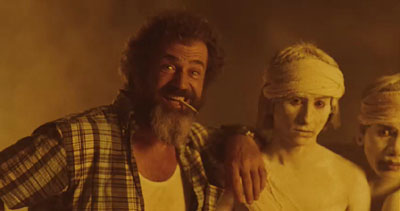
The first teaser trailer for Mel Gibson's Apocalypto is online. The new, aging Mel is some kind of something, but he's always had a reputation as a bit of a joker. The film might be about the bloody end of a Mayan society, but for now it just looks like a conventional enough trailer for a flashier take on John Boorman's Emerald Forest. Mel, (oh he's gas, Mel) won't actually appear in the movie, but does make a bizzare, fleeting appearance in the trailer (see the solitary framegrab above).

The sharp-eyed among you should go see for yourselves, wait for the second appearance of the white faced whatevers and use the Quicktime controls to find the frame he appears in. It's either that or play it a couple of times and blink quickly at the screen. I'm telling you, when he pops up, with the cigarette and the mad grin and the George Lucas directing plaid and the beard, it's weird. Does make you wonder how seriously he's going to treat the subject, maybe, a little bit? Can anyone think of another instance where an A-List director played a joke like this in a trailer?
via Cinemablend

The Kingmaker

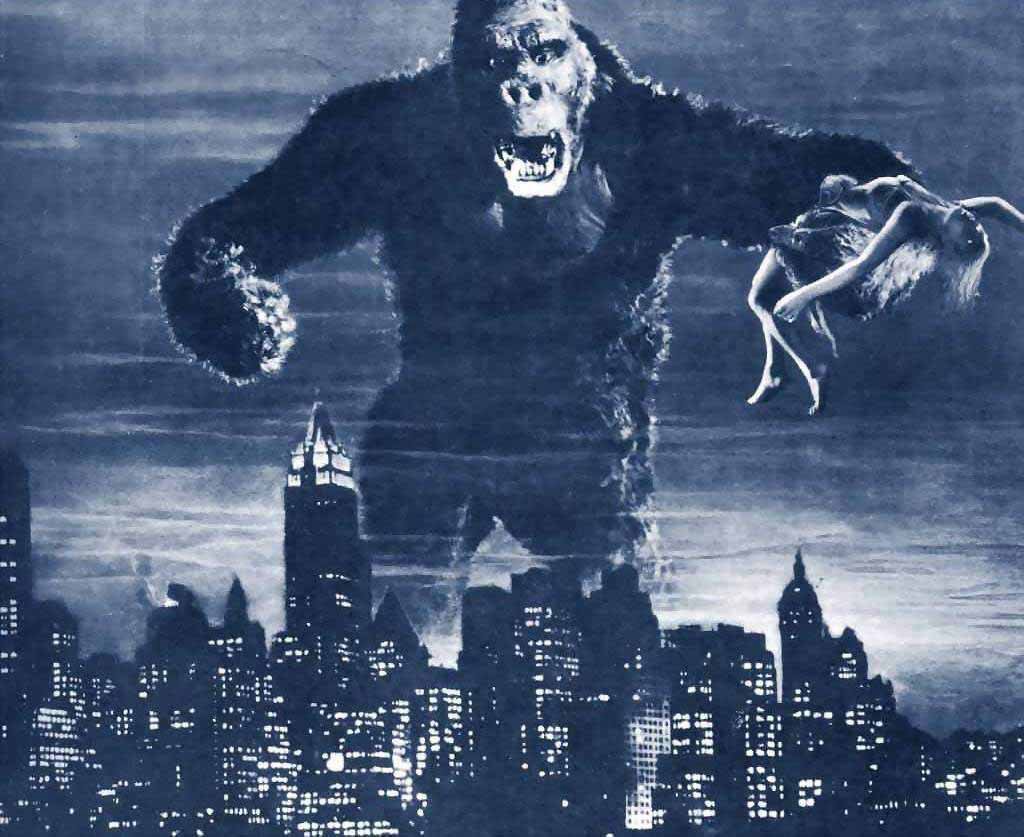
A big star needs a big picture, and Peter Jackson’s wonderful reworking of the classic monster movie King Kong is as big a picture as could possibly fit on a cinema screen. Over three hours long, bursting with innovative digital special effects and coming with a price-tag of something like €230 million; from the unexpected tingle that accompanies the period opening credits through to the famous final battle on the Empire State building, you get to thinking that they don’t make them like this anymore.

The trouble is though, they did, once. Venerated as the first blockbuster movie, alluded to and parodied in everything from Jurassic Park to The Rugrats in Paris, the original 1933 Kong casts a suitably enormous shadow across the last seventy years of entertainment. The sensations aroused by witnessing a giant whatever thundering through skyscrapers and scattering all before it might just have been exhausted by the legion of films that have taken their inspiration from Merian Cooper’s sensational puppet show. Thankfully, Jackson succeeds in paying his homage and remaining true to his source while crafting a wholly modern, seat-grabbing crazy cinema thrill-ride.

What a mad story this is anyway. Carl Denham (Jack Black), a shyster filmmaker, driven to the edge of hysteria by his thirst for fame, drags his cobbled-together filming unit halfway across the Pacific Ocean, searching for a long-lost island where he hopes to find and film, a legend. His leading lady, plucked from starvation hours before, is Ann Darrow (Naomi Watts in the role made iconic by Fay Wray), who only agrees to go because she admires the political playwright Jack Driscoll (Adrien Brody), who has been shanghaied into writing the script. Denham tries to keep their destination a secret, but one crew member eventually demands to know. “It has a local name,” Denham says. “I'm warning you, it doesn't sound good.” Although it takes an hour to get there, there’s hardly time to catch your breath once the ship arrives at Skull Island. Quickly running into trouble with the natives, just as savage as they were in 1933, the frantic filmmakers and mutinous sailors meet the island's resident king of the jungle, King Kong, a hulking 30-foot gorilla with a mean streak a mile wide and a newfound weakness for petite blondes.

As your eyes adjust to the dazzling widescreen vistas, Jackson fills them with a dizzying array of chasing monsters, blistering gunfights, bottomless ravines and instant, squishy death. An elaborate set-piece with a pack of stampeding brontosaurus decimating the crew follows hot on the heels of Kong’s first escape, with Ann Darrow in hand. Before you have time to catch your breath, three vicious T-Rex battle Kong (still gripping his prize) up a mountain and down a vine-tangled ravine. Jackson’s carte blanche even gives him the time and space to include his take on Cooper’s legendary lost ‘arachnid pit’ sequence – a terrifying scene where the jungle explorers are devoured by giant spiders that the original director removed for ‘pacing reasons’ – but chiefly because no test audience in 1933 could bear to watch it, and fled the cinema, making the rest of that film somewhat redundant. Although Jackson’s version of the deleted scene is scary, there isn’t a pacing issue because there isn’t time to think. It’s suitably icky, but is followed by an attack of giant vampire bats, then more explosions and finally, a chase that leads all the way back to New York and an appointment on top of the Empire State. It’s the finest hour in action cinema for decades and one you simply cannot miss.

Jackson's astonishing talent with digital creations tends to overshadow the simple fact that he's pretty good with ordinary human actors too. To create his Kong, Jackson called again on actor Andy Serkis, who played Gollum in LOTR and has perfected this sort of motion-capture performance. He gives an extraordinary humanity to the role, making Kong unnervingly sympathetic. This is a big role for Naomi Watts – filling boots that proved far too big for Jessica Lange in the camp remake in 1976. Occasionally tender, always determined, Watts does much more than scream her way through what is a complicated set of character motivations. Is she in love with the monkey or what? She sure acts like it. At the heart of the film is Jack Black – the flailing Californian fatso – whose natural slyness is perfect for the oily, scheming Denham, who survives to write the ape’s epitaph, taken directly from the original.

As Denham says, it's the old story of beauty and the beast. But films are different things now, seventy years on. The $229 million dollar difference in the price tag, for one thing, but Hollywood’s requirement for bi-annual ‘event’ blockbusters, each bigger than the last, coupled with the modern cult of celebrity directors means that there has to be more to Jackson’s film than the act of making it, however impressive that feat is. In blockbuster cinema, the moviemaking is more important than narrative. The act, in effect, is the play. Although King Kong (which is, neatly, a film about making films) has since become an icon, there weren’t dot coms and video games and credit cards and all-pervading merchandising lines back in 1933. Today, you could live a comfortable all-Kong branded existence, from toothbrush and cereal in the morning to pyjamas and novelisation at night. What has happened to entertainment, and where is it going? Kong’s fatal fascination with glamour and novelty are pretty much the same ones that propel us into cinema seats today. The monster’s loneliness and isolation, his all-too-human desire to escape a threatening world through a glimpse of beauty and a taste of desire are the unspoken pulses in the heart of this film, and the heart of all films.

It has to be said Kong isn’t perfect, but it’s as near as makes no difference. Some of the chase sequences have a rushed, muddy look, a couple of the human actors (Colin Hanks in particular) don’t have much to say or do. The story staggers a couple of times, but then it is over 70, and could be forgiven the creaks. But these are nitpicks at best, Jackson is a jaw-dropping visualist in seemingly effortless control of the most unpredictable of all monsters, the modern big-budget blockbuster. That he manages to make these films at all is a thing of wonder, but that he can still tell a pulsating human story, no matter how fantastic, amongst the blizzard of zeros and ones, is nothing less than astonishing. In the end, Jackson has exceeded himself in delivering a wholly revitalised big-screen Kong (and it really must be seen on a big screen) that, like the petite object of his desire, will have you in the palm of its hairy hand.

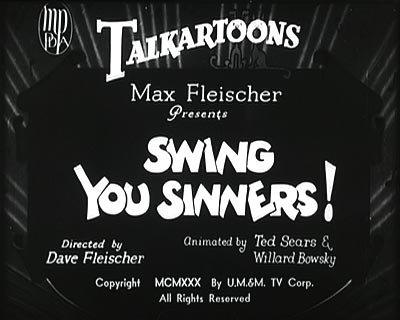
Hollywood Animation Archive Project Blog


Cartoons are great. The International Animated Film Society have a fascinating online blog that might be in it's early stages now but will expand, over time, into an online archive of images, museum and encyclopedia/wiki thing, with downloads like the cheeky number above . The link is here.

Frequent Flier

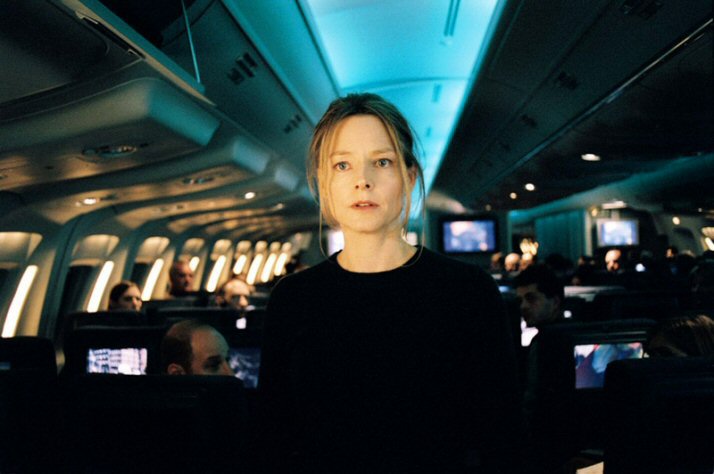
An increasingly stringy-looking Jodie Foster plays another threatened mother (as she did to middling effect in David Fincher’s Panic Room), in the taut airborne thriller Flight Plan, a high-concept titty-twister we will call ‘Hitchcockian’ for the lack of another neat descriptive word that means ‘movie that picks your pocket through pat co-incidence, suspense and plot twists’ The seriously flinty Foster plays Kyle Pratt, an aeronautical engineer who boards the same enormous jet she has spent the past year working on, in order to bring the coffin containing her recently deceased husband back to the US. A couple of hours after takeoff from a snowbound Berlin, Kyle and her six year old daughter Julia (Marlene Lawston) fall asleep. When mommy wakes up, the kid has vanished.

Watching her every move is federal air marshal Carson (Peter Sarsgaard), concerned about the safety of the flight after Kyle, teetering on the edge of hysteria, sees an Arab passenger (Michael Irby) and tells him she is convinced he is spying on her. Already barely holding it together, Kyle methodically searches the airplane, having the advantage of knowing it inside out. Appearing far more sane and rational to the cabin crew than the cinema audience, who have the advantage of knowing her mind inside out, Kyle’s search appears over when a stewardess (Erika Christensen) tells her that Julia’s name doesn’t appear on the passenger manifest, the departure gate at Munich says she did not get on the plane, her boarding pass and backpack are nowhere to be found and that the girl was never on board. The flight captain, played by a suitably square-jawed Sean Bean, while initially concerned about the disappearance, applies strict procedure when told the child wasn’t on the plane and that this bereaved woman has lost her senses.

And that's all you'll get from me. Regardless of the films qualities, it wouldn’t be fair to tell you any more. With this kind of thriller, the more you know in advance, the less effective the film will be. With such strong story elements at his disposal; separation, claustrophobia, unsympathetic officials and shifty-eyed, suspicious passengers, German director Robert Schwentke constructs a sweaty, cleverly convoluted story that is nevertheless a touch too cold and remote to connect with the impact it could have had.

Foster is good as the tough, resilient woman who uses her strengths to defend her child against an unknown threat, but she is in danger of running herself into a groove here. It’s the torturous unravelling of the exact nature of that threat that this film balances precariously upon, with the ultimate revelation bound to dismay as many as it delights. Why this is hapenning to her, out of all the people on the plane, is the key here and as with any other ‘sealed room’ Agatha Christie body-in-the-library mystery, that individually fashioned key might just barely fit the logical lock the storytellers have constructed around it. The great debt here is to Alfred Hitchcock's The Lady Vanishes, and the novel that inspired it, Ethel Lina White's The Wheel Spins, from where the central notions have been extracted, without credit. Like the train itself in Hitchcock's yarn, the Titanic-sized aircraft becomes a character, initially a suffocating, claustrophobic presence, but as the film explores every nook and cranny of the metal tube, there is far more made of it than is entirely necessary.

Cunningly, and crucially for interest levels, Schwentke and his screenwriters Peter Dowling and Billy Ray ask the audience another, deeper question, one that adds a sustaining nuance to Kyle’s motivations and makes our heroine completely, and satisfyingly, unreliable. Is she mad, from grief, or just madness itself, unexpected and terrible. For her part, when faced with this nightmare, Foster's character asks the same questions as we the viewers would, and for the most part, does what we would expect a woman in her position to do, keeping pace with the audience’s own internal logic as the plot unravels itself. But, and there’s almost always a but, the rush of unlikely co-incidences and hysterical revelations in the final third of the film go way too far, taking most of the painstakingly generated tension along with them. For all its shiny production values, A-list cast and swooping widescreen photography, Flightplan ultimately touches down on a well-worn runway about twenty minutes after you will.

Trial And Error


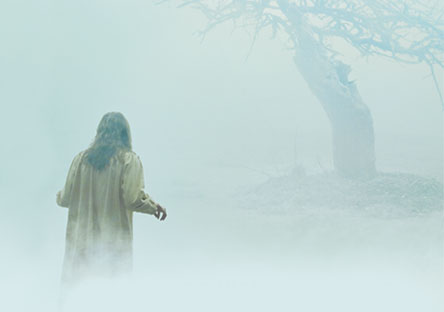
It would appear the Americans won’t be happy until God himself appears astride a beam of divine light, wrapped in Old Glory and swearing on his autobiography, to testify against Satan and Charles Darwin and Michael Moore and Harry Potter and anyone else, real or unreal, who doesn’t fit with their increasingly monochromatic notions of what constitutes right and wrong. As right-wing and reactionary as it’s possible to be without being composed of aborted stem cells, the daft horror The Exorcism of Emily Rose, directed by Scott Derrickson from a script he wrote with Paul Harris Boardman, is a bewilderingly empirical discussion about the existence of cosmic good guys and bad guys wrapped in a shabby splatter movie, itself stapled to a moribund and seemingly eternal courtroom drama.

An understandably worried-looking Catholic priest (played by Tom Wilkinson) is accused of manslaughter because a devout young student (Jennifer Carpenter), who believed herself to be possessed by demons, has died after a failed exorcism ritual. Appearing for the defence is Laura Linney, playing the ambitious lawyer Erin Bruner, all trendy atheism, sharp tailoring and minimalist furnishings. For the state, subtlety grey and moustachioed, is the patrician Campbell Scott, whose efforts to imprison the priest for negligently denying her medication, become increasingly strained. “Your honour, I object!” he shouts in true courtroom-drama lawyer style. On what grounds? “Well, silliness, for one.”

Sustained.

Based on a true story, in the same way as The Cat In The Hat might have a real-life counterpart somewhere licking it’s own arse in a jaunty beret, the film employs a succession of cross-genre techniques to try and have it’s audience accept as real the supernatural, specially-effected events it depicts. Never for a moment just another spooky November release, Emily Rose posits itself as being a matter of (eternal) life or death, a frothing evangelical tract rejecting science and championing faith through well-timed lightning storms, cawing ravens, black cats and hooded devils.

We know from the first scene that the stigmata-carrying martyr Emily didn’t survive the experience; that the priest (astonishingly, neither Irish nor alcoholic) is in jug and that the defence is having trouble believing there is a celestial battle being waged in the battered body of a theology student. It is left to Laura Linney to carry the story, and while her grace and intelligence are occasionally well served, she can do nothing about the pre-ordained direction the film takes. Presenting itself as a debate, it is anything but. As a horror movie, it has its moments. As a courtroom drama, it is especially dull. But as propaganda bedecked in the familiar raiments of popular entertainment, in the days of powerful politicians on missions from God and ‘intelligent design’, Emily Rose is priceless.

Pavee Lackeen


Perry Ogden has the unblinking eye of a cinema sniper and the soul of an angry poet. His debut film is a portrait of a people set apart, adrift in poverty and indifference, whose whole story can’t be told in a soundbite and once seen, somehow remains forever indelible. As Ireland & Co. Ltd (well, we have decided to live in an economy, rather than a society) rushes forward, those who, for whatever reason, can’t keep pace are being left behind, and for that shameful, sobering reason Pavee Lackeen: The Traveller Girl is a film that’s as necessary as oxygen.

Influenced by the ultra-naturalistic films of the Dardenne Brothers (most notably Rosetta), in seamlessly melding documentary and fiction, Ogden tells the story of Winnie Maughan, a tough, sensitive 10-year-old traveller living with her mother Rose and the rest of the family in a small camp of caravans beside an industrial road in North Dublin. Excluded from school for fighting, and with little else to do but shoplift and sniff solvents, Winnie spends her days messing about with her sister while their bewildered mother tries to deal with the council representatives (who want to move her to a different spot) and the Guards (who are there to do what the council wants) and tired-looking social workers and busy doctors concerned about the children’s health and welfare. There is nothing that represents a plot or narrative in the classical sense, just an unsentimental look at real life for these people.

The cast are excellent without exception, little wonder as they are essentially playing themselves. Where Pavee Lackeen stands out is in its beautiful photography, sensitive editing and a moving soundtrack, all well above standard for homegrown cinema. But for all that I found the film hard to watch. It is uncomfortable to say the least to have one’s own blithe middle-class prejudices and attitudes challenged, but far worse is the sense of hopelessness and irreparable isolation, that coppery tang that comes from the realisation that these are lives lived without any hope of a future unless significant changes are made. It should be screened for the Dáil.

You’ve got to get over the idea that a fashion photographer can go to a halting site and point his camera and not be compromised. Opening himself up to an accusation of exploitation is courageous to say the least, yet the director and his co-writer Mark Venner make no moral judgements, on anyone, and neatly avoid being patronising or romantic. Pavee Lackeen is a tough sell to any audience but one that will simultaneously reward and anger those adventurous enough to seek it out. The dinner-party revolutionaries who cooed over Paul Haggis’ Crash and bleated on about racism and discrimination in Black America should put down their salad forks and go see it right now.

"One of these days the sun's gonna come up and burn a hole clean through the planet like a giant electrical x-ray".


Ever wonder what the weather is like in LA? David Lynch provides a personal, daily, remarkably coherent 10 second report on his website, so we need wonder no more.

-Update-
Curiously, the fascinating 'outsider' artist Henry Darger was also obsessed with the weather and kept a comprehensive weather log.

Thin Lizzy

The aggressively non-filmic, anti-entertainment precedent established in American goo-merchant Cameron Crowe’s last effort, the vacant and pretentious Vanilla Sky, continues unabated with this awful romantic comedy, as plain-old-bad a movie as the Hollywood schmaltz machine will puke up this year and unarguable proof that Orlando Bloom is near helpless on screen without the cover provided by a pair of pointy prosthetic ears.

Although presumably in development for years, the basic set-up of Elizabethtown is essentially a more optimistic, focus-grouped version of Zach Braff's infinitely more interesting and complete Garden State, where a depressed young man returning home for a family funeral falls in love with a gorgeous local girl. But where that film had an angsty, contemporary mood and offbeat, prickly characters, Crowe’s approach is to fire indiscriminate love-bombs at his madly meandering story and then, after a few studio-mandated re-edits and a trim of twenty minutes, attempt to present a film from the resulting rainbow-drenched carnage.

The plot is an absolute mess. Bloom is Drew Baylor, an introverted shoe designer who just lost his Nike-inspired company a billion dollars. Later, while preparing a meticulously planned suicide, he gets a call from his neurotic sister (Judy Greer) to tell him his father has died while visiting his family in Kentucky and Drew must go and collect his remains. On the plane, he meets the pushy, free-spirited air stewardess Claire (Kirsten Dunst), with the two inexplicably linked from that point forward. Together Dunst and Bloom register an absolute zero on the chemistry gauge, and little wonder. The one-dimensional characters they're forced to play couldn't be more teeth-grindingly irritating if they were street charity muggers hustling your sort-code while playing Bohemian Rhapsody on broken kazoos and kicking you in the shins. Bloom's Drew is an inert, mostly re-active cipher for Crowe’s own fixations and never once a fully formed, three-dimensional cinema character. Dunst, saddled with some awful dialogue and struggling with the eye-lash fluttering Southern Belle accent, nervously grins and mugs her way through the elaborate staging, rescuing what she can from the resulting inferno before the ceiling collapses. That smoking crash comes when Susan Sarandon, playing the very merry Widow Baylor, gives a simpleminded five minute eulogy before a spontaneous, and similarly lengthy, tap dance at her dead husband’s memorial. What is supposed to be charming and quirky is just wrong and weird and worse, terminally boring.

A whole other movies worth of subplots frame the smoking craters here, offering fox-holes for Crowe and his wide-eyed cast to briefly escape the devastation but adding absolutely nothing to the drama while bloating the already patience-testing running-time to a fantastically grand level. The writer/director then adds a Ghandi-esque crowd of supporting players; Drew’s co-workers, extended family and childhood friends, all playing high notes in full voice. There’s barely room to move with cameos from a host of yet another level of supporting players, non-actors (TV chefs and folk singers among them) delivering every gumbo-stained stereotype imaginable, and then some. Whatever hopes Crowe had for his lead cutie-pies burgeoning romance is lost in the scrum of wise elders, eccentrics, screeching children and affectionate drunks.

This is jukebox cinema; a meandering mix tape of Crowe’s own back catalogue rattled out in an uncomfortably arch and distracted style and edited, apparently, by a combine harvester with no sense of comic timing. Elizabethtown is littered throughout with the chaff of Crowe’s peculiar obsessions – a never-ending soundtrack of dinosaur rock music (every scene has it’s own accompaniment), quirky girls in red hats and that golden 35mm lens flare flashing off the asphalt on the lumbering director’s well-travelled road to nowhere. Crowe’s dwindling efforts to mine the rich seam of screwball comedy that his heroes Preston Sturges, Frank Capra and Billy Wilder could tap into, seemingly at will but actually through hard graft at the typewriter and clarity of vision, is both bafflingly obtuse and criminally negligent of his own clumsy conceit. Very little gets resolved, but very few will care.

When, finally, Drew takes a sentimental road trip back across America - in what felt to me like real time - and Elizabethtown sputtered to its idiosyncratically candyfloss conclusion I hardly had the strength left to protest. “There's a difference between a failure and a fiasco”, someone says early on. Not from where I’m sitting.