How Bigalow Can You Go?

This wholly unmerited and unwelcome sequel to 1999s reviled comedy Deuce Bigalow washes up on our shores with writer and star Rob Schneider owing considerable compensation to cinemagoers unlucky enough to see it under the ‘polluter pays’ principle. I emerged from his latest laugh-free effort with an immediate need to wash my eyes, having seen his ‘he-whore’ character relocate to Europe, or the stoned Amsterdam bit of it anyway, to track down a serial killer who is decimating the gigolo herd.

Clumsy, dim-witted Deuce along with his pimp and friend T.J. Hicks (the shrieking Eddie Griffin) try to track the immediately obvious killer involving a brief parade of grotesque female suspects and you can figure out the rest for yourself. Troublingly, during his tiresome investigations Deuce meets a woman with a penis instead of a nose. You don’t want me to describe what happens when she, inevitably, sneezes. Having said that, if you are the kind of person who finds that unlucky image funny, then it’s safe to say you’re not reading this. Or anything else for that matter. But Schneider thinks it’s hilarious that this condition is a result of the Chernobyl nuclear accident, so stupid and offensive doesn’t come into it; this primordial thing is like something you’d scrape off your shoe.

The only good thing is that, at a merciful 75 minutes, it would appear to have had about a quarter of its childish skits excised by somebody with a sharp scissors and a lingering trace of humanity. My own act of compassion would be to bundle every existing reel of this awful film into a sack, leaving plenty of room for Schneider, and bury it, at night and in secret, at the bottom of the ocean. This unimaginative, mean-spirited effluent does not deserve to exist as a film and most certainly doesn’t deserve your attention.

I Eat Dead People...


Cinemagoers are hardly starved for zombie flesh. In the same week that Irish filmmaker Stephen Bradley brings us his High School zombie movie Boy Eats Girl, the maestro of the genre, George A Romero opens Land of the Dead, the fourth in his series of flesh-eating flicks. Although they are very different films, Bradley’s underwritten suburban comedy slash horror slash waste of time doesn’t bear the comparison well.

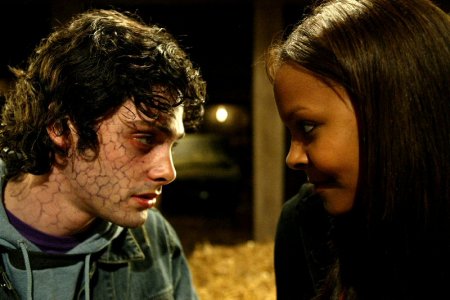
Seventeen year-old Nathan (David Leon) has fallen in love with his school friend, local fox Jessica (Samantha Mumba) but he just can't pluck up the courage to ask her out. Their friends, geeky sidekicks Henry and Diggs (Laurence Kinlan and Tadhg Murphy) decide to help cupid along by setting up a date where Nathan can, er, spill his guts to his nascent love. However, Jessica’s interfering father (played by Bryan Murray) discovers the plan and she misses their date. Later, while running through a movie-friendly rainstorm, Nathan thinks he spots Jessica having sex in a car with a sleazebag classmate. Distraught, the unrequited Romeo drinks a naggin of whiskey, plays a few depressing heartache records and winds up hanging himself in his bedroom. On finding his lifeless body, his mother Grace (played by the directors wife, Deirdre O’Kane) seizes on an old book of voodoo spells she has discovered in the bowels of a ruined church. She performs a restorative ritual in their kitchen, using teapots, newspapers and chicken hearts, and magically brings him back to life. When he wakes up the next morning, Nathan knows nothing of what has happened, but has a new found hunger for human flesh, superhuman strength and an even more remote attitude to life than his listless, disenfranchised pals. Later, outside the school disco, Nathan acts on his new desires, taking chunks out of the student body and setting in train a series of events that spreads his infection through the student body, with gory results. As mom tries to find a way to reverse the spell, having discovered the book had a vital page missing, Nathan struggles to rein in his new desires, save his friends from the advancing horde of revenants and win the heart of the gorgeous Jessica.

Bradley uses the tropes of zombie cinema to explore the real horrors of teenage existence; classroom bullies, peer pressure, social awkwardness and the stomach-clenching anxieties that whirl around the first flush of love. As penned by Derek Handy (Dead Bodies), Girl is a wholly self-aware teenage romp that takes as its inspiration the American high school comedies and screaming horrors. With his tongue firmly planted in his cheek, Nandy trots out a familiar series of off-the-shelf characters, lilting dialogue and clichéd set ups. None of it is all that inspired, the jokes are weak and predictable and the whole enterprise suffers badly from not having any real balance between its American inspiration and Irish setting. The splattering special effects work from Image Effects is a little more successful, culminating in an entertaining free-for-all with a tractor-mounted hedge strimmer and a small army of stumbling zombies.

Writing comedy is difficult and time-consuming, and without being too po-faced about it, requires a careful hand in making jokes about teenage depression and death. In the scene that gave the Irish film censor reason for pause, Nathan is driven to his suicide in the most asinine way. If heartache and whiskey were all that were required to top oneself, very few of us would have escaped adolescence. I know it’s a movie, and as a zombie movie, requires a death as a starting point for mayhem, but it’s so clumsy and illogical, so foolish at its core that the remainder of the film must collapse, built as it is on straws. As a heartbroken teenager, Leon is a bit of a flop, overly mannered and self-aware. As the object of his desire, the kick-boxing Mumba does much better, even if her tough-girl character is occasionally poorly served by offering nothing beyond a wonky grin and some tender eyelash flapping. The remainder of the ravenous undead, a budget-restricted army of about seven, hardly a horde at all and a complete misunderstanding of the true psychology of zombie cinema, play their one-note characters well within themselves. Sara James as class slut Cheryl is the sole stand-out. See, zombies are frightening because they congregate as a mob, all with one thought in their minds. A handful of undead revenants, no matter how tongue-in-cheek, just cannot offer any sense of dread. Rather than approach the scale and knuckle-chewing vision of Romero, Bradley takes his inspiration from the backyard splatter of Peter Jackson’s Braindead. Even when compared to that Boy Eats Girl barely passes muster.

I was deeply disappointed by Boy Eats Girl, thinking that it offered an opportunity to send Irish film in a new direction, but it actually sets the cause back by failing to match the low standards required for a B Movie, never mind inventing a new genre for home grown cinema. There’s a good case to be made for increasing production on cheap, quick genre films in the Irish industry, taking the international success of Korean and Australian cinema as a touchstone. But, and it’s a big but, genre doesn’t have to mean second rate and Bradley’s lacklustre film is exactly that.

Immoveable Object


The Guardian's excellent website has a rare interview with the venerated Japanese animator Hayao Miyazaki, the freewheeling genius behind Spirited Away, Princess Mononoke, and the imminent Howl's Moving Castle, where he offers his considerable opinions on modern animation, his creative process, the state of the planet's ecology and the unusual methods he was forced to employ in dealing with The Great Satan, or Harvey Weinstein as he is known in this dimensional incarnation. It's the reclusive Miyazaki's first interview with a journalist in over a decade. Check it here...

Punching Above Their Weight

A sepia-toned portrait of a working-class hero, Cinderella Man takes the almost impossibly perfect elements of the saga of underdog boxer James J. Braddock and fills it with emotional gravitas, grim triumph and a palpable sense of the disintegration of American life during the Great Depression in the 20s and 30s. The bare bones of Braddock’s life constitute an almost perfect arc of triumph – from a battling contender to friendless, poverty-stricken washout back to world heavyweight championship challenger – that would read as unbelievably trite and convenient were it not true.

As the film opens, Jim Braddock is a successful boxer, providing a good life for his wife Mae (played by Renee Zellweger) and their three young children. Then Braddock breaks a hand and is beaten so badly in his subsequent fights that his license to box is revoked and he is forced into abject poverty in the early days of the Depression. He ends up looking for work as a daily stevedore on the Hoboken docks where he finds a friend in co-worker Mike (Paddy Considine), a former Wall Street stockbroker who has turned to trades unionism, one of the few fictional characters in the film and one whose dramatic arc serves as an explicit comment on the politics of the times, with a resonance for today’s America, where the call has again gone out that a headless government has failed their people.

The Braddock’s helpless poverty means Jim has little time to develop a radical politics; he’s too busy trying to find enough for them to eat, although the square-jawed Considine does very well in his few scenes. Braddock’s wife Mae would prefer he quit boxing, but knows how badly they need the money to get by with their three kids. They cannot pay bills, or feed their children with Howard showing the depth of the family’s collapse in a heart-breaking scene where Braddock passes a hat around a roomful of his former peers, looking for donations. With nothing left to lose, when Braddock is given hope of a comeback and the media pick up his story, he becomes the inspiration, a last beacon of hope for Americans who had forgotten hope existed. Through the tribulation, Braddock gets his chance at a fighting comeback, as his tender-hearted, and similarly broke manager Joe Gould (Paul Giamatti) pushes him past the sneering boxing commission, who think he’s a broken washout, and towards a shot at the title. Without enough time to train, or the nutrition to rebuild his strength, Braddock takes on the heavyweight champion Max Baer (Craig Bierko), a monster who has already killed two of his opponents and seems likely to put a halt to his outsized, outclassed and out of luck opponent’s return to the top.

Sounds slushy, doesn’t it? Thankfully, a tougher, more sober Howard and his regular scenarist Akiva Goldsman have reined in their tendency to pile on the schmaltz in delivering a beautifully developed story about pride and determination that provides the perfect platform for a career-defining performance from a beefed-up Crowe, with exceptional support from Zellwegger as the long-suffering wife and Paul Giamatti as Braddock’s manager and friend, Joe Gould. Both are revelatory, with Giamatti in particular delivering another note-perfect performance, but the film belongs to Crowe, who shows his mettle in the ring and his courage in the face of economic adversity. In making an explicit connection between Braddock's wavering career trajectory and disintegrating family life and America’s Great Depression and the rise of the trade union movement, the film sounds a depth that approaches the operatic majesty of Raging Bull and at all time feels real and never forced. Rather than try to punch above their weight, Howard and Crowe don’t attempt to ape the long tradition of brutal boxing films, although their film is both fierce and violent. What they have done is give their sports movie a convincing and affecting emotional core that might occasionally teeter on the edge of sentimentality but never falls into soppiness. The many fights are consistently finely paced and beautifully choreographed. Although fight fans are hardly short on cinematic pugilists, Cinderella Man doesn’t abandon its duty to provide some teeth-rattling fight scenes, with the ultimate fight providing some genuine tension and thrills. Crowe, unsurprisingly a convincing bruiser, proves again his ability to give great humanity and heart to what is a classically drawn one-note cinema hero, his eyes full of sadness and his pain altogether palpable. Cinderella Man is a rousing, heartbreaking film that inexplicably failed on its release in the US but fully deserves it’s more discerning autumn audience here.

Holiday in Cambodia


Another week, another uninspired movie taken from an old television show and an object lesson, should it be required, in The Honeymooners, that Hollywood is continuing to mine a long-exhausted seam. Part-time hapless entrepreneur and full-time funk-loving New York bus driver Ralph Kramden (Cedric The Entertainer) and his feisty, long-suffering wife Alice (Gabrielle Union), who works as a waitress are stuck in the two-income trap, in that whatever income they derive from their two jobs is squandered on one of Ralph's many, desperately unfunny get-rich-quick schemes.

When the opportunity to buy an old lady’s duplex house in Brooklyn presents itself, together with their best friends and neighbours Ed and Trixie Norton (Mike Epps and Regina Hall) they have just enough money for a down payment. That is until Ralph and Ed get involved in a faintly ridiculous scheme to simultaneously enter the both the greyhound and tourism industries, putting the mortgage, and their marriages, at risk. Jackie Gleason’s monochrome domestic battleground, a simple stage set covered with two cameras but still considered one of the best television comedies of all time has been given a colourful urban makeover, replete with bouncing hip-hop soundtrack, rolling eyes, yo-mamma and fried chicken jokes and even a reference to Beyoncé’s fabulous booty. These hip-hop clichés are squeezed into a ludicrous and crushingly artless series of sketches and montages that emphases the cast’s clumsy attempts at slapstick above the blue-collar frustrations and effortless wordplay that the original is justly famed for.

Cedric the Entertainer huffs and puffs but loses stamina ten minutes in. Some honeymooner. His comic foil Mike Epps isn’t thrown a single genuinely funny line throughout the ninety minutes. The greyhound fares better. To be overly fair to both of them, and to the similarly underserved Union and Hall, the material doesn’t give them a chance. They literally have nothing to play with. Circling the chaos are the freeloading Eric Stoltz playing Davis, a yuppie scum property developer also looking to but the old lady's house and the unfortunate John Leguizamo as Dodge, a local grifter turned dog trainer, neither of whom ever convinces.

Director John Schultz, who filmed part of the movie last summer in Dublin and was previously the hand behind the ghastly, unwatchable Like Mike, doesn’t seem to have improved on his sense of scenario, his ear for dialogue or his comic timing. They’re all way off beam. Worst of all is the film’s last-reel grab for pathos, undeserved and sickeningly forced, that is just desperate to watch.

Rocking the Classroom

In a world where music has gradually been processed like so much cheap cheese, where whole nations sit down on Saturday nights to exercise their right to text fresh meat through the awful karaoke mincer, those of us who love music, real music, should go down on out knees and thank Paul Green. He’d love that. In Don Argott’s documentary Rock School, Green is the founder, principal and apparently the only teacher at the Paul Green School of Rock, a Philadelphia-based after-school club that takes local youngsters from the age of 9 to 17 and trains them to become rock musicians. Green, who turns out to be the biggest kid in the bunch, is a curious mix of motivational speaker, ringmaster, educator and mentor wrapped in a malodorous-looking, XXL Jethro Tull t-shirt. In between sweary rants at the listless kids and frantic ducking and diving to keep the operation going, Green, who started the school in 1998 when his own dreams of rock stardom didn’t pan out, leads us on a warts-and-all tour of the school and its pupils.

Among the trainees we meet are the all-rocking 9-year-old twins, Asa and Tucker Collins, a Joni Mitchell-like crooning Quaker named Madi Diaz-Svalgard, a depressed, mislabelled philosopher named Will O’Connor who chose Rock School over suicide and an astonishing 12-year-old prodigy, C.J. Tywoniak, whose guitar is a foot taller than him. What emerges most strongly from Rock School, apart from the jaw-dropping talents of some of the kids, is that Green is determined to treat them like adults. He refuses to pander to their whining, or talk down to them and is absolutely serious about their progress as musicians. It’s easy to see how readily his pupils respond to him, and how conducive the ramshackle, paper-strewn school is to fostering their talents, but, thinking back, it’s hard to see what Green does exactly. We never see him teaching chords, or giving voice lessons or tips on performance. He seems to play the role of vibes-master, a Pied Piper who has given himself the responsibility of finding and developing the next wave of axe-wielding rock gods. If all this sounds familiar, that's because Green’s antics were the basis for Richard Linklater's 2003 Jack Black vehicle School of Rock, but as usual, the real story is far more interesting.

Green, for all his verbose bluster and uncomfortable fits of arm-waving frenzy, comes across as a proud teacher, an intelligent and articulate musical historian and a highly efficient motivator. With all the shouting and roaring, it’s as if Green is training the kids for the inevitable hearing loss that a lifetime of strutting in front of a Marshall stack will inevitably result in. However, his results speak for themselves, with the film building towards Green taking a band of his best and brightest on a road trip to a Frank Zappa festival in Germany. Once there, he harries his well-practised charges into performing Zappa’s convoluted jazz-rock to an gob-smacked and highly appreciative audience. It’s the high point of a wholly satisfying, occasionally thoughtful and frequently hilarious movie.

Rock School is a delight; a palate-cleansing benzene sorbet that cuts through the gloopy starch of the recent run of bad films and the monstrous production-line of modern democratic pop.

Taradise Lost


Now officially classified as a casualty of the celebrity wars, the scar-tissue covered American Pie actress and newly crowned Queen of the B-List Skanks Tara Reid (AKA Frankenboobies, AKA If The Wind Changes Your Face Will Stay Like That, you get the idea) has booked her seat on the unstoppable death-train to self-destruction, taking in What Career, Desperate Boob Job and, a new stop on the route, Shut Your Fat Yap.

Currently, bafflingly, employed to spill her guts on a cable reality travel television show called, with a heavy dose of irony I sincerely fucking hope, Taradise, the full on raging alcoholic and all out screaming disaster (whose trade now appears to be her dimpled arse, seeing as it's sad , pockmarked droop is a permanent feature in the American supermarket tabloids), is busy proving conclusively that the part of her brain not devoted to blinking, breathing and operating her drinking elbow is not otherwise engaged in pondering the issues of the day. Reid recently took a breather from her unfettered Caligulian debauchery to bark on about the London bombings in a slurred monologue delivered straight to camera, eye-balls akimbo; a fervent plea for peace and love familiar to tired greeting card writers and mohair-clad kindergarten teachers.

“I wish all the mean people would just buy a country together and blow each other up”, she squeaked. “Then we’d have no terrorists left. Like, don’t kill innocent people for no reason. It’s not fair. We love everybody. We’d even like them if they said they’re sorry. It’s not fair that innocent people are getting hurt. It makes me sad.” While delivering this astonishing fairy-land foot-stomp, Reid is filmed quaffing champagne and tearing the claws off a lobster at a shore-line restaurant in Monaco, as far from the ‘mean people’ as it’s possible to be while remaining on Planet Earth, although it doesn't appear that Reid visits here much anymore anyway.

Spelling Test


When you spend most of your supposedly working life in the plush embrace of a cinema seat, you don’t see a lot of daytime television. Not that I feel I’m missing out, it’s that the result is sizeable gaps in my pop culture education, one of which is sit-com Bewitched, like the similarly naïve I Dream of Jeannie and Mr Ed one of a rash of supernaturally inspired shows from the early days of American television that still make the rounds of the outer reaches of the cable stations 40 years after they were originally broadcast, but a slice of Americana that means little or nothing to me.

Expectations are pretty low to begin with, so when inevitably and tiresomely the central concept behind Bewitched, a witch tries her hand at being a suburan housewife, is recycled by the Hollywood machine (busily spewing out retro-fitted big screen TV show makeovers for twenty years now and with no end in sight) in the shape of director Norah Ephron, you’d imagine looking at it with fresh eyes would help. It doesn’t. For these fractured, ironic, post-modern times a straight remake isn’t going to work. Ephron feels she needs an original kink, or at least let’s pretend its original, so this time the set up is Hollywood’s favourite topic, Hollywood.

The steamy cauldron of LA being increasingly the only source of magic in our snake’s belly shallow culture, it is entirely fitting that white witch Isobel Bigelow (Nicole Kidman) bases herself in a typical suburban house in the San Fernando Valley as she starts her new life, eschewing all of her magical powers to live instead an ordinary life as an ordinary woman. She wants to find cute pink sunhats, a yellow VW Beetle and her true love, and preferably in that order. The man she settles on, for reasons the film never makes clear, is the bigheaded, delusional Jack Wyatt (Will Ferrell), a faded former movie star whose career temperature has hit absolute zero, the same number as the sales of his last DVD. On the advice of his sleazy and increasingly desperate agent (Jason Schwartzman), Jack reverts to recurring television comedy drama and finds himself starring as the mild mannered husband in a remake of Bewitched. Countless audition montages fails to find an appropriately twitchy actress who can replicate Samantha’s nose movements until Jack sees Isabel in a bookshop. He wants her to take the role so he’ll get all the attention, she’s gorgeous and he’s recently divorced and, crucially, because of her ability to twitch her nose. What everyone doesn’t know is that Isabel is in fact a real life witch, an example of what I believe the Americans call ironing.

Following her ruminant appearance in The Hours, Bewitched is the second concoction built around Nicole Kidman’s nose – she was forbidden from twitching it in public by a studio nervous that doing so would deprive most of the audience of the reason for going to see the movie. But the twitch was the ultimate sit-com contrivance, in story terms it’s the equivalent of waving a wand around but far more discreet, perfect for a close up and not at all threatening. In terms of the drama, and the serial nature of the sit-com, it is, literally, a character tic designed to provide a couple of moments of small-screen intimacy in each episode between the pretty girl and the viewing audience and, funny or not, a spurt of canned laughter and a drumming twinkle of piano perfectly fit the crack in the soundtrack. It’s not nearly so much fun when the glacier-smooth nose is 70 foot tall and there doesn’t seem to be anything else happening.

Kidman is likeably frisky and sexily breathless, but perky and bright didn’t save The Stepford Wives and it doesn’t save Bewitched. For a man who has only recently risen to A List status, Ferrell is worrying repetitive and altogether ordinary. They both get to crack a few funny lines occasionally (Ferrell’s demand for 200 cappuccinos…“and bring me the best one!” is hilarious), but the whole misguided conceit has them headed in opposite directions, robotically executing parallel story lines that never intersect, not even for a moment. He never gives her a reason to find him even remotely loveable and she never looks at another man. The movie has been directed in her signature style by Nora Ephron (Sleepless in Seattle, You've Got Mail), that is to say anonymously. Together with her sister and co-screenwriter Delia, the Ephron’s present a cute parade of individual scenes, for all I know straight from the original material, but nothing approaching a film as such. It’s a traditionally structured movie, it has a start at the start and an ending at the end, but what either of Ephron’s stars are doing at either point I could not tell you.

But the problem with Bewitched isn’t the acting, or even the ongoing dredging of the cultural silt settled in the museum of television. The problem is the script. To all intents and purposes, there isn’t one. For a film that just scrapes 100 minutes, Bewitched drags along like November. The longer it drags, the less there is going on and everything gets sucked into the resulting narrative coriolis effect long before the point of boredom. The real interest in Bewitched might lie in the surrounding cast, reduced to cameos at the expense of the blundering top-line talent. Michael Caine has a handful of scenes as Kidman’s flirtatious old rogue of a father, Shirley McClaine, who famously thinks of herself as a mystic in real life, provides a few laughs as a showboating co-star who has a few tricks up her own sleeve. More of both might have helped things along enormously, but seeing as so little of their performances appears to have made it to the screen, we will never know. The litter of lost opportunities continues with bafflingly brief and random appearances from the likes of Ephron’s regular comic character foil Michael Badalucco and the upbeat and energetic Kristen Chenoweth.

Whatever magic there was here, and from where I'm standing there wasn’t all that much, has been evaporated – regardless of the tricks of modern conceptualisation, the moebius strip of overlapping storylines swallows up any opportunity to show where Isobel’s uncanny gift comes from or offer any real sense (beyond Kidman’s dreamy, orgiastic sighing) of other-worldliness. It’s all well and good for the first half hour but then everything seems to stall and the characters have nowhere to go. The set-ups continue, but they are so horribly fractured there’s no reason to care, or to pay much attention, even when someone is paying you to be there. Ferrell gets to do his comic riff on a rampant ego at the edge of hysteria; Kidman does the nose thing and learns to assert herself without magic and that’s about it. If Kidman and to a lesser extent Ferrell, insist on paddling in the shallows they can’t complain when they occasionally run aground. As there would appear to be no end to this tide of remakes inspired by old television, perhaps instead of leaving the house I should spend a bit more time on the couch, remote in hand, and call it research.

Subterranean Hole-sick Blues

In The Perfect Man, glum teenager Holly Hamilton (Hilary Duff) must up sticks and move city every time her single mother Jean (Heather Locklear) breaks up with one of her unsuitable men. To ease the pain of the metronomic heartache, Holly conceives the notion, inspired by Cyrano de Bergerac no doubt, to invent a secret e-mail admirer (played eventually by Chris Noth) and boost mommy’s shattered self-esteem.

What follows is the epitome of those time-wasting, gooey Hollywood tween audience-pleasers that completely fails to connect as entertainment or engage any of the senses or emotions in any way. Cliché follows cliché as the actors race around trying to find something tangible to hold on to. There is nothing to find; this is a comedy without a single joke (beyond the meta-joke of Duff’s tortured performance), a single original idea or even the merest flash of cinematic inspiration. Its mush; pre-chewed pap for unimaginative children, and worse, part of the same string of deep-rooted cultural enzymes that are poisoning our waters with consumerist, ambitious and deeply cynical stories of the American teenage experience. Its oily professionalism and deliberate messaging is just one part of a complex, gangrenous social venom that has a generation of Irish children speaking like air headed San Fernando Valley cheerleaders, an ear-wrenching intonation that turns every statement into a lilting question, peppered with like…totally…whatever.

This is a film that is beyond criticism in that it knows full well that it’s a piece of aspirational fluff with as much depth as a paddling pool and all the impact of a pillow fight. There is really nothing further to say, beyond noting that Hilary Duff has surely entered into some kind of diabolical contract as her success is otherwise a mystery. Duff represents all that is wrong in children’s cinema. Here is a teenage actress of extraordinary limitation, with no perceivable emotional range and the inability to deliver even the most straightforward line reading, elevated to the status of an icon. Every squeaky word spewed torturously from between Duff’s trembling pout, emerges from beneath her pert nose and furrowed brow to fall gasping on the floor, bereft. The rest of the cast stand around to watch it die. She is the mashed potatoes of cinema: white, bland and starchy. Like in the similarly Geneva Convention–defying Cinderella Story or The Lizzie Maguire Movie, Duff offers nothing because she has nothing to offer. Although she gives every impression that someone with a sandblaster has given her smooth head the once over, both inside and out, faded beauty queen Heather Locklear as the man-crazy mother somehow manages to transcend the dire nature of the material to offer fragmentary glimpses of a woman lost and alone in middle age, fearful of the future and desperate for happiness. But she’s drowning, adrift in the overwhelming pointlessness of the thing. Whatever indeed.

The physical impossibility of Stealth in the mind of someone living.
In the same week that the animalistic high-concept director Michael Bay likens the failure of his new blockbuster The Island to the setbacks suffered by Stanley Kubrick during his career, his counterpart in the art of blowing the shit out of things, The Fast & The Furious director Rob Cohen steals the central concept from the great man’s 2001 in presenting Stealth or 'Machines Are Bad: Any Questions?'

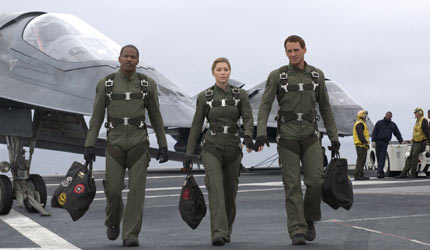
In the near future, everything is covered in blinking red lights and everybody is really stupid. That’s the lesson gleaned from this awful film, by some considerable distance the worst movie I have ever seen and a worthless cinematic endurance test of SAS survival-training proportions. I saw it a week ago and it still hurts, like a blister or an earache. The plot can be disposed of in two lines. The warmongering Yanks have developed a high-tech fighter plane operated by an artificial intelligence called EDI but it gets hit by lightning while on manoeuvres and turns evil. Three human pilots, whose character names are unimportant but are portrayed by the cartoonishly heroic Josh Lucas, the it's-better-than-lapdancing Jessica Biel and the Jesus help us Oscar winner Jamie Foxx, are charged with bringing Hal 9000, sorry, EDI back from the brink of full scale war and, while they're at it, employ their big noisy guns to blow the everloving tar out of the ululating ‘terrorists’ in North Korea, Myanmar and Tajikistan - all in the name of Uncle Sam and all on the same busy day. The rest of the thing is indecipherable, but it is jet-engine loud, pit-bull aggressive and day-old stupid. It actually doesn’t matter who these steroidal goons are, or what war crimes they get up to because the whole sorry mess is thrashed to shreds in the digital tumble dryer of frenzied, whiplash editing, slow-motion explosions and lingering military pornography. How dense does a film have to be to make Top Gun look smart?

To refer to Rob Cohen as a filmmaker is incorrect. He assembles slow-witted, belligerent, politically disgusting and noisy cock fights, not movies. Rather than concentrate on those elements that make films interesting; like plot, dialogue and character, Cohen's approach is to tack ten minutes of grisly chit-chat into a shoddy, juddering genre action scene extended over two hours. It is an assault, not entertainment. For an expensive special-effects driven piece, the final results are just shocking (think: the chroma key experimentation of late-period Wanderly Wagon) with every single visual element of the production horribly over-designed and childishly executed. The dialogue is just bilge and the characterisation entirely absent. Stealth is what $150 million buys you in today’s Hollywood: nine reels of dog dirt masquerading as a motion picture. At one stage Lucas roars at his superior officer that he “doesn’t want to see war turned into a video game.” I feel the same way about movies. The only thing noteworthy about Stealth is that it gave me a pain in my head and a pain in my arse at the same time. As for Jamie Foxx, he might find his career going into what the fuck mode after this baffling outing. This is exactly the opposite of the ideal film for an Oscar winning follow up and he might find himself comparing notes with Cuba Gooding Jr if he’s not careful. He's terrible, ridiculous really: they all are, but Foxx is the one with the most to lose.

Banging on about another piece of shit Hollywood turkey, so what? Am I missing the point completely? I don't think so. I believe that cinema has a legacy to protect and allowing modern directors, but specifically testosterone-fuelled goons like Bay, Cohen and, God help us, McG (the talentless bollocks) to remake Kubrick’s films, even in this cackhandedly sneaky way, has to be discouraged right from the outset. They haven't the wits or the desire to properly handle the kind of ideas Kubrick effortlessly put across, without relying on crappy computer animations or the demographic-chasing delights in having every scene with the 'smart' machine battered with a pounding soundtrack of bubblegum metal pop (I closed my eyes for most of those, and thought instead about a meadow on a sunny day, but they are astonishingly loud and persistent). Paying over your hard-eared money to watch this kind of unmitigated rubbish will only provide these hacks with the excuse they need to keep plundering.

Glucose To The Edit: Charlie & the Chocolate Factory

First off, it’s impossible to watch Tim Burton’s new adaptation of Roald Dahl’s sugary fantasy without reference to Mel Stuart’s charming and literate 1971 musical which, by way of relentless repetition in Christmas television scheduling, became a favourite with families and a cult hit. Personally, I might have seen the Gene Wilder version ten times and could sing you a couple of the songs on the soundtrack if you'd like so I found myself consciously fighting the urge to make comparisons between old and new while watching Burton’s explicit alter ego Johnny Depp emerge blinking from the lavish factory to start the ball rolling. This is where he does the somersault, I thought to myself. The other couple of hundred people watching, old and young, probably thought the same thing. Depp, of course, does not tumble because this isn’t a shot for shot remake, it isn’t a remake at all; it’s Dahl’s original book lavishly adapted by Hollywood’s pre-eminent fantasist and given a tepid psychological edge that’s tweaked to deliver a simple modern morality tale. No time for parlour tricks like somersaults when there’s $40m worth of special effects to get through.

Ah well, the tumble is hardly missed. The story, for the most part faithfully adapted by Burton’s regular scenarist John August and familiar to all of us, tells of a poor young lad named Charlie (the cheerful Freddie Highmore) who lives in high Dickensian squalor in a tumbledown cottage down the street from Willie Wonka's enormous chocolate factory. Charlie, his loving mother (Helena Bonham Carter) and good-natured father (Noah Taylor) share the shack with both sets of bed-ridden grandparents, one of which, Grandpa Joe is played by the astonishingly spry Irish actor David Kelly. One day the reclusive Wonka, unseen for years, announces a worldwide contest in which five lucky children will get a peek inside the gates of the fabulous factory, guided personally around by the confectioner himself. Special golden tickets have been hidden in five chocolate bars and delivered around the world. Naturally, Charlie, who has never had a stroke of good fortune in his young life, eats cabbage soup all day and sleeps under a hole in the roof at night, is one of the lucky five. Grandpa Joe is coming too, a return in his case as he once worked for Wonka.

And this is where the fun starts. Unlike the cherubic Charlie, the other four and their parents are monsters: there’s sticky glutton Augustus Gloop (Philip Wiegratz), a Germanic eating machine who is constantly stuffing his fat little face, spoiled rich miss Veruca Salt (Julia Winter), who flaps her eyelashes and bears her maw in a bitchy pout until Daddy (James Fox) buys her what she wants, tracksuit-clad and super-competitive Violet Beauregarde (Annasophia Robb), a champion gum chewer and kickboxer and spurred on by her robotic mother (Missy Pyle) and finally, junior overachiever Mike Teevee (Jordan Fry), overeducated, over-stimulated and overbearing. The children's individual, and unsettling appearance seems modelled after Loretta Lux's disturbing portraits of glossy children, with their beautifully realised costumes and ultimate body-shapes inspired by the grotesque excesses of cartoons and the bizarre alternate universe of comic-books. Plucking the eventual winner from this ghastly line-up is no great challenge to the audience, which means the delights in the film come from making the tour yourself and seeing what Burton imagines is behind the gates. The wonderfully realised sets include the candy garden with the chocolate waterfall, the ships journey along the chocolate river and, most impressively, a room where one hundred specially trained squirrels (actual squirrels, not animatronics or special effects) sit perched on tiny stools, shelling hazelnuts. The place is run by the tiny workers, the Oompa Loompas, who are all played by the same diminutive actor, Deep Roy, who seem to have spent the time between shifts on the factory floor watching Busby Berkeley musicals from the 1930s.

The nub of the story is that bad, nasty and greedy children are punished for their hideousness with their parents coming to realise how they have enabled their offspring to develop into junior psychopaths. As we know, all during the tour each vile child is eliminated by their overriding personality flaw – greed, selfishness, disobedience or aggression. Each time one of the little bastards gets the chop, the Oompa Loompas serenades them with an admonishing song, taken from Dahl’s original lyrics. During these interludes, which are a bit too methodical and regular for me, Burton let’s fly with his scattershot imagination, replacing the classical and Shakespearean references from Wilder’s film with homages to Hollywood classics like Esther Williams kaleidoscopic swimming pool fantasies and even, bizarrely, the opening of Stanley Kubrick’s 2001 and the shower scene in Psycho. The simple songs and messages of the original tunes are gone though, replaced with a dizzying pastiche of pop videos, Broadway show tunes, stadium-pleasing rock ballads and, I don’t know, kabuki theatre or the Eskimo Olympics? It’s hard to keep up. Through newly written flashbacks we learn that Willy's new life of day-glo whimsy is a reaction to an emotionally impoverished childhood, complete with toweringly strict father (played by Christopher Lee), a sadistic dentist who hated sweets. But Willy, twenty years on, needs more than a hug from his support group. He needs an heir and a protégée and finds his kindred spirit in Charlie, a cheerful child, optimistic and good hearted who is struggling to overcome a more prosaic poverty himself, the 'I'm hungry' kind.

Depp, a brilliant actor and the only viable option for the role today, displays all his usual courage and individuality but it’s not all successful. His blank shining face is hiding something more than a crappy childhood, and far more troubling that his tombstone-like array of teeth is the question mark that hangs over his motivations. The story has always had disturbing undertones, bad things happen to bad children, but Depp cannot muster the same love and affection that Gene Wilder engendered in the other version. A scene like the still-startling ending to the 1971 film, where Wonka switches from a cold, aggressive businessman to benevolent all-giving provider in the briefest moment, and to devastating effect, is missing here. Depp plays Wonka as the puppetmaster: the engineer of fate – a karmic avenger come to teach the wicked a lesson while bringing a just reward to Charlie and his humble family. Depp is suitably attired for such a dark mission, with his Edwardian dress coat, top hat and smear of lipstick he reminded me of the Child Catcher from Chitty Chitty Bang Bang. There is also a visual hint to Edward Scissorhands, who shares his isolation with the billionaire chocolate maker. But in the end Depp’s is an individual performance that won’t work for everyone and Burton has him ask more questions than he answers. For some reason, Wonka has been given an elaborate back story - complete with pubescent traumas and psyche-shattering misunderstandings - that attempts to ask how and why Willy Wonka became the reclusive, damaged man-child he is. Opening these wounds requires extensive surgery later, a time-consuming and distracting resolution of the father-son conflict that haunts all of Burton’s films and doesn’t really fit in here. He should have read his own script: “Candy doesn't have to have a point,” the wise-before-his-years Charlie says to the attention-defecit Mike Teevee, “that's why it's called candy.”

The Pacifier Review: Smell the brimstone.
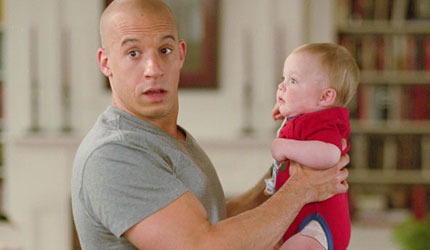

In The Pacifier, a horrible Kindergarten Cop do-over, the inexplicable Vin Diesel plays Lt. Shane Wolfe, a tough soldier shot during a botched rescue in which a government scientist dies who, on recovery, is horrified to find himself babysitting the dead man’s five children while his widow heads off to find the combination to a top secret briefcase. What follows is a hell so fresh you can still smell the brimstone.

Passing over, for now, the age-inappropriate disregard for gunplay and death without consequence, this children’s film quickly degenerates into the kind of migraine-inducing knockabout farce that has a bad pun for a title and nothing else. Somewhere in the back of your mind you know the throaty growl is all an act and Lt. Wolfe will eventually reveal his true self, a pyjama-clad softie who would rather braid hair than wire dynamite. In ninety minutes he’ll have fixed the dysfunctional family, solved all their photo-story problems (which don’t include mourning their dead father, strangely) and returned to duty with a rainbow-firing rifle of family love added to his bulging arsenal.

If you don’t mind exposing your children to the transparently fetishistic treatments of weaponry and soldiery on display here, perhaps the sequence where Diesel teaches the children deadly ninja moves or kicks in their bedroom door in a demonstration of “shock and awe” will provide a valuable future training aide. Later, Diesel provides a detailed demonstration of government sanctioned torture techniques when he hogties a troop of Girl Scouts that had the temerity to offer him a biscuit. Essential viewing for the twitchy-eyed amongst us set on raising a platoon of junior fascists, but a horrifying prospect for anyone out there reluctant to have their children’s entertainments built around the premise of normalizing war, torture and death.

Director Adam Shankman's by-the-numbers approach leads one to the certain conclusion that Mr. Shankman never learned to add up. His meandering film is an unqualified mess; sloppily filmed, shamefully edited and awash with potty-mouthed dialogue so cloth-eared it is an insult to textiles. The unfunniest joke of all is the benighted presence of former bouncer Diesel, a mortal fool called an actor only because you need a descriptive noun for the person jigging about in front of the camera. He is far from alone in his unrelenting loathsomeness. The supporting cast’s collective performances are so wooden I worried about the risk of fire when the script called for them to brush up against one another. Brad Garrett - one of a raft of minor sitcom actors in the cast – is called upon to do a two-minute rant as a hectoring school principal. All Diesel can do in response is stare blankly at his fellow actor, his face a mask of whatever the opposite of humanity and emotion and ‘being in the moment’ is and quietly leave the room.

In presenting his rib-tickling scenario Shankman displays all the comic timing of a drunken butcher, giddily slashing his way through reams of the clumsiest exposition and, strangest of all, deciding to let his camera dwell on something (usually Diesel’s raised eyebrow) at the end of every scene - as if waiting for the laughter to die down and the audience to finish rolling in the aisles. He’d still be waiting. When called upon to take over directorial duties on the school’s production of The Sound of Music, there is a long pause as the weight of this new development slowly sinks through Diesel’s gleaming skull. Having twigged the metronomic pattern to events by then, I saw my chance to run and took it.

Hollywood Creative Bankruptcy Watch #1


The powers that be in Sony clearly didn't get where they are today by sitting around watching a load of damn movies. Ask them about the process of keeping a factory churning out product though.

I'll tell ya what works, they'd answer, very loudly. They might rise from behind their vast oaken desks and poke you in the chest with the wet end of their cigar.

Sequels and franchises, buddy! That's what they'd say, jabbing for emphasis.

Ya gotta get a franchise going!

In that spirit, of despair in case you're not following, we greet news that Sony Pictures is planning a whole raft of sequels, including but not limited to Hollow Man 2, I'll Always Know What You Did Last Summer and Road House 2.

Let that information sink in there now for a minute and we'll deal with these one at a time.

The original Hollow Man, in case you missed it, was ever-so-naughty Dutchman Paul Verhoeven's noisy and pointless Invisible Man 'homage'. Kevin Bacon was in it, getting his stalk on with some pretty girls and getting all drunk with power but, er, spoiler, he dies in a jet of superhot gas at the end. So I guess it'll be some daytime soap opera chimp's turn to stare at his hands goggle-eyed as they gently fade into blur-outlined transparency with the chai latte sweep of a bearded Californian's mouse. Beautiful.

With the amount of damage I've done to my brain watching swill like I Know What You Did Last Summer over the years, it's a good thing someone will remember. Shame so many beautiful teenagers will have to die in the process, though. It's not like I did anything cool.

The original Road House remains on my list of yet-to-see movies. Seeing as how it stars elbow-faced meat puppet Patrick Swayze, it'll be there for a while yet. He plays Dalton, a kickass bouncer slash dance instructor hired to clean up a scuzzy biker bar slash ballet conservatory somewhere in the desert. A follow up set in Baghdad (not really) is precisely what America needs to keep its spirits up in this time of war. Swayze dancing around a bombed out marketplace like a horny spastic would send the right message to the towelheads. Awwrright! U! S! A! Whoooo!

Here's the thing. All of these movies were released years ago. Roadhouse is from 1989. If the originals were any good, or if the audience was crying out to see more of them, Sony would have made the follow-up before now. Is there really anyone out there looking to see more Swayze, or events inspired by Swayze's antics fifteen years ago? It's like a snake eating its own tail. They may as well just tape the beginning to the end of any given reel of film and show it, endlessly.

The guy in Sony whose job it is to come up with new ideas must have a lot of cigar spit on the front of his shirt.

War of the Worlds Review
This post is the complete review for Spielberg's new one, War of the Worlds, most of which was published in the Independent's Day & Night magazine last weekend. I tend to write more than fits the available space and there just isn't room for all of it. No such trouble here...but it is more or less unedited. I'll probably do this for selected films from now on, but I won't post everything.

War of the Worlds, 12A

H.G. Wells, the father of science-fiction, wrote “The War of the Worlds" in 1898, stirred into genius by reports of an Italian astronomer mistaking Martian rock formations for artificial canals and looking for a metaphor to carry a story intended as a warning about the rise of the Kaiser and Imperial Germany. A young Orson Welles notoriously adapted the story as a breathless caution against the rise of Hitler in 1938. In the 1953 film, it was the Soviet Reds. Now, I suppose, the warning is about 9/11 or the War on Terror, but I haven’t been able to figure that one out quite yet.

See, DreamWorks perfectly legitimate desire to snatch a massive opening weekend from a dismal summer season, coupled with their equally fervent desire to foil the DVD pirates (and stymie the potentially disastrous effects of poor word of mouth) means that instead of the usual leisurely cud-chewing that goes into passing judgement on a movie, there is almost no time to run the ruler over the new Steven Spielberg film. War of The Worlds was shown to the Irish press just two days before the public get to see it and just a couple of hours before this section of the Irish Independent goes to press. It’s a marketing manipulation as cunning as anything the sneaky Martians could have come up with but haste makes waste and make no mistake, War of the Worlds is a waste, being the first half a great film stitched onto the second half of a mediocre one.

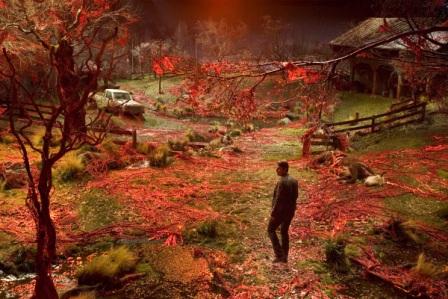
After a suitably ominous, rumbling introduction, narrated over images of the workaday world going about its business by Morgan Freeman, we are quickly introduced to the blue-collar Ray Ferrier (Tom Cruise), a crane-operator at the NJ docks (very macho) who drives a Dodge Charger (likewise) and lives alone in a messy house under a bridge. Given Spielberg’s obsession with divorce and the dissolution of the nuclear family, Ray must be a weekend dad and a deadbeat one at that. Shortly after his estranged ex-wife (Miranda Otto in another fleeting appearance following In My Father's Den) and her new husband drop his moody teenage son Robbie (Justin Chatwin) and young daughter Rachel (Dakota Fanning) off for a rare weekend visit, a strange and powerful electrical storm lights up the sky over his house. The power goes out, the phones don’t work and car engines have been disabled by an electro-magnetic pulse. Lightning strikes the street near Ray's house, and up from the resulting crater rises an towering three-legged alien weapon that proceeds to lay waste to the town. The fleeing people are incinerated by death rays and buildings topple in rubble. So far, so exciting. Ray bundles the family into the only working car around and flees to Boston, where the ex-wife is and where the family can be re-united. The ordinary-joe Ray has to battle marauding aliens, the hapless military and the raging mobs of terrified people to do the right thing for his children.

That’s the journey Spielberg is interested in here, a sentimental and manipulative series of separations and reinforcements that have been sanitised for a summer audience. The shadow of the Kaiser or Kruschev or whoever is ignored in the rush to say I Love You, Daddy. Strangely for a Spielberg film (he usually patches over his gaps and illogicalities with a glossy sheen) it's possible to pin down almost exactly where the story starts to topple over: twenty scant minutes of WOW almost ruins everything else. A massive set-piece battle between a troop of alien tripods and the overwhelmed military introduces a deeply suspicious and badly played separation which puts the mopey kid in limbo and Ray and Rachel in a bombed out cellar with a fellow survivor, played by Tim Robbins. The war raging outside, and everything else grinds to a sudden stop and we’re in this over-designed basement for what feels like a very long time, watching Robbins do his wild-eyed and desperate disintegration thing. Which is all well and good but the clock is ticking and the yarn is losing its pulse. Again and again the admirably tidy aliens arrive to snoop around for stragglers and the plucky trio outwits them. As a sidebar, it offers a few minor thrills amidst some well-staged set-pieces, but the overriding anxiety is gone from the story and the film’s focus has evaporated.

Spielberg again relies on his core filmmaking team of regular collaborators, led by director of photography Janusz Kaminski, production designer Rick Carter and a suitably ominous musical score from John Williams. Together they do supply some moments of real magic that only serve to highlight what a disappointment the remainder of the film is. A flaming train flashes through a level-crossing, flames leaping from every window: a beautifully realised image in and of itself and a shocking metaphor for chaos. A scene where Ray and the children are overcome by a mob is terrifying for both its immediate realism and its nod to the relentless psychology of B Movie zombies. What’s really noticeable here, and it’s to the films credit, is what’s missing. No crumbling Statue of Liberty (in fact, beyond some anonymous NJ bridge, no destruction of landmarks at all), no floundering Army generals calling the President on the big red phone. Cruise never faces off against the Leader of the Aliens and there is never a suggestion that he would be particularly heroic if such a face off were to happen. Cruise is a decent hero, but it's almost impossible to see a star of his magnitude play an ordinary man, even if he efficiently struggles to cope as his country collapses around his head.

Dakota Fanning – to many a far more terrifying prospect than regime change at the hands of bloodthirsty alien beings – does surprisingly well for a young actor called upon to show courage while remain vulnerable and innocent. Likewise Justin Chatwin who plays Cruise's grungy teenage son. Initially insufferably disaffected, the sulky youth is inspired to a sort of individual nobility by realising he actually loves his life just at the point where something is threatening to take it away.

So where's the problem? Legendary story, beautiful special effects, decent performances, a contemporary theme? If WOW isn’t really about an alien invasion of Earth, what is it about? Spielberg, whose parents divorced while he was in his teens, is more concerned with the destruction of one family than the obliteration of billions. Focusing on Cruise, as a confused modern father who comes good under pressure, at the expense of the grand theatre of destruction enacted a mile over his head adds an element of oversimplification and manipulation (that word again) that means the impact WOW can carry is fatally limited and nauseatingly self-obsessed. In being called upon continuously to face up to himself, Cruise can never face the evil of the external threat, and so we cannot either. The invading aliens become a narrative device, lying in wait for a million years before attacking for no other reason than we hadn’t invented custody laws, visitations or divorce back when we were throwing sticks at each other. The ending, rushed as so many other elements of this saga are, is a fairly poor excuse for a coda to the occasionally riveting drama that has gone before. But it’s only one underwhelming movie. It’s not the end of the world.

TC is starting to frighten me


Tom Cruise. Who let this guy off the leash? Shotgun weddings, on-set Scientology tents, jumping on Oprah's couch like he's done a boom boom and has a full nappy? Ranting about fizzy-drink-antidote Ritalin. Live on the TV! And proper ranting too, 'cross the road to avoid the mad tramp' kind of stuff. Look at the eyes! When TC turns it on full beam, it's well and truly on, brother.

Why is he bashing on about Ritalin and shrinks? Has it something to do with his newly acquired 'zest for life'? That we would not be witness to the the irrepressible new side to Tom had he not recently decided to drop the happy pills is wild, almost feral speculation on my part, by the way. I need hardly clarify that I am not a confidante of TC or anyone close to him, and I live in Dublin, not LA. I don't even read Heat. And I think he was dead right to get mad about being squirted in the face by those muppets. That, to me is OK mad, not a problem. But when a very famous person is increasingly being perceived as acting really oddly in public, and no-one seems to be telling him to lay off a bit, it's only human nature to wonder why.

My point is (and long story short) if Tom Cruise was a friend of yours, you'd have a quiet word in his ear. Personally, I'd call for an intervention, but that sounds suspiciously like psychiatry and might lead to a session or two with the talking doctor and we (now) know how Tom feels about that (too). Ifs and buts aren't going to save Maverick from the mindfuck though, and if twenty years of ubiquitious celebrity has taught us anything, (and we all know it hasn't really) it's that generally loopy behaviour is likely to end badly.

We in the real world must be content to sit and watch as (someday fairly soon I'm thinking) his Thetan superbrain liquifies and starts seeping out of his eyesockets. Puking a puddle of intergalactic grey goo, strobe-lit black against his teeth for a moment by the paparazzi's flashbulbs. The publicist's shocked face as she grips her client's elbow. A random smiling co-star waving a skinny arm in the background, unawares in a pink frock. Moments later breaking news - crawling updates, 'iconic images', flower-strewn vigils. A moonlighting specialist with a nervous tic perched on a stool in a too-hot studio bleating on about 'explosive brainfreeze' and 'massive cerebral coughs'. I'm telling you, that is where all this is headed.

I don't want Tom's face to melt on the street outside some cinema in front of a thousand o-faced cameraphone owners. I'm not having a go at his religion (there is no shortage of people who will), I think he can believe whatever he chooses to believe. I'm more concerned about his newfound willingness to discuss Scientology and debate it's doctrines at length: excited, off-topic discussions that are more like frothy-lipped, evangelical testemonies than interviews. For a long time he wouldn't talk about his beliefs much at all. Now, his willingness to debate issues that seem to have nothing to do with War of the Worlds or the business of being an in-demand movie star or busy producer seem, to me, like carefully chosen opportunities to promote his beliefs and reinforce his overwhelming message. That following this cult/mental yoga/religion/sci-fi hogwash/whatever brought him positive results and untold riches, spiritual and secular. He's like Frank T.J. Mackey with this brain-dwelling aliens shit and I don't like it. A-List star endorsements are powerful marketing tools and the longer it continues, and the more I read about Scientology online, the more concerned I become about giving this nice guy with the big smile and the steady gaze the stage to sing its praises. And there's months of this stuff coming.

Directions

I've been puzzling over what to do with this online space and the nuggets of available time I have to use it. I'm interested in my ongoing developing, almost professional relationship with movies and entertainment - and the few of the good ones that might have an insight or make an impression that develops into a fascination. I'm also interested in exploring my own rapidly yellowing opinion of Hollywood, and posting items that you might not see elsewhere that , to me, go some way towards exposing the absurdity of modern cinema. But maybe any artform/business model is ridiculous when you take the stupid stuff (Cruise vs Holmes, Pitt vs Joilie) and extract it to make a cumulative conclusion. Especially during the summer season. You tend to forget that not every line of dialogue is roared across a cavernous set. At a robot. But that's an argument for another day.

So, a rambling Proustian diary or a cynical sub-Defamer pisstake? Great choice. It'll probably end up being a mix of both of these things with whatever half baked theory or trashy rumour I find online thrown in for good measure. You expected?

Consider this. A film producer knows that people love going to the movies. In this country we go all the time, with almost 5 million admissions in 2004 at about €7 a pop. A film producer takes this love, this desire to be entertained - to escape the drudgery of everyday life for a couple of hours - and uses it as a stick to beat loose change from the pockets of unsuspecting audiences. Even if they pay no attention to us, much less thank us, critics stand between those people and that beating.

Barking at the mooon

Link

"Anything where you have a dog in that superhero context, that’s appealing on a global basis...’

Soon there will be animated super-canines in EVERY movie.

Creativity Circadian Rythmn

Link

Spielberg works nine to five - like a salesman or a dentist. Why is that factoid gnawing away at me?

By the way...

If anyone comes across this site accidentally (unlikely, I know) - please ignore it's appearance, content and generally sketchy air of desperation for now. I'm new here and haven't told anyone I don't know what I'm doing yet. If you did stumble in here, welcome...

First post

OK, what now? Well...