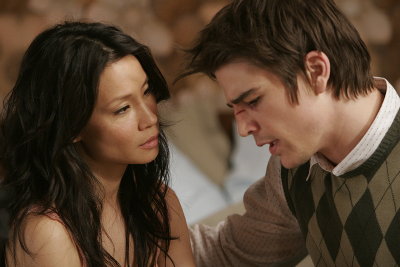
 Rivalling Plan 9 From Outer Space or The Sisterhood of the Travelling Pants for “Stupidest Title For A Movie”, Lucky Number Slevin isn’t the sloppily-spelled biopic of former Republic of Ireland midfielder Bernie Slavin, but a sub-Tarantino mistaken-identity crime caper from Scottish director Paul McGuigan (Wicker Park) that is ocassionally as violent and funny as you’d expect from this tired old genre, but isn’t half as clever as it thinks it is.
 Slevin Blides Flor Slevin Blothers
Rivalling Plan 9 From Outer Space or The Sisterhood of the Travelling Pants for “Stupidest Title For A Movie”, Lucky Number Slevin isn’t the sloppily-spelled biopic of former Republic of Ireland midfielder Bernie Slavin, but a sub-Tarantino mistaken-identity crime caper from Scottish director Paul McGuigan (Wicker Park) that is ocassionally as violent and funny as you’d expect from this tired old genre, but isn’t half as clever as it thinks it is. Sympathy For The Devil
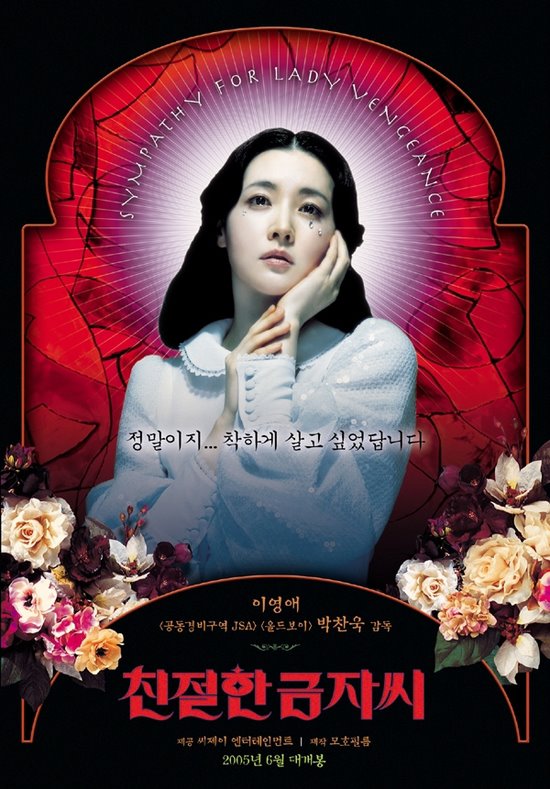
Acclaimed Korean director Park Chan-wook completes his trilogy of operatic revenge films on a high note with the dreamlike Lady Vengeance. If your dreams feature dismemberment and coffee cake, that is. Following the themes of redemption and justice established in Sympathy for Mr. Vengeance and OldBoy, this time the story revolves around a young woman named Geum-ja (played by Lee Young-ae), recently released from prison having served 13 years for a notorious crime, the kidnap and murder of a young boy. The timid, religious girl that went in is a very different woman now, having spent the 13 cramped years festering in spite and plotting a complex plan. Once on the outside, she shuns her family, the rabid media attention and the creepy Christian group that helped her get parole. Using her prison contacts and keen sense of cunning, she constructs her suitably elaborate and vicious revenge, focused on one man, the evil schoolteacher Mr. Baek (Choi Min-shik from OldBoy). Reunited with her own teenage daughter, fostered in Australia, and armed with a mysterious, custom-made revolver, Geum-ja sets about her task with relish..
Flux That

Hard-won reputations take a serious kicking in Aeon Flux, with Charlize Theron following fellow Best Actress Oscar winner, Catwoman Halle Berry into the career-threatening high-wire genre of the female action superhero with similarly disastrous results.
Sometime soon, all bar five million or so of the world’s population is wiped out by a deadly virus. 400 years later, those few survivors live in a seemingly utopian society called Bregna run by Trevor Goodchild (Marton Csokas), a scientific genius who created the vaccine that saved humanity, and his brother Oren (Johnny Lee Miller). They keep a tight grip on the population via a combination of Big Brother surveillance and heavy-handed military force. The architecture all looks very high-tech, and the fashions are suitably evolved, but there is trouble in paradise and people are starting to disappear. The deadly assassin Aeon Flux (Theron) is part of a rebel group named the Monicans, led by The Handler (Frances McDormand), who have secret meetings in a courtroom inside their brains. Aeon has a sidekick, Sithandra (Sophie Okonedo), who has hands instead of feet. Hang on, I’m nearly finished. When Aeon and Sithandra are sent on a mission to kill Trevor (Trevor?), they must dodge killer grass and beehives that shoot arrows before, not unexpectedly, uncovering a vast government conspiracy and an earth-shattering secret.
A Warning From History
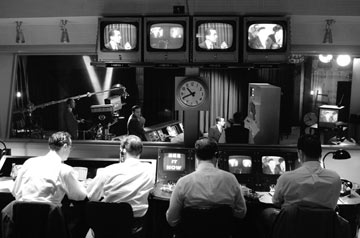 George Clooney's second picture as a director, the succinct and unpretentious Good Night, and Good Luck, is a modest movie, in scale, cost and running-time, but a huge film in terms of its message and relevance to today’s news media. It tells the story of a key chapter in American political life, the Communist witch hunt conducted by the paranoid, power-hungry Senator Joseph McCarthy in the 1950s and the efforts of television journalist Edward R. Murrow, played by David Strathrain, and his team of news producers, including Clooney as Fred Friendly, to expose him as a liar and a fraud. Murrow’s sense of decency and justice is offended by McCarthy and his cronies and in saying as much, he threatened his own position and that of his company, CBS. He is vilified by McCarthy’s supporters, his own management and by sponsors, who abandon the station as soon as the controversy breaks.
 In framing the meat of his story between two snippets of a brilliant cautionary speech about the importance of an independent media that Murrow delivered at a dinner in his honour, Clooney presents his key episode as an almost surgical procedure – a group of right minded people in a position to do something who fight the tide of popular opinion and commercial pressure and fear of exposure to remove a malignant presence from the body politic.
Strathrain, a renowned theatre actor and veteran of almost 80 films but still a relatively unfamiliar face, is excellent as Murrow, suave and cool on the exterior but burning with a righteous fire of indignation underneath. Clooney plays Murrow’s dedicated producer Fred Friendly, with Frank Langella, Robert Downey Jr. and Patricia Clarkson making the strongest impressions from the remainder of the large ensemble cast. The other central character is McCarthy himself, and Clooney masterstroke is having the sweaty, charmless Senator play himself, using actual archive footage to damning effect. That the movie is entirely about 50 year old politics and the early days of the American television news business might discourage Irish audiences from seeking it out. But the movie is not really about the McCarthy and his pernicious influence, rather the rightminded way in which Murrow and his team eventually engineered his downfall. Far from a bitter polemic, the film is a morality play, as relevant and important to today’s international politics and the business of reporting the truth as it is a lovingly-crafted period drama.
McCarthy's flickering presence aside, Clooney does some interesting things as a director. In shooting in glorious black & white and expending considerable energy in getting his atmosphere and production design just right, Clooney is refusing to colourise the 1950s. This isn’t ironic homage, a Technicolour trip down memory lane, its straight reportage related with a dispassionate eye and attention to detail.
The story, about tough, principled men forced by a shift in politics to make a stand, to do the hard thing in an uncertain situation, is as much a call to arms for today’s society as an opportunity to revisit the past for guidance. Clooney keeps his camera tight to create intimacy and immediacy, and his script pared down to avoid confusion. He skilfully creates an attentive calm around his key moments, provoking the audience into joining the dots between what happened 50 years ago and what is happening today in terms of press freedom and civil liberties. The film’s message is crystal clear, bullies must be stopped and liars exposed.
Heavy Jelly
A skinny black man dresses up as a fat, googley-eyed black grandmother, does a series of dirty-minded Uncle Tom skits that would have Hattie McDaniel choking on her popcorn and calls it a kid’s movie. So what? In the world of comedy, political correctness means nothing. You should be able to laugh at anybody and everybody. Anybody except Martin Lawrence.
Six years on from the character's first outing, Lawrence’s FBI agent Malcolm finds himself working undercover as a nanny for a family caught up in a murder case, an international spy-ring and a cheerleading competition. Uptight Mommy (Emily Procter) is overprotective and regimented. Absent Daddy (Mark Moses) is a boffin who’s a threat to National Security. I could try to relate the rest of the plot, but like an eye-witness to a road accident, my testimony might not make much sense after the fact. I remember there were lots of colours and loud noises. There was a dog that got drunk and one cute kid that fell down a lot and a chase scene at the beach. Big Momma shouts all the time you see, and it’s hard to stop yourself from wincing, so I might have missed a few things.
In short, entirely as you’d expect from this genre of former star relegated to ‘family’ slapsticks, the results are blatantly contrived, astonishingly vulgar and designed only to serve the Lawks-A-Mercy antics of the gurning lead.
The Irish Blog Awards
Cast a vote for me, and visit some other Irish blogs in a load of different categories at the awards website. You can go back and vote for them later...
And it burns, burns, burns
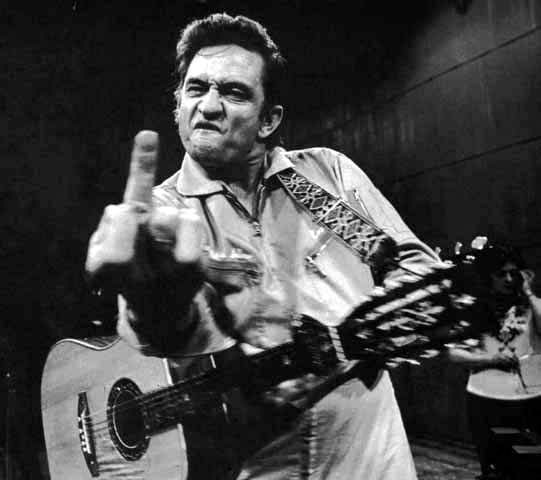 Based on Johnny Cash’s own autobiography and developed with considerable input from himself and his wife June up until their deaths in 2003, James Mangold (Girl, Interrupted) tells the first part of the story of a legendary life in music with astonishing power and sensitivity. Superficially, Walk the Line follows the same, tried and tested tracks of other musical biopics, but perhaps because many musicians have the same story to tell; hard times, the struggle for success and recognition, drugs, alcohol, rehab and redemption, their stories can’t help but resemble each other.
 Although JR Cash’s poor childhood in rural Arkansas is quickly told, Mangold does manage to establish three key elements of his subject’s troubled personality. We discover the impact the tragic death of his beloved older brother had on his life, that his alcoholism was likely hereditary and that his father's lifelong animosity towards him scarred him deeply. “The Devil did this,” Ray Cash (played with devastating meanness by the excellent Robert Patrick) shouts. “He took the wrong son.” And you wonder why he wore black? After a tour of duty with the Army in Germany, Cash returned to the US to marry his sweetheart Vivian (Ginnifer Goodwin), and raise their daughter. It’s just as Cash is unhappy with the direction his life has taken, and struggling to establish himself as a musician, that the film kicks into life, in an altogether rattling scene that sustains the momentum through to the finale in Fulsom Prison.
Despite being an outstanding musician, Cash was also an adulterer and an addict. To the film’s enormous credit, Mangold doesn’t pull his punches for the sake of audience sympathy. This is entirely fitting for Cash, a man who sang about his troubles and the trouble he caused so directly and so eloquently and so simply. In his autobiography, Chronicles, Bob Dylan paid homage to Johnny Cash and his music, saying that the Man in Black’s throaty growl “was so big, it made the world grow small.” In taking on that voice, and approximating the man who held it, Joaquin Phoenix delivers a startlingly good performance that never once turns into an imitation. He is note-perfect, but the film’s energy and heart come from Reese Witherspoon as June Carter Cash. She positively lights up the screen with every scene, matching Phoenix’s furrowed fervour snarl for snarl. The chemistry between them is palpable, which Mangold uses to fashion an immensely believable and compelling story. Like that startling instant, when Johnny Cash finds his voice, (“steady like a train, sharp like a razor,” as June later described it), this is a film full of riveting thumbnails; a bass guitar with the chords written on the fretboard, the first time Phoenix slings his guitar back on his shoulder, Jerry Lee Lewis’ leopard-skin collars.
Two scenes are particularly memorable, sketching the time and place with a keen eye and heart. An encounter the twice-divorced June has in a rural shop with a sharp-tongued bigot is powerfully written and brilliantly performed. Later, Cash wakes up on a tour bus and in stumbling past his sleeping guitarist Luther Perkins, plucks a cigarette out of his mouth. In real life, just months later, Perkins died in a fire in his Tennessee home, having done the same thing again.
Brave New World

Although some story elements are entirely fiction, Malick has gone to tremendous efforts to ensure his film is absolutely as it was 400 years ago in every other regard. He filmed along the Chickahominy River, very close to the original Jamestown settlement. His rough-hewn, hand-built sets, realistic costumes and armoury help to ground the carefully constructed atmosphere and dreamlike mood. Visually, Malick and his ace cinematographer Emmanuel Lubezki present a deluge of arresting and original images, brought to the screen without the aid of electric lighting. The results might not have the same heavenly glow of his other pictures, but it was a brave move, totally in keeping with his requirement for realism. Malick can make a kennel look like a cathedral, and his film is a masterclass in crafting a story from little more than light and magic.
The film builds to a fascinating last act, with Rachel and Rolfe summoned back to England to meet the King. This development provides the film’s emotional heart, with Rachel wandering through a finely realised London, it’s wet, grey streets and heaving crowds with the lush forests. Those who know the story know what happened next, with Malick choosing devastatingly effective shots of a freshly made, empty bed and a still, darkened Native face to represent his conclusion, a moment that sings off the screen with heart and wisdom and genuine emotion.
The way commercial movies are constructed now, the unfamiliar attention a film like The New World (and Micheal Haneke's Caché) requires can split an audience right down the middle. Impatient viewers might baulk at another shot of distant birds flying in formation across a huge, bruised sky or a series of composed visual haikus on the way water falls on rocks or how leaves fracture sunlight into rainbows. Malick’s approach might strike you as either totally immersive and rewarding or maddeningly dense and boring. Or somewhere in between. Personally, I loved it, but seeing as it might be another five years or more before we see anything like it again, I'm prepared to debate it for the sake of argument.
Seoul Assassin

Death comes dropping slow in Korean director Kim Jee Woon’s (A Tale of Two Sisters) new crime thriller A Bittersweet Life. For seven years, loyal Sun Woo (Lee Byung-hun) has acted as a mob enforcer for a mafia syndicate led by the elderly President Kang (Kim Young-chul), under the cover of managing the swanky ‘Dolce Vita’ bar. One day, Kang asks Sun Woo to do him a personal favour: He must go out of town for a few days on business, and needs someone to keep an eye on his young mistress Hee Soo (Shim Min-ah), who he suspects might be seeing another man behind his back. If she is indeed cheating on him, then Sun Woo must use his considerable killing skills to settle the matter. Sure enough, Sun Woo catches the girl in her innocent deception, but rather than murder her in cold blood as per orders, he allows her and her terrified lover to live, as long as they swear never to see each other again.
It's this simple act of mercy, wholly out of character, that will ultimately cost Sun Woo dearly.
*** It occured to me as I was posting this review that I never got round to talking about how almost every major character in the movie ends up with major damage to their left hand - usually the effects of a shotgun blast. Did anyone else notice that and has anybody any idea what it might mean? I'm thinking "if your left hand offends you, cut it off", like in the Bible, except here there's a bad guy with a bowie knife to save you the trouble...***
Sayuri, We Hardly Knew Ye
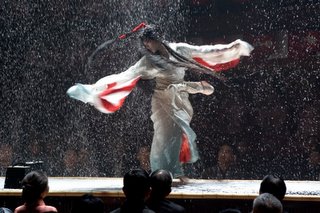 Memoirs Of A Geisha, the picture-book new film from Chicago director Rob Marshall doesn't pretend to be a complicated drama, but the source novel, Arthur Golden's best-selling 1997 potboiler, never had pretentions of depth either. Instead, both book and movie provide a lush, immaculately detailed and visually absorbing portrayal of a peculiarly Japanese world, that of the special class of paid female companions, artists, musicians and, to be blunt about it, chatteled sex workers: the geisha.
The film opens with an almost silent sequence that highlights the considerable talents of young actress Suzuka Ohgo playing the frightened young Chiyo, taken from her impoverished family in 1929 and sold to a renowned geisha house in Kyoto. Here she is subjected to cruel treatment from the owner Mother (Kaori Momoi), who works the little girl to the bone, with Chiyo’s slavery made even more unbearable by the malignant attentions of Hatsumomo (Gong Li from Raise the Red Lantern). The reigning queen of the geisha house, Hatsumomo realises the threat the newcomer represents, not to her present, but to her inheritance, and cruelly engineers her isolation, especially from her only friend, Pumpkin (Youki Kudoh). She frames Chiyo for a minor crime, which leads to her being sold to Mameha (Michelle Yeoh, also from Crouching Tiger, Hidden Dragon), a beautiful geisha in her late thirties who is the companion of the Baron (Cary-Hiroyuki Tagawa) and his friend, the wealthy Chairman (Ken Watanabe from The Last Samurai). With Mameha’s careful tutelage, the shy and withdrawn Chiyo becomes the radiant geisha Sayuri, the talk of the town and a famed entertainer. The girls have been carefully drilled to realise that love has no role in their new world; that these men are clients, not potential husbands. The distinction between these women and prostitutes, and the geisha and a wife is made clear, with politically motivated flattery replacing the honesty of romance. Nevertheless, Sayuri falls in love with the Chairman, always keeping his dropped handkerchief and a newspaper photograph in the folds of her kimono.
Regardless of how she delivers her dialogue, Ziyi Zhang (House Of Flying Daggers) has the face of an angel, sometimes blank and serene but always filled with subtleties and tiny human gestures that add tremendous soul to her performance. For his part, Watanabe’s Chairman, representing an idealised concept of love for the innocent Sayuri (his dropped handkerchief becomes her prized possession) plays a storybook romantic ideal, capable, brave and kind. But their gradual coming together takes a back seat to Sayuri’s own coming of age, which, once achieved, leaves the remainder of the broadly drawn, essentially formulaic Cinderella melodrama with nowhere to go. Still, it is a lovely thing to look at, and sometimes that's enough.
In one way, the painstaking approach to the first two-thirds of the film, the precise and painstaking recreation of this complicated world, is to be applauded; it’s slow unravelling setting a totally immersive, captivating tone. However, the film as a whole never recovers from the brutal intrusion of the Second World War and the subsequent occupation of Japan by the beer-swilling, skirt-chasing Americans. A subplot running through the film that highlights how these young women were cast against each other as rivals falls flat in it’s clumsy resolution, with the viewers attention taken more with where they are (and how gorgeous it all looks) rather than what they are saying to one another or what it means to Sayuri’s desperate love. Marshall has conjured up a lost world with considerable fluency, but the magic of the film is in it's recreations, almost alien in their exoticism, and not its uninvolving emotions.
Trading Places
 Anand Tucker's Shopgirl is the adaptation of Steve Martin’s popular but essentially gloomy novella, his first work of fiction, which has more life on paper and in the mind of the reader than it does when played out on the big screen in three dimensions.
Country girl Mirabelle (Claire Danes) is a shy, withdrawn retail assistant, new to LA, who works at the quiet glove counter of a big department store, but spends her days mostly staring off into space, dreaming of love and escape. One evening, while washing her smalls in one of those Laundromats beloved of screenwriters, she meets Jeremy (Jason Schwartzman), a random, completely uninhibited and rather scruffy wannabe musician and amplifier salesman. They go on an awkward date, gingerly feeling one another out (rather than up) but there is little spark between them. However, Mirabelle is just lonely enough to call him again, and they start a clumsy, uncomfortable physical relationship. So far, so awkward.
Enter the other side to the potential love triangle, the wealthy middle-aged businessman Ray Porter (Martin himself, who looks like he's had some sandblasting done to his face, especially around the eyes). Mirabelle and Ray start to see each other, and before too long their relationship escalates into something more substantial and rewarding than Jeremy had to offer. But for all his impoverished stains and filthy hair, Jeremy was a young man with a heart, which might be worn on his sleeve, but is undeniably still beating. Ray, for all his money and the freedom it brings, is shallow, self-obsessed and faintly creepy, something Mirabelle gradually comes to realise.
Tucker does employ his keen visual sense on occasion to break the mood with some assured and delicate photography, but the film’s determined anti-romantic point of view never really admits us and is altogether far too downbeat and mopey to make any real connection. It’s not much of a watch, but when compared to Martin’s other recent offering, Cheaper By The Dozen 2, it’s a fucking masterpiece. Modern love isn’t the only thing that’s not funny anymore.
Full Mental Jerk Off

“Are we ever going to get to kill anyone?” asks a soldier at the start of British director Sam Mendes' new film. No, they’re not, and it’s the lack of events or purpose that makes Jarhead a different kind of antiwar film - a war film without a war. In it Tony Swofford, played well enough by Jake Gyllenhaal, enlists as Marine, the title comes from the corps nickname, and after training is seconded into an elite division of snipers. Paired up with a spotter, played by Peter Sarsgaard, the 20 year old Swofford is sent to Kuwait in 1991 as part of Desert Storm. But the soldiers don't get to do much of anything when they get there, other than conduct patrols through the desert and perform drills and demonstrate their fancy equipment to uninterested journalists, with the gradual disconnect from home, from government and from the business end of the war itself driving them close to a kind of madness. Their cold-eyed tormentor in the desert is Staff Sergeant Sykes, played by a macho Jamie Foxx, who maintains a rigorous sense of discipline combined with a juicy sadistic streak. Once the actual conflict begins, the troop spends their time mopping up the burning oil fields or on patrol along the burnt-out cars on the infamous “Highway of Death”. Crucially, they never get to kill anyone; an impotence and lack of purpose that builds slowly into frustration and anger.
Interview: Neil Jordan & Pat McCabe The Rocky Mountain News
 I’m laughing at a story about an actress on a short film misreading the stage direction ‘hovering’ for ‘hoovering’ when Neil Jordan pokes his head around the door and asks where he can smoke a cigarette. “Outside? Oh, Jesus”. I go with him, half wondering if I should take my recording device (I don’t) and as we smoke we talk about how the whole country got all worked up over Willie "Oh'Dear" O'Dea being photographed pointing a handgun. “What’s that all about?” asks Jordan, by way of introduction to a minor rant about the insular nature of Irish Sunday newspapers, which, according to the director, have no idea that there’s a wider world out there. “The Rocky Mountain News has more in it”.
 McCabe, just as stocky and square as Jordan but with a profoundly more open disposition, has a cameo in the film as Peepers Egan, a local man. I ask him if he spent much time on the set, outside of his performance. “Oh yeah, well, it’s very interesting making a movie and I love hanging around anyway. When you’re just sitting around writing stories. It gets you out of the house”. Jordan gives a big sigh. “Every writer just wants to get out of the house, you know.” McCabe agrees. “They do really, sure it drives you mad”. Out and about or not, Jordan is a notoriously difficult subject to interview. He doesn’t pretend to enjoy the process of talking about himself or his work, and seems incapable of offering pat, polished anecdotes, the familiar, pre-assembled witticisms that slip easily into a comfortable celebrity puff-piece. He thinks before he answers questions, often falling into silence, or disagreeing, or answering a question with another question. He’s not difficult or obstreperous; he’s precise, which can be just as maddening. I ask them both about dealing with the IRA in their work, looking at Jordan’s seeming obsession with the North and citing the obvious points of connection in the director’s own back catalogue. Jordan claims he doesn’t understand what I mean, so I explain further, saying that someone from the outside looking in would find it difficult to differentiate between say, Jordan’s IRA pub-bombing and the psychological weight that carries here and a pyrotechnic sequence in a Bruce Willis action movie? It’s not meant as an explicit criticism, but it sounds like one, and a clumsy one at that. Jordan just looks at me. McCabe answers, gently, saying that the IRA is at the heart of the film. “How would you deal with a young kid living on the border in 1971 without having the IRA involved? How would you do that? Given the subject matter in the film, we couldn’t avoid it”. But, I say, Jordan has gone over this ground again and again. What elements of the North, for both writers, add up to make a drama? “Well, yeah”, Jordan replies, after a silence. “I made a movie about Michael Collins, I made The Crying Game and Angel, but one of the reasons I put off making Breakfast on Pluto for so long is that I didn’t want to deal with the issue of political violence immediately again”. “Well”, says McCabe, “I can see how this would be much more of a problem for Neil than it is for me. I haven’t dealt with the IRA before in my work. The book is set in the borderland in the 1970s, so like I said, it’s unavoidable. But the quintessential IRA movie, outside of Michael Collins, simply hasn’t been made yet. It’s like a movie you’d make about Sarajevo in the nineties, like a Battle of Algiers or something. But that’s for someone else to make and write. I don’t have that kind of mind, and maybe that’s the movie you want to see, but this film doesn’t purport to deal with those issues. The IRA in the context here represents a threatening, sinister, outside force, like a pack of wolves. A film dealing directly with the IRA and covert forces in NI would be far more politically complex than what we’ve done here”.
One thing that’s fascinating about the strange world of Breakfast on Pluto is that things are never spelled out in black or white. Everybody is ephemeral, socially, sexually, politically; a turbulent ensemble cast of characters that are all open to interpretation while resisting any neat categorisation. McCabe sucks his mint, meditatively. “It prefigures the modern world, I think. Someone was saying to me, I think it was Gavin Friday (who plays showband leader Billy Rock), that a lot of the characters are people that you just didn’t see in fiction in Ireland, even if they were right there in front of everyone. They just weren’t part of the dramatic landscape, they were swept under the carpet. Now, in the modern world, we can address them because all these things are all out in the open. They had a peculiar kind of ambience feeling about them – because of it being the early seventies, where there was a lot of depression, really, and alienation and silence. So the period that it’s set in is very significant”. He’s warming to the theme, and stretches out in his chair as he expands. “The seventies were such a weird time, really. Just looking at something like ‘Reeling in the Years’ (the archive show from RTE), it seems to me now that fashionwise, politics wise and socially wise, it was all very strange and you’d find yourself wondering what were we all thinking, watching it now”. It’s like a different planet, I say, cheerfully alluding to the Pluto of the title. A bus roars by outside. McCabe sucks his mint and Jordan sucks his lemon. I use the resulting silence to ask another question.
Jordan has predicted my next question, but this is the most he’s said for quite a few minutes, and the clock is ticking, so I’m reluctant to interrupt. “Ultimately”, he continues, “everybody in the movie, no matter how awful their journey or how badly they have behaved, arrives at a kind of peace. They become good”. He looks across at McCabe. “We should have called it How To Be Good”.
Match Point
 It’s not just the much-heralded exile in London and the sympathetic bosom of the BBC that marks Woody Allen’s attractive new drama out from the couple of dozen or so films he has made in his native New York. Match Point is a whiplash drama featuring a cast of mainly British and Irish actors, a couple of torrid sex scenes, gritty violence and, most surprising of all, after a run of six apathetic duds, it’s really very good.
A different kind of 'Year in Film'

A Norwegian blogger called Erik took a photo out his window every other day for a year and pulled the images together into a beautiful, silent, two minute film he's posted online here.
Perfect for those deep January thoughts of another year and the passage of time and the changing of the seasons and all that.
The Best and Worst of 2005
Best of 2005
I'm asked all the time, 'What's your favourite movie?' Tediously, I don't have a ready answer (although I do sometimes say Goodfellas for the sake of saying something, and I really do love Goodfellas), so in that spirit, although in no particular order and for all sorts of reasons, these are the movies I liked the best at the cinema this year.
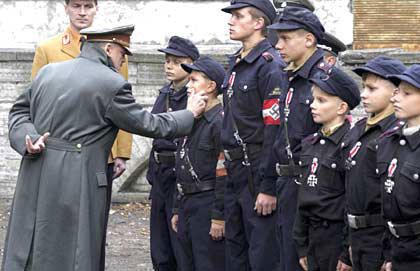
If I had to pick one to recommend above all the others, it'd be The Downfall (Der Untergang). That took a few days to get over.
Kung Fu Hustle
The Twilight Samurai
The Constant Gardener
Serenity
Bad Education
Downfall
Dig!
3-Iron
The Assassination of Richard Nixon
A History of Violence
The Aviator
2046
The Aristocrats
The Beat That My Heart Skipped
Wallace & Gromit: Curse of the Wererabbit
The Sea Inside
Broken Flowers
Sideways
The Machinist
Million Dollar Baby
Primer
Cache (Hidden) - opens in the IFI 27th January
King Kong
The Descent
A Tale of Two Sisters
A Very Long Engagement
The CorporationWorst of 2005
More than a few of these poisonous pieces of fosillized meso-stupid era Hollywood dog turds would have no trouble making the line-up in Worst of All Time List, should such a thing ever exist.
Especially Elizabethtown. That too took a couple of days to get over, but it was more like waking up to find yourself covered in your own shit and not having a clue how it got there...Kind of a thing that would stay with you.
Surviving Christmas
Alexander
Paparazzi
Darkness
Are We There Yet?
Deuce Bigalow: European Gigolo
Stealth
Elektra
The Island
Alfie
The Wedding Date
Elizabethtown
Cursed
Ocean’s 12
Brothers Grimm
The Pacifier
The Perfect Man
Hide and Seek
The Dukes of Hazzard
Bewitched
Miss Congeniality 2: Armed and Fabulous
Revolver
I don't want you to leave you with the foul hum of Guy Richie's bag of old kabollocks still in the air, so the best book about movies I read this year was The Stanley Kubrick Archives from Taschen and the best song I heard was "Let My People Go" by Darondo, from his soon-to-be-re-issued LP. Happy New Year.
Apocalypto Now
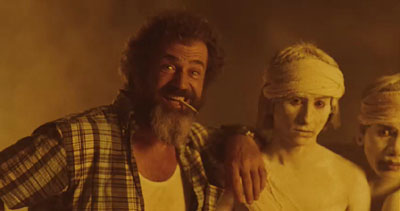
The first teaser trailer for Mel Gibson's Apocalypto is online. The new, aging Mel is some kind of something, but he's always had a reputation as a bit of a joker. The film might be about the bloody end of a Mayan society, but for now it just looks like a conventional enough trailer for a flashier take on John Boorman's Emerald Forest. Mel, (oh he's gas, Mel) won't actually appear in the movie, but does make a bizzare, fleeting appearance in the trailer (see the solitary framegrab above).
The sharp-eyed among you should go see for yourselves, wait for the second appearance of the white faced whatevers and use the Quicktime controls to find the frame he appears in. It's either that or play it a couple of times and blink quickly at the screen. I'm telling you, when he pops up, with the cigarette and the mad grin and the George Lucas directing plaid and the beard, it's weird. Does make you wonder how seriously he's going to treat the subject, maybe, a little bit? Can anyone think of another instance where an A-List director played a joke like this in a trailer? via Cinemablend
The Kingmaker
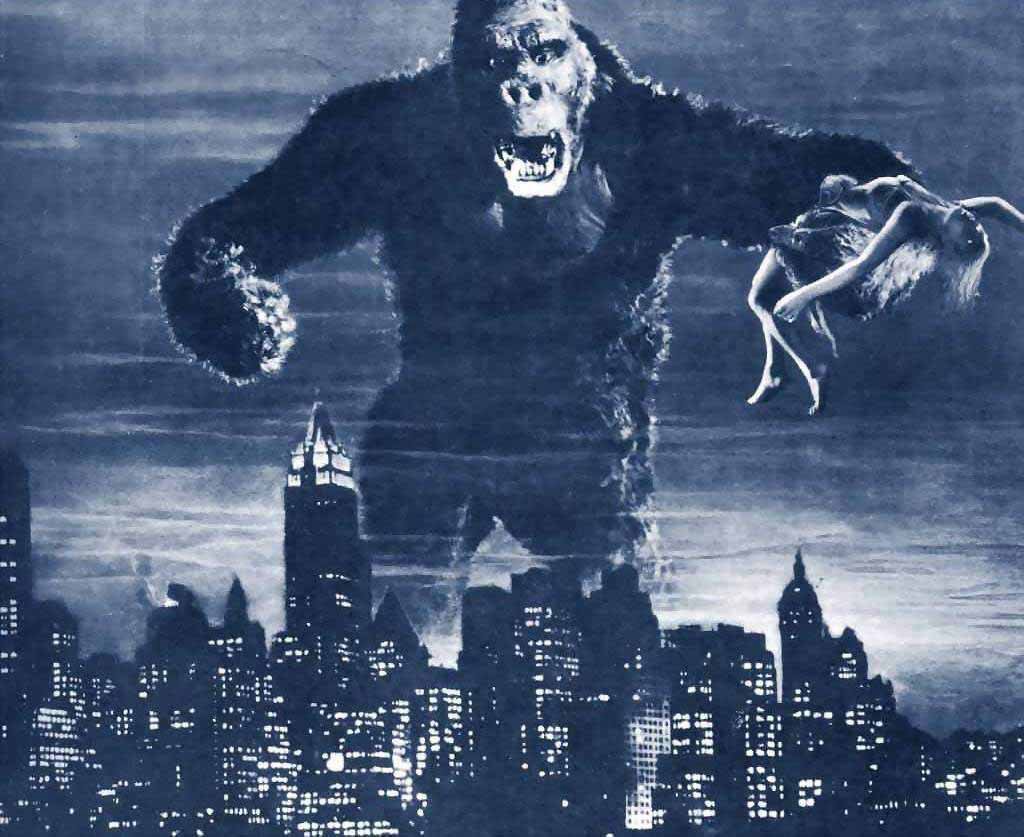 A big star needs a big picture, and Peter Jackson’s wonderful reworking of the classic monster movie King Kong is as big a picture as could possibly fit on a cinema screen. Over three hours long, bursting with innovative digital special effects and coming with a price-tag of something like €230 million; from the unexpected tingle that accompanies the period opening credits through to the famous final battle on the Empire State building, you get to thinking that they don’t make them like this anymore.
 As your eyes adjust to the dazzling widescreen vistas, Jackson fills them with a dizzying array of chasing monsters, blistering gunfights, bottomless ravines and instant, squishy death. An elaborate set-piece with a pack of stampeding brontosaurus decimating the crew follows hot on the heels of Kong’s first escape, with Ann Darrow in hand. Before you have time to catch your breath, three vicious T-Rex battle Kong (still gripping his prize) up a mountain and down a vine-tangled ravine. Jackson’s carte blanche even gives him the time and space to include his take on Cooper’s legendary lost ‘arachnid pit’ sequence – a terrifying scene where the jungle explorers are devoured by giant spiders that the original director removed for ‘pacing reasons’ – but chiefly because no test audience in 1933 could bear to watch it, and fled the cinema, making the rest of that film somewhat redundant. Although Jackson’s version of the deleted scene is scary, there isn’t a pacing issue because there isn’t time to think. It’s suitably icky, but is followed by an attack of giant vampire bats, then more explosions and finally, a chase that leads all the way back to New York and an appointment on top of the Empire State. It’s the finest hour in action cinema for decades and one you simply cannot miss.