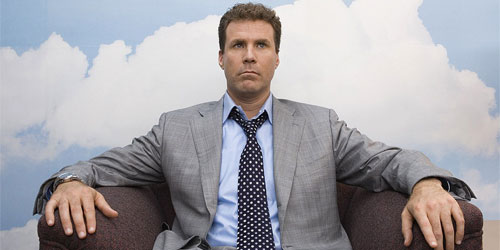
 Breathless comic Will Ferrell plays it mostly straight in Marc Forster’s enchanting modern-day fable Stranger Than Fiction, a brilliantly realised story of an ordinary man caught up in an inexplicable fantasy.
 Guillermo Del Toro’s extraordinary grown-up fairytale Pan's Labyrinth arrives on a wave of expectation, having wowed the crowd into a half-hour standing ovation at Cannes, in the process garnering the best reviews of the Mexican directors career, and it doesn’t disappoint. It is a hugely rewarding film; a rich, dark, meaty stew perfect for a long winter’s night. The story, written by del Toro, opens in Northern Spain in 1944, where we meet a young girl, Ofelia (Ivana Baquero), travelling with her pregnant mother Carmen (Ariadna Gil) from the city to the mountain headquarters of Captain Vidal (Sergi López), a Franco Nationalist on a mission to eradicate the local Republican resistance. Ofelia’s mother, recently widowed, has recently married the sadistic Captain, who has demanded she travel to the hilltop camp so his son can be born in his father’s house. Ofelia has brought her only possessions, illustrated books of fairy tales, although she has been told she is getting too old for them.
 Robert Altman, one of America's finest directors and a wilful, cantankerous son of a bitch, died yesterday in LA. He was 81. Like Hitchcock and Scorsese, he had been nominated for the Best Director Oscar a total of five times (the last being for Gosford Park in 2001), but never won it.
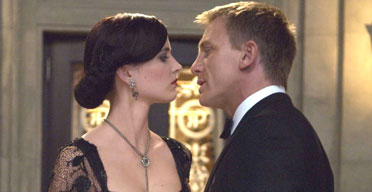 Meet the new Bond, same as the old Bond. Blonde British actor Daniel Craig might be the current incarnation of Ian Fleming’s super spy, with the filmmakers set on re-inventing the suave agent for a new generation but in Casino Royale, the much-heralded changes are mostly cosmetic. The 40 year old franchise is again produced by the Broccoli family, directed by Goldeneye’s Martin Campbell and written by veteran Bond team Neil Purvis and Robert Wade. With the success of Matt Damon’s Bourne films, Bond was forced to contemporise, but the more they change, the more things stay the same.
 Things fall apart for Liam O’Leary, a millionaire property developer when he meets his doppelganger while stuck in a traffic jam, a sinister exact double that insidiously takes over his life in John Boorman’s snapshot of modern life in Ireland, The Tiger's Tale. Obsessed with finding out who this man is, and what he wants, O’Leary’s personal and professional lives quickly spiral out of control, as the double moves into Gleeson’s bank account, opulent mansion, boardroom and his wife’s (played by Kim Cattrall) bed. Now the Pauper to the impostor’s Prince, homeless and broke, O’Leary takes a journey of self discovery in an effort to patch up his fractured sense of identity.

In Starter For Ten, working-class Essex-boy Brian Jackson (James McAvoy), has always been obsessed with trivia, growing up watching University Challenge on TV throughout the 70s and early 80s. When he passes his exams and gets accepted to Bristol, he leaves behind his widowed mother (Catherine Tate), and best friend Spencer (Dominic Cooper). At a fresher’s week party Brian meets the beret-wearing, right on Rebecca (Rebecca Hall, who also features in The Prestige). Just as something might happen between them, his head is turned by the snooty, stunning blonde Alice (Alice Eve), who is also his team-mate on the Bristol University Challenge squad. The story plays out against the background of the tricky TV quiz, as young Brian works out his priorities, romantic and academic, learning life lessons along the way.
 Brian Kirk’s gloomy Northern Irish gothic Middletown is the story of a squat, fogbound village, marooned in what might be the 1960s, visited by an avenging angel. Fifteen years before, young Gabriel Hunter (Tyrone McKenna) is told he has been called by God for a higher purpose in life. After a spell on the African Missions, Gabriel, now played by Matthew MacFadyen, comes back to Middletown to take over the local church, with his father Bill (Gerard McSorley), brother Jim (Daniel Mays) and his wife Caroline (Eva Birthistle) waiting at a dinner in his honour.
Daragh Carville’s screenplay begins as a drama about the chasm that exists between the ideals of a fundamentalist church and the reality of life as people live it, but ultimately wanders back to more familiar genre territory. Without some element of a personal history or any sense of humanity (even a simple mark like the ‘Love’ and ‘Hate’ etched on Robert Mitchum’s lumpy knuckles), Gabriel’s mission loses its spiritual dimension and becomes a procedural psychotic rampage. There are hints at a greater darkness, like a scene where the minister furiously scrubs his bare chest with wire-wool, but this territory isn’t explored in detail. There’s no mistaking Macfadyen’s blank-eyed conviction, whatever its source, but in the clunky melodramas that follow, he is a one-dimensional zealot, a stiff, lifeless cipher.
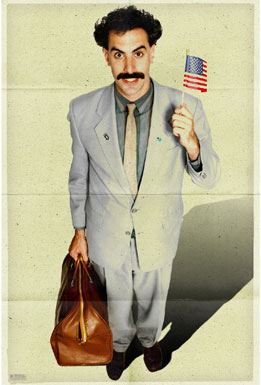 For those seven of you who don’t know, Borat Sagdiyev is the creation of British comedian Sascha Baron Cohen who, like his other alter-ego Ali G, makes the transition from small screen to big in the extravagantly, extraordinarily titled Cultural Learnings of America For Make Benefit Glorious Nation of Kazakhstan, but for those of you who remember In Da House, this time with considerably more comic effect.
Opening with a quick introduction to life in his impoverished village in impoverished Kazakhstan, proudly displaying his VCR and cassette player in the rundown shack he shares with a cow, Borat makes some quick introductions to his over-friendly sister, the fourth best prostitute in the country and his terrifying wife, who despises him, before announcing that the Ministry of Culture are to send him to make a documentary about the US and A. Enough of a storyline to satisfy our need for a consecutive narrative and sustain a stream of gags kicks in once Borat arrives in America, figures out the television in his hotel room and happens upon a rerun of Baywatch. The camera holds on his face, a picture of wonder, as Pamela Anderson bounces across the screen in slow-motion. Abandoning all other committments (the government, his journalistic integrity, the education of his nation), right there and then, Borat instead buys an ice-cream van and starts out on a road-trip, across the country to LA to find and marry the buxom babe with his flapping producer Azamat (Ken Davitian) and a huge brown bear in tow.
To further pile on the embarrassment there are a few no-holds-barred gross-out scenes. He has Western bathroom etiquette explained to him in detail by a Southern Belle and wrestles his despoiling producer naked through a crowded hotel lobby in a riotous scene, done in a single unbroken take. On the issue of anti-Semetism, Baron Cohen is Jewish, so is perfectly entitled to mine this seam for humour in the same way as, say, Tommy Tiernan casts his yellow eye on the Irish
UPDATE: Joe Queenan is a fucking idiot.
FURTHER UPDATE: Except for the opening paragraphs about Life Is Beautiful. He's bang on there, even if I don't really see the connection.
 Based on Peter Mayle’s 80s yuppie fantasy A Year in Provence and directed by his old friend and colleague in the advertising business Ridley Scott, A Good Year is a tired, predictable knockabout farce pushed beyond the point of blithe disregard by an atypical performance by the Gladiator star Russell Crowe, unforgettable for all the wrong reasons. His Max Skinner (played as a boy by Freddie Highmore) used to spend idyllic summers at his roguish Uncle Henry’s (Albert Finney) chateau and vineyard in Provence. Now, fully-grown but hardly matured, Max is a bond trader in The City of London, a high-flying millionaire and low-minded boor. When word arrives that Uncle Henry has died, Max takes off to France to settle his affairs, and sell his treasured home to the highest bidder, leaving Henry’s staff, Francis (Didier Bourdon) and wife Ludivine (Isabelle Candelier) out of a job and homeless. A convenient job suspension for insider trading keeps Max in Provence longer than he planned, but just long enough for the rural charm to cast its spell. Intrigue and romance arrives in the form of beautiful American girl Christie (Abbie Cornish), who says Uncle Henry was her father and who might stymie Skinner’s plans for a quick sale.

Opening on a static shot of the young princess supine on a chaise longue, wrapped in lace and surrounded by cakes, Sofia Coppola’s third feature, a kind of dreaming biopic of France’s ill-fated Marie Antoinette confounds expectations, being empty and superficial, but impossible to hate for all that. High-born in Austria, the innocent Marie (gracefully played by a childlike Kirsten Dunst) is married off to the shy Dauphin Louis XVI (Jason Schwartzman) in a match arranged between her domineering mother Maria Teresa (Marianne Faithfull) and the King of France (Rip Torn). Making the journey by coach to Versailles, the young princess is stopped at the border, in the first of Coppola’s more complicated and emotionally resonant scenes, to be divested of everything she owns, including her friends and her beloved puppy. On arriving at Versailles, the teenage princess is astonished at the opulent luxury of the court and troubled by the constant gossip and seemingly endless, incomprehensible protocol.
Without an heir, Marie’s situation is precarious; a fact she is reminded of in her mother’s regular admonishing letters, and the lectures delivered by her ambassador (a wry Steve Coogan). Later, her brother, the Emperor of Austria (Danny Huston in a cameo) arrives to lecture the distracted Louis about his husbandly duties and the two eventually have children. The third act has the increasingly rebellious Marie establish a hideaway in Versailles, a manicured rural idyll where she can raise her daughter and entertain her friends, including a half-imagined affair with a young Swedish soldier (Jamie Dornan). These episodes are languorously told, simple framed moments drawn out into lengthy sections, adding to the ethereal mood but short on drama, dialogue or incident. Critically, Coppola stops her story just at the point where the revolutionary mob (played mostly as noises off) are kicking in the door of the palace; preferring a poetic, symbolic bow on a balcony to showing the Queen’s final bow before Madame Guillotine.
 The History Boys, the film version of the multi-award-winning play by Alan Bennett reunites the cast and director (Nicholas Hytner) from the theatre production for a snappy trip down memory lane for the 1983 graduating class in a Sheffield secondary school. As the film opens, a small group of nine high-achieving students, having just received their A-level results, are gathered together by their headmaster for an extra term to prepare for the Oxford and Cambridge entrance exams in December.
 After mixed success with his two grand epics, The Gangs of New York and The Aviator, Martin Scorsese returns to the mean streets of the American gangster movie for The Departed, a loose remake of the labyrinthine 2002 Hong Kong cop thriller Infernal Affairs and one of the films of the year.
Both have the backup of their respective administrations; Damon’s police are led by Captain Ellerby (Alec Baldwin) and his undercover experts, Queenan and Dignam (Martin Sheen and a never-better Mark Wahlberg), while Di Caprio has to contend with Costello’s dangerous second-in-command, Mr. French (Ray Winstone) and two henchmen, Fitzy and Delahunt (David O’Hara and Mark Rolston). It’s a brilliant set-up for the tense, twisting, violent drama that follows; rich with the language and psychology of the streets and fused for detonation as each man becomes consumed by his double life, each trying to smoke the outer out and suffering the consequences of living under a death sentence. The two moles lives also intersect at the point of police psychologist Madolyn (Vera Farmiga), who starts a relationship with Colin at the same time as she starts to counsel Billy, who comes to see her as part of his parole.
Departed to the judgment,
A mighty afternoon;
Great clouds like ushers leaning,
Creation looking on.
The flesh surrendered, cancelled
The bodiless begun;
Two worlds, like audiences, disperse
And leave the soul alone.
Emily Dickinson [wiki]
 When Jean-Luc Godard resolved that his next movie would be about “a girl and a gun”, he was cracking wise about the conventions of gangster movies and at the same time coming to terms with the fact that in order to sell tickets, the filmmaker must give the public what it wants. So it proves in Oliver Stone’s World Trade Centre, which takes the true story of two policemen who were pulled from the rubble of the collapsed towers to fashion a mausoleum of faithful Christian heroes, substituting gat-toting molls for atheists and foxholes. From the bones of a story that everybody knows, we are presented with a flag-waving, overly sentimental film designed to help American audiences exorcise the ghosts of 9/11 without ever confronting the reasons why the catastrophe happened or how it brought about the War in Iraq.
 The world, the one you’re standing on right now, is heating up faster than a teenager’s face at a school disco, a process that means serious trouble for mankind. Now that is inconvenient.
Global warming is real, not the ramblings of tree-huggers. And it isn't a natural, cyclical phenomenon, we caused it to happen. A short twenty years from now, according to Al Gore in his brilliantly argued but terrifying documentary, An Inconvenient Truth, it’ll be too late to reverse its disastrous effects, meaning life for our children and grandchildren will be an distinctly uncomfortable prospect.
Director Davis Guggenheim’s documentary is, for the most part, a simple recording of the powerpoint presentation and lecture that Gore has toured the world with (on carbon-spewing aeroplanes, worryingly) for the past five or six years, enlivened by the addition of some robustly presentled statistics of doom, a few chucklesome, self-effacing jokes and long segues into biographical background details on the former US Vice President. If that sounds boring, the film is anything but – it’s as gripping as any horror movie with the difference being that this is real, and its denouement is imminent.
Practical information and more details on the film are available at the film's special website.
 Little Miss Sunshine, the Sundance-winning feature debut from husband and wife directing team Jonathan Dayton and Valerie Faris, takes a stock film genre, the dysfunctional family road-trip, and with the help of a razor-sharp script from fellow newcomer Michael Arndt, breathes into it new, albeit warped and sardonic, life.
The American everyman Greg Kinnear and the brilliant Toni Collette are Richard and Sheryl Hoover, a married couple barely holding everything together in the flat-pack suburbs of Albuquerque. She’s tired of trying, feeding the family take-out chicken on paper plates while he’s a failed motivational speaker. They have two children; teenager Dwayne (Paul Dano), who is devoted to Nietzsche and has taken a vow of silence until he is allowed to join the air force and the younger Olive (Abigail Breslin), a chubby seven year old who harbours dreams of becoming a beauty queen. Their grandpa (the extraordinary Alan Arkin) is helping her achieve this dream, in between hits from his heroin stash. When Sheryl’s brother Frank (Steve Carell), a literature professor, fails in a suicide attempt and has nowhere left to go, she takes him in, completing the dysfunctional clan. All they need now is something to do; which, when another kid drops out, takes the shape of a cross-country road trip to take little Olive to the titular Little Miss Sunshine pageant in California. With little money, they pile into the family van and hit the road.
 Crank, I am assured, is American street slang for methamphetamine, making it the perfect title, never mind prerequisite, for this blistering action movie which takes us through the last day on earth of an ex-pat British hit-man. Jason Statham, who has made a career out of these tough-guy chase movies following The Transporter, plays British hit-man Chev Chelios, who wakes up on the day in question with a bit of a problem. Local Chicano gangster Ricky Verona has taken umbrage with Chev eliminating a Chinese drug runner, and has administered a dose of ‘Beijing’ poison while he slept. According to the DVD message Verona leaves behind, Chev only has hours to live and there is no antidote. Already struggling, our anti-hero makes a run for it, believing there must be some way to stay alive or at least exact an excruciating revenge on his tormentors. His medical pal Dr Miles (a deliciously sleazy Dwight Yoakam) is stuck on an airplane, but tells him that the only way to keep breathing is to maintain the adrenaline level in his body until he can attend to him. Cue deliberately dangerous manoeuvres on Chev’s part as he screeches around LA, with the requirement to stay buzzed matched by the desire to avenge his own death. Meanwhile, the army of gangsters are furiously trying to finish the job, Chev’s pot-smoking surf-girl girlfriend Eve (Amy Smart) is along for her own safety and the cannon-fodder cops are closing the dragnet, following the eye of the hurricane.
 Michael Douglas leads the line in The Sentinel; a dull, formulaic political thriller that gives the surgically-elevated grandfather another opportunity to race around in a dark suit, shouting important-sounding things into his cuffs and shooting off guns. He plays Secret Service agent Pete Garrison, who in 1981 took a bullet during the assassination attempt on Ronald Reagan and is still guarding current President Ballentine (David Rasche) 25 years later. Garrision’s duties also include tending to the First Lady Sarah (Kim Basinger), with whom he is having an unlikely but passionate affair, under the noses of the crack security team and the world’s press.
 From crashing the wedding to crashing the honeymoon, Owen Wilson continues his one-man assault on the funny bones of the world with this middling ménage-a-trois comedy, which might be underwritten and derivative but still provides a fine platform for the golden boy’s easy charms.
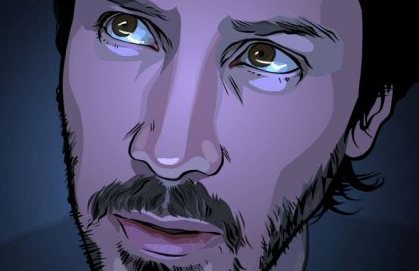 Richard Linklater is for me, one of those hit or miss filmmakers but regardless (- I have to stop myself going into my anti Before Sunrise, Before Sunset rant here. Give me a minute-...) one with the ability and determination to make his own personal, experimental films, like them or not (-deep breath-) while at the same time crafting slick commercial entertainments like School of Rock. Thankfully A Scanner Darkly is a hit, but a perverse one. A meditation on the nature of addiction and perceptions of reality presented as a paranoid, psychedelic freak-out, Scanner Darkly is real, surreal and hyper-real and all at the same time. It’s as close as science-fiction cinema has come since Blade Runner to capturing the vibrancy, intensity and complexity of Phillip K Dick’s fiction. That it achieves this while being made more linear and accessible and frequently very funny, marks it out from the crowd of others that have tried and failed to translate Dick’s warped, wild visions into ‘must-see’ cinema.