Niall Heery and Small Engine Repair

Niall Heery, director of the new Irish film Small Engine Repair, looks like he could do with an oil change himself. After a full day spent talking to the press, the 33 year old Dubliners long face has a weary cast and his drooping eyes are ringed with tired smudges. As we sit in the bright, airy library of the Irish Film Institute, it might not help matters that my first question asks him to recall his film’s long journey to the screen. “Yeah”, he says, with a blink and there’s a momentary hesitation while he gets his timeline arranged in his head. “I wrote the script maybe four or five years ago, and like you say, it took a long time to get it off the ground. I had completed two or three drafts when I thought it was in good enough shape to approach Subotica (the producers, whose track record includes Song For A Raggy Boy and the TV series Proof). Thankfully, they expressed an interest in it and they were confident they would be able to make it happen quite quickly. That’s not really the way it worked out, mainly because I had no track record in feature films and I had never directed before.”

Heery, who got his first start in the industry as an assistant to Antoine Fuqua on the big-budget King Arthur and subsequently directed shorts and a couple of music videos, knew that pulling a €2.5 million production budget together was going to be a challenge. “Even though four years seems like a long time, it’s not unusual in film to have that kind of gap between the initial idea and an audience sitting down to watch it, and in a funny way it was time well spent because it gave me the time to work on the script. When I made my first approach, to be honest, it wasn’t like everything was ready to go. It did need work and it did change somewhat over that period of time. When I first wrote it, it was called In Like Flynn and there was more comedy in it, but as I got into the characters and the situation they find themselves in, I found it had edged towards a more human drama.”

In the film, which took it’s new title from a Tom Russell song, Iain Glen plays Doug, a shy, timid man who dreams of becoming a country and western singer. Having lost his job, his home and his wife Agnes (Kathy Keira Clarke) in quick succession, Doug is at a crossroads. Together with his best friend Bill (Steven Macintosh), he puts together a demo tape of a few songs and plays a gig at his local pub. In the process of overcoming his own troubles and confronting his fear of failure, Doug realises there is a place for his ambitions and his creativity outside of the claustrophobic community. “I always saw the movie, on a basic level, as a buddy movie”, Heery says. “And I always saw these characters as being immature. When I looked at the relationships between them, they weren’t those of middle-aged, well-adjusted men, as I know them. I thought of teenagers, or younger men in their twenties. Its like they have been arrested, and become almost stagnant in this small, enclosed world. They haven’t had the opportunity to progress as people”.

For his debut feature, Heery says he was determined to assemble the best cast he could, no easy task first time out and a process he says he found fascinating. “Especially finding Doug. I would talk to actors and they’d be interested in the role but the whole music element was a worry. It had to be somebody who was excited about expressing themselves musically, because otherwise it would become a chore for the actor and I didn’t want to dub the songs either. A friend of mine suggested I watch a film called Silent Scream, a biopic of a guy called Larry Winters, that David Hayman had made back in 1990. Iain plays the lead and in the final scene we see him in a jail cell, singing and playing the guitar and he’s really, really, good. I had been talking to him about playing another role, the town bully Burley, and he had shown an interest. But after watching that movie, I mentioned playing Doug to him and he was ecstatic. He said that when he read the script, it was the part that had jumped off the page, so he had that enthusiasm I was looking for and of course he can really sing and play so it came together for us very naturally in the end."


One of the most striking aspects of Small Engine Repair is that it refuses to represent the movie Ireland of Darby O’Gill, a verdant, craic-filled Tír na nÓg of high-kicking maidens and turf-slinging sleveens. Heery says this was a conscious decision that had its origins in the melancholy songs he chose for the soundtrack. “In terms of the landscape, I could have gone for a more traditional, rose-tinted representation of the Irish countryside but that just wasn’t exciting for me, especially when I thought about the nature of the story and the characters themselves. I saw Small Engine Repair as an opportunity to do something different, so I decided early on to filter that mournful American folk music ethos through the place I had written. So I ended up with a world that wasn’t intrinsically Ireland as we know it, and at the same time certainly wasn’t American, but was its own kind of universe. That felt like a comfortable place to set this story.”

Citing Willie Nelson and Kris Kristofferson as musical influences, Heery never thought he was making a musical, but telling a story that was both inspired by and told through songs about heartache and loss. I ask him which came first, the songs or the scenes. “I would say that, by and large, the scenes came first and while I was writing it I had ideas for songs that would fit, that would go with the images that I was putting down. It developed over the years. For example there’s a song by the Willard Grant Conspiracy called ‘The Suffering Song’ that features in the scene where the guys are driving to the first gig in the pub, and that was a song I knew, I mean it was very clear in my head, should be there for that moment in the film. When I was writing I was very aware of the music, because a lot of the heartache the Doug goes through – he loses his wife and his job and he feels hopeless and afraid – are almost clichés in country and western. His dog doesn’t die, but only because he doesn’t have a dog. I was confident though, that I could put all of that in an entirely different format, and have it feel fresh again through the nature of the film-making process”.

The unnamed town is a place almost entirely without women, and the one woman we meet, Doug’s wife Agnes, is sneaking around behind his back. Heery explains his choices, saying he hopes that absence can be felt. “I always thought that these characters behaved in the way they did because they had no women around them. Doug spends a lot of the film trying to win his woman back. Bill, at least in my head, is a guy who has never dealt with the fact that his wife had left him. That’s something we don’t deal with in terms of the story, but it speaks to how he behaves. This is a film about men, but its also about how they cannot exist in isolation”. It’s a theme that makes the film occasionally frustrating to watch and adds to the mood of helplessness and vulnerability. Doug in particular is a character that, the more time you spend with him, you feel the desire to slap him out of his stupor. “Yeah, but that’s the split in the guy. He’s a good man, a good soul, but at the same time he has no motivation, no ambition and totally lacks self-belief. And that feeds into the problems he has with Agnes; she’s been living with this guy for a long time and he has become increasingly difficult to be around. So, I would like to think that when we pick up their story in the film, she’s at the end of her tether. She’s been with this guy for ten years, and it’s taken it’s toll on her and you can sympathise with that”.

Before it’s Irish release, Small Engine Repair has been shown at festivals all over the world, winning a guitar-case full of awards including last year’s Galway Fleadh and a breakthrough award at this year’s IFTAs. I ask him about that response, which must be as overwhelming as it is heartening. “Yeah”, Heery agrees, his face showing just the right mix of pride and modesty. “It helps the film along enormously. When you’re making low-budget, independent films, it’s almost impossible to get distribution. Changes in technology mean it’s easier, and I use that word carefully, to make films but because there are so many more films out there, its increasingly difficult to get distribution. Winning awards is great, really it is, but what it boils down to is that more people might potentially see your film."

Heery had been present at the Nashville film festival just a week before to pick up a double award for the film, including an audience award for best film. I ask him about the process of selling ice to the Inuits, or Stetsons to cowboys. “I had been to Nashville once before, kind of as research, and I said to myself that if I ever eventually got the film made, I would bring it back. A lot of the musicians on the soundtrack were from Nashville, and its where they would have originally recorded the songs, so it was something that excited me”. As we wrap up, I ask Heery if he’s been to see Once, and he admits he hasn’t yet but is looking forward to seeing it. We talk for a couple of minutes about how the two films are superficially similar being Irish-set musicals, but are very different both in tone and theme. Heery says he is delighted at the success of John Carney’s film, which is still showing at the US box-office more than two months after a low-key opening and tells me that Small Engine Repair, likewise, has secured American and international distribution. “We open in the UK in September, and then across the US towards the end of the year. That’s very exciting, obviously. Before Once, low-budget Irish films haven’t been all that well received in the States. That’s not to say that this one will be but I like to think that they will understand it and recognize where it’s coming from. Where it’s heart is.”

Harry Potter And The Attention To Detail

From the outside, there isn’t much to get excited about when you pull up at Leavesden Studios, a squat, post-industrial spread of concrete and glass on the London road outside Watford. Inside, it’s a different story. The old Rolls-Royce factory has been home to the Harry Potter films since 2000 and, even allowing for the excitable hyperbole that sometimes infects movie journalism, this is a wonderland filled with indescribable glories.

I’ve just watched Brendan Gleeson shoot a scene with newcomer Natalia Tena (who plays teenage witch Tonks) – a simple set-up where she opens the door to Harry Potter’s suburban bedroom and they share a couple of lines of dialogue. Tena waves her wand around, to Gleeson’s comical annoyance, the blue bulb at the end washing the boxy set in a ghostly glow. As a courtesy, Daniel Radcliffe is hunched down beside the camera, running his lines and offering his fellow actors something to play against. Order of the Phoenix director David Yates pops around the door to give the players a few whispered notes, adjusting their pacing and positions while the cinematographer checks the lighting and waves his script through a few wisps of movie smoke. Gleeson leans against the door jamb on the perfectly realised set, elevated on stilts over the studio floor. His laugh booms across the sound stage, over the bustling crew and squawking walkie-talkies. As I sit on a stool beside a bank of plasma screen monitors, trying to take it all in, a tall man strides past in a luminous turquoise cape, scattered with embroidered golden stars. In a far corner, a handler smoothes the feathers on a brilliant white owl as it hops on his outstretched arm. It’s yellow eyes are as wide as mine.

The scene completed to everyone’s satisfaction, Gleeson weaves through the throng in his Mad Eye Moody costume, a carefully assembled dishevelment of heavy trousers and vest under a couple of matted coats, his long ginger hair on end. There’s the unsettling bonus of his character’s bright blue wandering eyeball still strapped across his face. It jumps around with a life of its own as he arranges his attire and sits down. I ask him how the effect works and he looks at me with the good eye. “Magic”.

Gleeson’s Moody is an Auror, a kind-of policeman charged with protecting the schoolboy wizard and capturing those who break the law. He is a tough character, gruff and direct, and Gleeson plays him with an obvious relish. “Moody is such a daft creation, a bizarre character really, so he’s always going to surprise you. That’s the real fun of it.” At the start of the new adventure, Moody and his lieutenants rescue Potter from the threat of the soul-sucking Dementors who have tracked him to Little Whinging and, after mounting their broomsticks, return him to the safety of Hogwarts. “There was a lot of people who thought Moody would be killed off at the end of the last book”, Gleeson says, “and I’m certainly glad he wasn’t. There were aspects of him that were being taken over by the events around him, so hopefully this time it will pay off in the sense that I know who he is. Moody is in the next movie too (The Half Blood Prince) and I from what JK Rowling has been saying, he’ll make an appearance in the finale. It’s getting to finish the story out and see where everyone ends up, that’s what’s driving everybody. I’m very glad to be a part of that”.

As we’re talking, the publication date for the seventh and final book, The Deathly Hallows, is still months away. I ask Gleeson if he has any thoughts on how this phenomenal series will wrap itself up? “JK has been flawless up to now, so I trust her to do the right things. In a way, Moody was all done in the last film, so it’s more about where is he going to bring me. I wouldn’t feel right dumping him half way and I want to see for myself where he ends up”. I point at his impressively detailed coat and enormous boots and ask how the costume helps with creating his character. “Well, the original designs were far more complicated, with a mask and computer effects, but there didn’t seem to me to be much point in doing all that. They could have done it all on a computer and had the same result. So we’ve tried to keep it some way recognisable and something I can work in for the day. We get to keep the actor in there, under all this stuff, and that’s important.”

And out of the costume, does he get recognised as Moody? “I’m a very boring man in real life. Honestly. I prefer to keep the kids in particular from being disappointed if they meet me. I remember when I played the Cowardly Lion in the Wizard of Oz years ago in panto. People would bring kids backstage and they’d see me sitting there with the head on the table, face red after sweating for three hours. I could see their faces fall at the realisation. Kids will have bought into the character, not the actor playing the part. That’s one of the great things about this whole series, that kids have been inspired to believe in it. So when people ask me, well, how did you do this or that, I try not to explain, like you asking about the eyeball. I could tell you, but I feel I owe it to people to let them wonder.”

Wonder is the word that sticks in my head as the studio publicist gathers the assembled journalists together and takes us on a tour of the sets. First stop is Dumbledore’s office, a recurring set that is kept dressed throughout production. Familiar from the movies as a book-filled, two-tiered room, still only a fraction of the set’s microscopic detail makes it onto the screen. Every surface is covered in props, vellum-bound volumes, hand-written letters, copies of the Daily Prophet, all unique. Two shelved walls are full of ornately crafted brass astrolabes, from ceiling to floor. Walking up the stone steps to the upper level, I sit behind the headmaster’s heavy wooden desk, scattered with magical ephemera; papers, quills, talismans. I open a drawer at the front. It is filled with more props. Although there will never be a scene where Dumbledore fumbles in a drawer in the seven films, the publicity people tell me the art department like to fill the drawers and cupboards with stuff to help the actors feel like they are in a real space. For an outsider, it is a disconcerting sight that hints both at the extraordinary skills of the art department and their obsessive immersion in the fantasy world of Harry Potter.

Our guides walk us through the labyrinthine warehouse of old sets and props, connected by broad pathways with taped off cycle lanes and painted directional arrows. Here, every single item ever made for the films – from Ford Anglias to carved stone gargoyles - is catalogued and stored, ready for shipment to Florida for the Potter theme park once production is completed on the series. As we walk, our guides fire statistics about the production over their shoulders: the whole backlot is spread over 85 acres. Before Rolls Royce, it was a military airport. There is half a million square feet of studio space, where around four hundred crew members work at any given time. There can be another four hundred extras on set for crowd scenes. There are almost ten thousand costumes in a series of wardrobe rooms, somewhere out back.

We stop outside the set for the atrium of the Ministry of Magic, which they tell me has taken three months to build. The green painted floor is still wet, so we can’t walk through. “We use forced perspective to make it look bigger than it really is”, they say. It’s still huge, an indoor cathedral that stretches to the back wall of the studio and is immaculately detailed. Down another corridor, past the Great Hall, being prepared for a feasting scene, I turn a corner and am confronted with an astonishing set – thousands of glittering black tiles completely covering a vast, circular room. There is a pile of black rock built up in the centre, where art department technicians are putting the finishing touches to a towering archway. This will be the setting for one of the film’s climactic battles, between Dumbledore’s army led by their emerging hero Potter and the forces of darkness led by the pernicious Lucius Malfoy. Just to one side, two sculptors are sizing up a twenty foot block of polystyrene, using a thin, red-hot iron rod to score the outline of a centaur on it’s knobbly surface. One of them shows me the design for the finished statue, which will be painted gold and placed in the centre of the atrium set. When I pass by again later, the piece is nearly complete, a perfectly rendered half-man, half-horse rearing out of the lumpy material. Covered in flecks of dust, faces set in concentration, their pride in their work is obvious.

Throughout the tour, which took us from the mock-suburbia of Privet Lane in one corner of the studio, to the chilly mortuary of the Black family home, the predominance of shadows, soot and black lace hinted at the dark days that Potter faces in his fifth adventure. Not that you’d realise that from the bright, smiling Radcliffe, as he bounds across the studio floor barefoot in a loose-fitting tracksuit. The boy who became Harry Potter is all grown up now. Not up in the vertical sense, like most actors the young star is just about average height, but when compared to the ten year old that first waved his wand in The Philosophers Stone, Radcliffe, with a faint trace of teenage stubble tufting his upper lip, looks like Harry Potter’s uncle, one who might spend his weekends in the garage with his amateur rock band.

In this film, Harry and his friends are starting their transition into adulthood and are dealing with increasingly serious and significant issues. Not only does Harry have to stand trial for using magic outside of Hogwarts, he must raise and train an army from his classmates to battle the returning Lord Voldemort. There’s also the threat from his new Defense Against the Dark Arts teacher, Professor Dolores Umbridge, who has usurped his beloved Dumbledore and brought regime change to Hogwarts. I ask him about the changes in his character, and how he dealt with the onset of maturity. “I haven’t analysed it really. I hope I have gotten better, because that’s the one thing I try to do between each film. At this point we have all grown up, and so the films have to be grown up films with grown up performances in them. That’s what I’ve been striving for. The fourth film was really fun to play, full of spectacle and amazing set-pieces, even for me. That’s great, but what is exciting for me now is that I get to grow with Harry. Personally, I would much rather do an emotional scene with Gary Oldman (who plays father-figure Sirius Black) than fight a dragon or something, you know?"

Radcliffe, all polite enthusiasm, bobs his head a lot and emphasises his positive message with smiles and nods and strident hands. After Rowling, he is the most important person in this billion-dollar enterprise. He’s seen directors come and go over the past seven years, so I ask him how he is getting on with the new one, David Yates. “It wasn’t a massive readjustment. He’s an easy guy to get to know, sure of what he wants and able to communicate that. He’s a fantastic director and we are having the most fun on this movie because, at least I hope, I’m at a point in my acting where I can be pushed further. David seems to be relishing that opportunity to really challenge me, so this has been the best time so far out of all the films. How does that challenge come about? “Well, If I think I’ve done a good take, David might whisper in my ear that he thinks I can do better. It’s not a demand, you know, but he isn’t willing to settle for less. He doesn’t want good, he wants really good and honest and subtle and real.”

Although the teenage celebrity Radcliffe is bound to have kissed a few girls at this stage of his life, his character up to now has been chaste and pure. In the new movie, he falls for Cho Chang (Katie Leung), a fellow student who joins his rag-tag army. “I have a bet on with my publicity liaison for how long it takes that question to appear in interviews. It’s usually first, so you’re being reserved by comparison. It was fine, good, er, you know. Ahem.” Radcliffe reddens and looks at his toes. This is before he stripped off on the West End stage for Equus. “Any actor will tell you that it’s like any other scene really, because there are hundreds of people around. At first I did feel really nervous because it is a bit odd, a bit strange, but it is such a clinical, professional process that after five takes there is nothing exciting about it.”

The blush proves that the seventeen year old Radcliffe is still very young. Does he have any ideas for the future, once the final film is made and a new phase of his life and career begins? “I won’t be going on to university, I don’t think. Most people go to college to find out what it is that they want to do, and I know already, or I have a pretty good idea at least. If I wanted to be a physicist, I wouldn’t have an option, because you can’t teach yourself physics. But the subjects I love are English, religion and history, and those are the kinds of subjects you can take away and read about by yourself. I’m not a religious person, at all, but I am very much influenced by the philosophical side of it.”

I tell him I find that interesting, when you consider how steeped in old ideologies of good and evil the books and films are, but Radcliffe doesn’t agree. “To me, Harry suffers a loss of innocence. Obviously the battle between the forces of good and evil is there, and that’s something people can relate to, but I see Harry as being a boy who doesn’t know the truth about who he is or anything about his heritage. He goes from the real world, where he is being mistreated and bullied, into the wizard world, where life at first is fantastic and magical but where bad things can happen just as easily. And life can be a lot worse than what happens in the world outside”.

Having wandered this enormous, close-horizoned space for a day, it’s easy to forget there is a world outside. Radcliffe nods and laughs. “I take all this for granted, walking around the sets and watching the shots come together, but I know it can be a shock for outsiders to come in and see what it is we’re doing here and how it all comes together. I see it every day, so I hardly notice it. You forget just how incredible and beautiful this place is. But after you’ve sat in the Great Hall for two weeks under hot lights, with lines to remember and marks to hit and disintegrating food props in front of you, you get a different perspective.”

Some Like It Fuzzy

“What are we doing?” asks Nick Frost. “It’s an interview for a newspaper that has expressed an interest in a film we made called Hot Fuzz”, replies Simon Pegg. “You remember that, don’t you?” “Er”, says Frost, with worrying sincerity. “Doesn’t matter, say what you like”, replies Pegg, the practised straight-man, spinning it out. “If we just talk over one another, it’ll be impossible to transcribe anyway”. “Ah yes,” Frost says, lapsing into Pegg’s clipped accent. “We used to have this thing with our families where I’d phone my mum, say, put the phone onto Simon halfway through and he’d ask her questions about girl’s parts or whatever.” The two collapse into giggles. “She never once twigged”. If their own mothers couldn’t tell them apart, what chance do I have? Add that to the fact the two have been best friends since they met fifteen years ago, speak in the same elaborate language (pop-references, jokes, semi-serious actor-speak) and share a boundless, bouncing enthusiasm, further limits accurate attribution. I did my best to sort out what I could, with the help of a follow-up session with their only slightly less ebullient director, Edgar Wright.

Loosely, the story of Hot Fuzz is what happens when an overachieving cop, Nicholas Angel (Pegg), is forcibly transferred by top brass (“You’re making the rest of us look bad”) from the thick of it in London to the sticks of rural Somerset. In the country village of Sandford (the name comes from the fake town where the real Met train) Angel is partnered up with simple-minded local copper Danny Butterman, played by Frost, Pegg's best friend, as outlined above; best man at his wedding and constant co-star from sit-com Spaced to Shaun of the Dead. Soon after Angel’s grim-faced arrival, a series of grisly accidents rocks the village. Angel is convinced that the villagers are hiding a dreadful secret and as the intrigue deepens, Danny’s movie-inspired dream of an action-filled adventure becomes a bloodthirsty reality. Pegg, who again co-wrote the screenplay with Wright, describes the movie as “a cross between Midsomer Murders and Lethal Weapon”. “We wanted to do something that was an evolution from Shaun of the Dead; taking what we’d done there and run with it a little bit. Edgar had done some amateur cop movies when he was very young (he’s only thirty now) and filmed them where we ended up shooting, Wells in Somerset which is where he grew up. So he had all these unrealised ideas from back then and we wanted to do something that grew out of SotD. Something, you know, bigger”.

“That turned us onto the idea of doing an action film, a traditionally American genre” (“Or Chinese” stage-whispers Frost. “The French have done a few). “OK, a traditionally international genre, but set it somewhere very parochial, in the heart of Middle England. A hybrid of small town cop story and insane action extravaganza”. From there, Pegg and Wright started to think how to re-imagine the idea of the British police service, “making these Dixon of Dock Green characters into Schwarzeneggers, with guns and guts.” Pegg, who has been in a couple of other movies since SotD, including a spot in Mission Impossible III opposite Tom Cruise, found Nick Angel to be the hardest role he had ever done. “Because I have to fight every instinct I have in order to play him. He’s so straight, he’s like a robot. We had this idea of making a super-cop, like the T-1000 of The Met. This guy who is morally uptight, totally hampered by his own belief in proper procedure and it takes moving to a place like Sandford for him to work all that out. He has to learn to be a human being throughout the film, which is what he learns from Danny.”

“That’s the whole journey”, says Frost, “but there are more jokes”. “I came up with the name Danny Butterman ages ago”, the actor explains, rubbing his formidable belly, “because it seemed like such a good fit for a guy I’d play. If I’m a good boy, they let me have things like that”. Much more so than the uptight London super-cop, the unsophisticated, unfulfilled Butterman is the film’s identifiable, every-man character. Frost says he doesn’t mind in the slightest that he’s not involved with the writing process. Before Pegg and Wright finalise the script, the three spend a couple of days going over it. “If I have something to bring to it, and we agree it works, we’ll do it”. Pegg says they spent a long time deciding on how to follow the success of their zombie comedy. “We didn’t want to rest on our laurels and assume that whatever came out of our pens was going to be great. We really wanted to try and improve and evolve as writers and actors and directors. We couldn’t have written Hot Fuzz, never mind making it, before SotD, because everything we learned on one went into the other”.

Part of that learning curve was avoiding the temptation to cash in on a quick sequel to SotD, the cheap and funny movie that wildly exceeded expectations, going from cult to mainstream, especially in the US. The success led to a long courtship from the major studios for Pegg and Wright (Hot Fuzz is a Universal Picture), but the actors are more interested in recalling their cameos in George A Romero’s remake of Land of the Dead, (which both describe as the “ultimate thrill”), than big-money offers. “We were never going to do Shaun 2: Electric Boogaloo”, says Pegg, emphatically. “I think you can retroactively spoil a good movie by making a sequel because when you end it, as you must, you run the risk of ruining the first one. Take Jaws. If you believe in Jaws, you have to believe that at some stage he is going to end up in the Caribbean fighting Michael Bloody Caine”. “The classic one”, says Frost “is going from Aliens into Aliens III. Cameron’s is a great sequel because it turns the whole thing around and goes from a monster movie into an action movie. But in Alien III, the two people Sigourney Weaver has been breaking her neck to save die in the first five minutes. You watch it and think, well, she might as well not even bother. They’ll be dead on that prison planet in a few years. May as well just go back to hyper sleep.” At this point, the two slip into a longish, well-trodden private argument debating precisely how the first Star Wars trilogy was ruined by the second three. In short, Pegg and Frost are nerds. “We don’t use the ‘n’ word, we prefer the term geeks”.

“We have always been aware of our geekdom and have learned to embrace it”, says Pegg. “The whole of Spaced (the brilliant Channel 4 sitcom that was their first collaboration) is basically saying, ‘don’t worry about being geeky, it’s fine’. Being a geek is just about being enthusiastic and having a more developed sense of attention to detail.” The merest hint of a tone has wandered into Pegg’s voice, so I assure him that I wasn’t passing judgement. “The geek community know what they love and they really, really love it”, says Frost. “We went to the comic conventions for Shaun and for Hot Fuzz and say what you want about them, but they’re a great audience”.

Typical of the two actor’s shared, unashamed geekiness, they are fond of putting things in their correct classifications and giving their pop-culture findings catchy names. For the film’s half-way change of tone they invoked what they refer to as Bruckheimer’s Law, after Jerry, the arch-duke of high-concept pyrotechnics. “Well I say law, but it’s really more a set of rules derived from the application of Popcorn Logic”, continues Pegg as I nod, understandingly. “As you might discern, we spend a lot of time sitting around watching films. For the purposes of Hot Fuzz, we’re trying to get the right ear for the language of them, to look at the alphabet of the genre – what are the clichés and which of them we want to include. Then, we write it out and hopefully, make it funny, but the point is that logic goes out the window in an action movie like this. So, when the time came to explain something away on set, that was the term we used, Bruckheimer’s Law. Things like not having to observe the elementary laws of physics or human physiology. Or never having to reload your gun”. Wright explains how this model of filmmaking fits, saying Hot Fuzz is “about wanting to make a film that was resolutely parochial English but inexorably became something unmistakably Hollywood. And as it does so, it starts to take on all the attributes of both types of films. We start tight and repressed and finish loose and mad as hell. Our film mutates from this pastoral comedy into this loud, chaotic beast of a stand-off; a mini-Armageddon.”

All three of them are obvious fans of the genres they adapt into their own comic universe, zombie horrors for SotD and action blockbusters for the follow-up. “Hot Fuzz is definitely a tribute to those kinds of movies”, explains Pegg “but we’re referencing the whole genre, I suppose, rather than specific films. Except for The Wicker Man and Bad Boys II and Point Break”. “And Supercop and Rambo and Lethal Weapon and every one of John Woo’s films“, says Frost. “Yes, um, but I’m talking about stuff like how the bad guy will always get up again after you think he’s dead, and when someone speaks into a microphone in a public place, you’ll always get feedback. It’s the familiar shorthand for action movies and we had to learn that; know how to place those elements in the movie”. “Like a mathematical formula, or a magic spell”, says Frost, wriggling his fingers.

“But going back to all those references that I made a point of saying we didn’t want to make a big deal out of”, Pegg continues, “The Wickerman was a real starting point for us. We watched a lot of movies about small communities and we thought that this uptight cop coming in from outside was a great place to start for comedy. The idea of casting Edward Woodward came later, when we thought it’d be great to offer him a part. When we were writing, I always pictured Skinner as looking like Timothy Dalton with a moustache until the thought occurred, why not ask Timothy Dalton and, if we’re lucky enough to get him, ask him to grow a moustache?”

Later, director Wright gets very excited when talking about his cast, describing it as a dream ensemble and listing them one by one with a superlative in the middle of their names. He also gets very animated when mention is made of the top-secret cameos in the film, inserted “for our own entertainment, really, not credited”. The first one arrives in the opening reel and features an Oscar-winning actress. I had an idea who it might be but Wright, who congratulated me for getting it, but asked me not to reveal it, maintained there’s another “very high-profile” actor in Hot Fuzz. “He makes a fleeting appearance much later, and he is just as well known. I think of the cameos as little rewards for sharp-eyed viewers.”

Wright might love his in-jokes, but he respects his genres. “There’s a big difference between celebrating something and taking the mickey out of it. Tarantino truly loves his inspirations and it shows but somebody like the makers of Scary Movie or whatever, don’t. And it shows too. We want to exalt! Enthuse!” Pegg puts it another way, saying that any interest in the types of movies they’re paying homage to will add to the whole experience. “We always throw stuff out there that deliberately plays to that side of the audience. I think it’s important to have that level of interaction in a film that’s made, really, for the audience. It changes it from being just something to watch into something that allows the spectator to make connections. It’s more enjoyable, like that, joining the dots”.

I tell them that having watched the movie, all the scenes of sitting around, eating cake have a real-life feel to them. “Well, yes”, admits Pegg, “pastries and ribald talk are essential to the process, but the whole thing about the cake in the movie, as with a lot of the language and the more absurd events, are that they’re based on our research. We spent a lot of time with real cops. The escaped swan is, word-for-word, a real story. Having to buy cake for everybody when they mess up, that happens all the time”. “Not only that, there are different grades of cake for different indiscretions,” says Frost. “A misfiled arrest report might mean a tray of éclairs. Wrongful arrest, a couple of Black Forest Gateaux”. If Hot Fuzz has a message at all, according to Frost, “it’s something like what Danny says to Nick during the couch scene, ‘sometimes you’ve got to just switch off’.”

Oscar Nominations

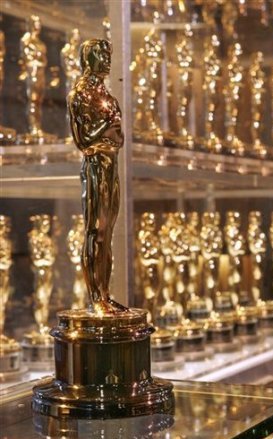
There weren't that many surprises in the list of films nominated for the 2007 Oscars when Salma Hayek and some grey-haired suit took to the podium at an ungodly hour of the morning and read the lists off the autocue through sleep-glued eyes.

Perhaps the biggest story is the 8 nominations for Dreamgirls (which I saw this morning and was more or less impressed by), but no Best Film or Director nomination for Bill Condon, which limits its chances. Scorsese and The Departed got their long-anticipated nods, along with Mark Wahlberg for his hyperkinetic turn in Best Supporting Actor. Leonardo DiCaprio too got a Best Actor nomination but for a lesser film, Blood Diamond, which opens here on Friday. I'll post a review later.

Irish interest comes in the bedraggled form of Peter O'Toole, whose turn as an aged letch in Venus (which hasn't been screened for the press here yet) gets a nod after the actor accepted a lifetime achievement Oscar in 2003 with the hope that there was still time to earn one on his own. Veteran costumier Consolata Boyle also gets her first nomination for The Queen, and is in good shape to pick up a win.

Anyways, my predictions for glory on the 25th of February are below

Best Picture - The Departed

Best Director - Martin Scorsese

Best Actor - Forest Whitaker, The Last King of Scotland

Best Actress - Helen Mirren, The Queen (going on word of mouth, I've yet to see the movie)

Best Supporting Actor - Djimon Hounsou, Blood Diamond

Best Supporting Actress - Jennifer Hudson, Dreamgirls

Best Foreign Film - Pan's Labyrinth

Best Animated Film - Happy Feet

There's no shortage of commentary online, nor will there be for the next month. Movie City News has an extensive round-up, and a running score-card.

Tower of Strength

Babel, the third arm of a loose trilogy following Amores Perros and 21 Grams and similarly built around themes of cause and effect, sees Mexican director Alejandro González Iñárritu and his writing partner Guillermo Arriaga continue to connect and to challenge in this broad, daring and downright beautiful picture, which won the Best Director award at last year’s Cannes festival. The first thing we meet is the central hub around which this globalised story circles, a Winchester rifle – traded between Moroccan shepherds, the first of four seemingly unrelated but inextricably interconnected stories. A farmer named Abdullah (Mustapha Rachidi) buys the rifle to protect his herd of goats from roaming jackals. Although it is bigger than both of them, he gives it to his two young sons, Yussef (Boubker Ait El Caid) and Ahmed (Said Tarchani). Fooling around, one of them takes aim at a passing tour bus on the mountain pass, and fires.

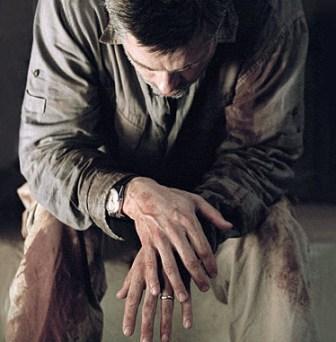
The bullet hits Susan (Cate Blanchett) in the neck. She is travelling with her husband Richard (Brad Pitt), a vacation intended to bring them closer together after an unspoken rift. They have left their two young children, Mike (Nathan Gamble) and Debbie (Ellie Fanning) in San Diego under the care of their Mexican nanny Amelia (Adriana Barraza), a Mexican nanny. The third arm of the story has Amelia take the two kids across the border in her nephew Santiago’s (Gael García Bernal) car, to attend a family wedding, because she cannot find anyone else to look after them for the day. The fourth section of the narrative, again somehow related to each of the other stories, introduces us to a deaf mute Japanese schoolgirl, Chieko (the outstanding Rinko Kikuchi), an isolated, unhappy girl, estranged from her father and struggling to find somebody to connect with. In many ways, the Tokyo section of the film exists on its own, being more dramatically complete than the other sections and might have formed a film on its own.

The film is beautifully photographed. The sparkling megalopolis of Tokyo contrasts with the stark Moroccan mountain desert and the dusty border wasteland between Mexico and America in the empathic compositions of regular Iñárritu collaborator Rodrigo Prieto. Although the story is deliberately unwieldy and cumbersome, it is edited with a marvellous economy and seamless fluidity. There are more than a few jarring cuts, transitions between the stories that are initially obscure, but gradually come into focus as the viewer discovers more information. There is also a fine sense of space and time in the judicious use of sound and music. The acting performances are all exemplary. Pitt and Blachett are most familiar to Western audiences and both excel in making whole and actual characters that are carefully, but finely sketched. Pitt, looking tired and grey, shows considerable power and soul in what are frantic circumstances. Blanchett glows even as she pales from loss of blood. In the Mexican section, Barraza and García Bernal are outstanding, with the standout from the ensemble being the young Japanese actress Kikuchi, who has the most challenging role, explicitly themed and hampered by her handicap, but does wonderful things with it.

Babel is a complex, wide-ranging film that takes the central idea of alienation and isolation and draws it out beyond the limits of its extension. It is about the difficulties in communication, verbal and cultural, and how these differences are what create the gaps that exist between people and further, between those people and an oppressive, uncaring bureaucracy. The film is filled with juxtapositions and contrasts that underline the director’s ideas with tremendous facility and, by their transitory nature, lyrically communicate what are difficult cinematic concepts. The final resolutions of each of the four threads amount to an emotional endurance test, as each arc is stretched well beyond comfort into an area of intense dramatic flux. Iñárritu drags us through the emotional briars of his elliptical story in a harrowingly direct way, and although the film ends on what, in context, amounts to a moment of redemption, it is a small mercy, more a final exhalation of relief than a soothing coda. Not all films are happy entertainments, which is a good thing, by the way. Sometimes there is greater satisfaction to be found in a puzzling, challenging work that asks the viewer to think than in the jumping puppet shows that trot out the same few superficial stories, seemingly just to pass the time.

Smoke 'Em If You've Got 'Em

In 2002, a writer director named Joe Carnahan made an exemplary, but little-seen cop thriller called Narc, a shadowy noir exercise in reinvention that marked him down as one to watch. Unfortunately in Smokin’ Aces, much of that gritty potential goes to waste in what amounts to an over-produced, under-written re-thread of sub-Guy Ritchie crime comedy capers, a disappointingly familiar and excessively violent ensemble bloodbath built around the theme of exhaustion.

It says something about the film when the wafer-thin plot can be dispatched in two short sentences while listing the cast members that act it out might take up the remainder of the available space. Basically, a dying mafia boss has taken out a $1 million contract on the life of his former protégé, a Las Vegas magician turned mobster who has entered the FBI Witness protection programme. While the G-Men try and protect their witness, a small army of professional assassins descend on his lakeside hide-out in a race to be the first to kill the stool pigeon and claim the bounty.

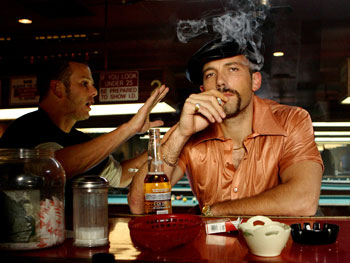
Entourage star Jeremy Piven plays the sleazy magician, Buddy “Aces” Israel, trailed by FBI director Locke (Andy Garcia), and his agents, Messner (Ryan Reynolds) and Carruthers (Ray Liotta). The early part of the film is staged to introduce the seven or eight different squads of hit-men chasing the prize, a parade of characters that requires more concentration from the audience than the film merits. Chief among them are former cop Jack Dupree (Ben Affleck) and his cronies Elmore (Martin Henderson) and Deeks (Peter Berg), accompanied unawares by a gang of chainsaw-wielding neo-Nazi punks, a pair of urban assassins (singer Alisha Keyes among them) and so on, right up to the point where the viewer loses all track of who is chasing who and why.

Although the film is presented as an ultra-violent cartoon (It’s A Mad Mad Mad Mad World as re-imagined by Tarantino) the only sustained comedy comes from a couple of short scenes with Arrested Development’s Jason Bateman as a drunken, cross-dressing go-between. It is shortly after this momentary relief that the film begins to fall apart completely, with Carnahan piling on the high-decibel gun-battles as whatever passed as a story is forgotten, until a wholly unconvincing revelatory final act that messily attempts to shoehorn meaning into what was a frantic, excessively gory, bullet ballet. Tired and clichéd, despite heaps of visual invention and an admirable commitment to all-out action, Smokin’ Aces never delivers on its slender promise.

Heart of Darkness: James McAvoy and the Last King Of Scotland

“How's things?” says James McAvoy, stretching a hand in greeting and widening his eyes in a charming gesture of polite inquiry. Fine, I say, how are things going for you? “Relentlessly”, he says, and lets out an enormous sigh, a surprising displacement of breath from such a slight man. “Reee-lent-less-ly”, he repeats, collapsing sideways into the over-stuffed Dorchester couch, stretching out his syllables with another deep exhalation. For a moment, I thought he was going to sleep, but instead the actor launches unasked into a précis of the last five weeks of his life, time spent touring the world to talk to people like me about his new film, The Last King of Scotland, the latest in a lengthening line of ‘breakthroughs’, taking in film festivals in Toronto, LA and New York, a month and more of talking, shaking hands and more talking. It sounds exhausting.

The increasingly important Toronto festival, seen as a gateway to distribution in the US, was McAvoy’s first time at the kerbside of the busy intersection between cinema and commerce and he found himself surprised by it. He had three films being screened, including the one we’re here to discuss today, but he doesn’t know quite how to feel about that singular success. “I couldn’t really get involved in anything except my own stuff. There are just so many people running around chasing their own arses and chasing their own success – everyone is rather focused on their own thing, so you wonder what it is that they are doing. A festival is supposed to be a celebration, isn’t it? And yet its not a celebration, it’s just an extension of marketing. Great for the people of Toronto who get to see lots of great movies, but if you go there as an actor, you have no ‘festival’ which is a shame – my impression is that it’s a lot of work”.

He looks across the room at something for a moment or two and then returns with a blink to the conversation. It’s fair to say he looks a little distracted. The 27 year old, small-framed like most actors, is dressed in a black v-neck jumper and artfully distressed jeans, with a mop of floppy hair and dark circles around his eyes. McAvoy picks up a silver pencil from the table and starts twisting it in his fingers; drops it, picks it up, drops it again, and says something as his head is turned away from my microphone. Later, I decipher it as something about eventually running out of things to say. We’ve been talking for less than two minutes. I attempt to kick start the conversation again by asking him if he’s tired of being constantly called ‘an actor on the rise’. “Well”, he replies, visibly brightening, “I dunno really. I suppose I’ve always been a young actor, I’m a young man, but people can say things like that about you at any point in your career. I’ve been doing this for nearly eight years now and the fact that people are taking notice of me, now as opposed to when I was starting out, doesn’t really make me feel any different and doesn’t change the way I do my job. I’m honestly not bothered about what people say. If I’d been around for a week and then was called an actor on the rise, that might make a difference, but by now I’m quite used to people judging me, every night in a play, every time I’m on the telly”.

I look down at the few scribbled notes I’ve taken as he was talking. ‘Dark circles’. ‘Big sighs’. The word ‘fidgety’ is underlined twice. Now McAvoy is looking at what I’m looking at and I’m hoping he can’t read upside down. This all happens in a moment, and he politely breaks the silence with a line that probably sums up his last couple of months, expressed with the greatest weariness imaginable, “I think people think too much about actors”. Oh yeah? But if the right people are talking about you as a talent they want to work with, doesn’t that lead to better scripts, famous directors and new opportunities? “Honestly”, he replies, “up until very recently, I’ve just taken whatever it is I've been offered. People say to me, ‘oh, you've chosen such interesting projects’, and I say to myself, ‘take what you can get’. I've been lucky that most of those have been good choices, but that was never a conscious thing. I've gotten a little more choice, but it’s not that much choice, and with having a choice comes a certain amount of fear- you’re responsible for whatever it is that you are doing, so you have to be bloody good”.

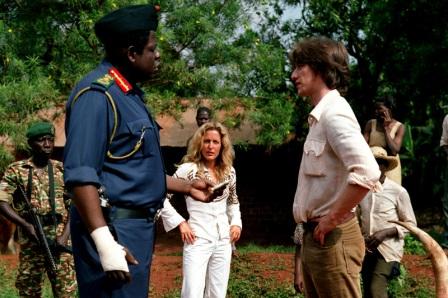
Luckily for me, he kept talking and luckily for everybody else, he is bloody good in Kevin McDonald’s dramatic debut. The Last King of Scotland is the story of Idi Amin, the Ugandan dictator who ruled his country with a bloodstained fist throughout the 1970s. Based on Giles Foden’s award-winning novel of the same name, the film offers two indelible portraits: one of charming, psychopathic dictator who ravaged his country and the other of a self-serving pleasure-seeker who eventually finds enough courage to take a stand. The unconventional biopic examines a fascinating historical figure through the eyes of a fictional character by exploring the emotionally complex relationship that develops between the two men. Forrest Whittaker plays Amin with brute force and a childlike bluntness. McAvoy plays Nicholas Garrigan, a feckless Scottish missionary doctor who arrived in the country in 1971 on a whim, and quickly ingratiated himself into Amin’s inner circle, becoming his personal physician and as a result, living high on the hog. His character is a fictionalised amalgam of a couple of ex-patriot playboys that flitted from country to country around that time, making money and connections on the back of unimaginable oppression. How did McAvoy get the role? “I simply don’t know how they decided on me. Possibly, because I was the only Scotsman of the right age and experience to do it, and still cheap enough – I’m not being funny now – but a lot of the other Scottish actors mid-twenties to early thirties were all a bit too expensive. That was that”.

Location filming in and around Kampala took the actor to Africa for three months of 2004, an experience he has found difficult to shake off. “I had never been there before. My first impression was that this is poverty on a level I could have never prepared myself for. The media and news coverage of Africa is a great thing, but it supposes that we understand the world, and we don’t, really. We have an encyclopaedic, academic viewpoint, but we don’t actually know it. I knew I would encounter these things, but until you actually do, you just aren’t ready – physically, you know. I learned that pity is a completely redundant, cheap emotion. Saying to yourself, ‘oh that’s a wee shame’, means you can walk away and not actually connect with anything that’s happening in front of you, but walk away thinking you’re a good person. That means nothing”. To illustrate this point he tells me a couple of stories about the time he spent in Ireland preparing for his role in Damien O’Donnell’s Inside I’m Dancing, detailing the reactions he felt while working with differently-abled people that boiled down to the same cheap sentiment, something he didn’t like himself for feeling, and something he struggled to get over. “That’s not all that different from the first reactions I had to Africa. I couldn’t actually do anything until I got over this sense of pity. That was the first thing I went through. After that, the rest was all work for me. I literally worked in every single scene in the movie – fourteen hour days, six day weeks, for three months. I never got a day off. So, my only cultural experience was downtime spent eating and talking with the crew and a single night spent camping beside the Nile”. Later, McAvoy tells me he will return to Uganda to work with a group of actors and musicians led by David Oyewolo (who plays Dr Junju in the film) for a couple of weeks in the early part of 2007, detailing the work that they do and how it helps the local community. It is one of the very few times that he smiles.

When I ask him about Whittaker, his more experienced co-star, McAvoy is full of praise for the heavyweight actor. Between them they divide the lion’s share of the storytelling and the friendship that developed between the two men is palpable. “It’s an odd relationship – firstly because it’s between two men. They have a lot of love for one another and that always seems to make people uncomfortable, even if it’s not a sexual thing. The other thing is that the relationship between me and Amin represents very closely the relationship the British government and Foreign Office had with him. The ups and downs are the same; the key points in ours are the same as the historical key points in theirs. Amin wasn’t just a murderer; he was a sensation, a media-manufactured figure. Instead of telling the truth, that this guy was a demon, instead we heard that he liked to wear blue Stetsons and wearing kilts and, you know, what fun! All just to make the white man laugh”. He found himself wary of intruding on the older actor while filming, with Whittaker buried deep inside a complicated character. “Forrest isn’t exactly what you’d call a method actor, but he is when it’s necessary and appropriate and this was one of those times. It’s difficult to learn anything from watching him, because you just don’t want to mess him up. He’s living it; he’s trying to become someone, so he doesn’t need someone like me asking ‘er, sorry pal, how are you doing that’?”

McAvoy had a similar learning curve to negotiate with McDonald, the director behind the award-winning documentaries One Day In September and Touching The Void, slowly building a rapport and establishing the right approach to the material. “I thought his documentaries were really cool, but I had no reason to trust him. The only thing that gave me heart before we started was the fact that I wanted to portray the character differently to the way that the script portrayed him. I didn’t want Nicholas to be an innocent caught in the middle without realising where he is. That’s the way it was originally written and, for me that had to change. So we sat down and discussed those issues and made the changes and McDonald was great with that. He re-mastered the script and that process continued when we were in Uganda. But the simple fact that there was some agreement there meant we could go off together and do it. I had to trust him and, you know, he had to trust me. We could have gone out there and it could have been a disaster”.

We’ve been talking for a while now, and the actor’s breathable intensity has hardly dipped for a moment. He seems angry about the dark history raised in the film, and passionate about telling the truth as he discovered it for himself. Raised in a working class family in a tough part of Glasgow, I wonder if he is more politically charged now as a result of his experiences. “No, politically is the wrong word, but socially charged, definitely. I have an understanding now that what we have in the West is unbelievably privileged. The working-class chip on my shoulder is gone, and I have an entirely different perspective on what real hardship is. You have to be incredibly unfortunate in this country to be born with less of a chance than anybody in Africa”. We talk for another couple of minutes about the stark statistics that end the film, estimates of the dead, a roll call of devastation. McAvoy looks genuinely pained as I rattle out the numbers. The twirling pencil falls again from his grasp and he slides off the couch to pick it up. All he says is “yeah, yeah”.

The Defiant Ones

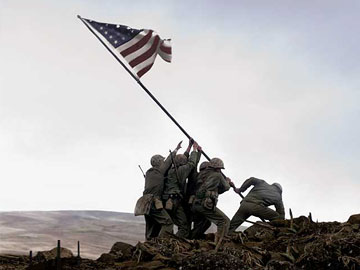
Right from the opening scenes of Clint Eastwood’s epic Flags of our Fathers, the viewer is dragged into the hell of the pacific War in 1945. Flares burst overhead as frightened soldiers scramble over the black rocks of Iwo Jima, a dot of volcanic land 300 miles south of Tokyo and the scene of one of the bloodiest battles in the entire conflict. An essential air base for the Japanese, the island is guarded by 20,000 soldiers, dug into tunnels dug in the mountain. An expeditionary force of 30,000 American GIs arrives, in an enormous fleet of battleships, to dislodge the enemy and move on to the mainland. Among these men are John "Doc" Bradley (Ryan Phillippe), a navy medic, Rene Gagnon (Jesse Bradford), Native American Ira Hayes (Adam Beach), their leader Sgt. Mike Strank (Barry Pepper), and a nervous teenager, Ralph ‘Iggy’ Ignatowski (Jamie Bell). The film focuses on those that would eventually raise the Stars and Stripes as a display of defiance, an event captured by Joe Rosenthal in an iconic photograph that would define the entire war for the American nation. What the public was not told is that the flag-raising was re-staged for the camera, and that the men, whose faces cannot be seen, might not be the same men hailed as the heroes.

Returned from the battlefield by their superiors, quick to realise their propaganda potential, three of the surviving young men are put to work selling war bonds to the public, advised by one cynical PR man that unless they can help raise $14 billion dollars, America will be bankrupt and will ‘have to give the Japanese whatever they want’. Re-enacting the event for the cameras, and seeing it everywhere from posters to postage stamps to ice-cream deserts, the men are hailed as heroes. The preening Rene delights in the attention, the stoic Doc reminds everybody that the real heroes are dead on the island while Ira the Native American falls further into sorrow and whiskey. The complicated narrative traces a line through three separate timelines – the initial assault on the island, the return to the US for the promotional tour and, rather less emphatically, the efforts, years later, of Doc’s son to write the story of his father’s wartime experiences, the book by James Bradley that the film is based upon. However, Eastwood and his regular writing partner Paul Haggis, concentrate in the later stages on the tragic character of Ira, who is returned to a life of poverty and discrimination once the glint wears off his medals. Regardless of the mangling effect they have on the narrative, these almost-silent scenes are immeasurably powerful. There is further, deep-felt sorrow in the conclusions that Eastwood draws around Doc, who dies in his bed an old man, surrounded by his family, and seems to despise himself for it. Although the war ended fifty years before, Eastwood makes it clear, with considerable cinematic skill and tremendous empathy, that the men that fought it never left it.

A war film, even one as unmistakeably anti-war as this one, uses blood and death as its currency, electrifying us with images of carnage. Eastwood, who has built a career on screen violence, employs all the technical skills that allow that reconstruction today, but throughout forces the audience to confront the carnage, holding his camera still, for long, unendurable moments on scenes of unblinking, graphic brutality. This is an intense and ultra-realistic war film, the initial assault on the black sand beach out-performing Saving Private Ryan (Steven Spielberg is one of the producers), but there is no exultation here. The director is more concerned with the way the truth can be manhandled to fit the circumstances, and the ghosts that live in dim remnants of memory, than he is in rattling his sabre. The effect is profound and deeply saddening. This is a film about the artificial creation of heroes, men made larger than life to fill a gap in the public consciousness, exposing the hypocrisy of the glad-handing US Administration and the manipulative media, as they both seize on any aspect of the men’s experience to further their agenda. The story of these six men must also be compared to the recent US military efforts to adapt the death in Iraq of the All-American Corporal Pat Tillman or the ‘rescue’ of Pvt Jessica Lynch for their own purposes, expediently changing the facts to suit their needs.

Although Flags of our Fathers shows flaws, they are minor defects; more instances of awkward storytelling than any core problem of philosophy or execution. Showing his dedication to and respect for the truth, Eastwood will revisit the battle in Letters From Iwo Jima, set to open early next year, where he will tell the story again, this time from the point of view of the Japanese. I cannot wait to see it.

The Best and Worst of 2006

I sat down the other day to compile my 'best of' list for the newly minted Dublin Film Critics Circle (more about that in a few weeks) and found myself surprised at how many really excellent films I saw in 2006.

There are about 250 movies released in Irish cinemas every year. Its interesting, to me at least, that I can confidently mark 10% or so of them as being well worth watching and well-nigh essential if you consider yourself conversant with the modern cinema. Just as interesting, about 10% of that annual slate are unmitigated rubbish, leaving the majority of films in the mediocre category - that may have proved popular, like Superman Returns, Casino Royale, The Queen or World Trade Centre, but are flawed for a variety of reasons. I really enjoyed watching Superman and gave it a glowing review at the time, but the film passed from memory too quickly and my opinions on it have changed very slightly. My opinions have hardened on Casino Royale, but to a much greater extent. WTC was too bland to consider re-considering.

But the point is this. 25 movies of a standard as good as any year in the recent history of the medium is a decent rate of return for the regular cinemagoer. There are at least another 25 that won't leave you feeling disappointed, exactly. If you picked the shit 25 (to which I could add another 25 if I was feeling particularly bilious) well that's just tough.

The Departed was, for me, the most consistently entertaining and exciting film I saw this year. I am a Scorsese fan (as opposed to fanatic) but was electrified by the angular story, the gritty performances and the blank, dark tone. It's the only film this year that I went out to watch again in the cinema. So thats tops, but the remainder of the must-see list are presented in no particular order.

Best Films of 2006

The Departed

United 93 - for a sense of horror that didn't fade for days

Pan’s Labyrinth - awesome visuals and brilliant writing and performances

Little Children

Little Miss Sunshine

The New World - utterly transfixing, made me aware of changes in my breathing.

The Squid & The Whale

The Wind That Shakes The Barley - after The Departed, the film most people talked with me about this year

Junebug

An Inconvenient Truth

The Three Burials of Melquiandes Estrada

Borat: Cultural Learnings…- the funniest comedy

Red Road - the ending was disappointing, but what went before was excellent

The Host

Flags of our Fathers - angry, brilliantly realised war film

Romanzo Criminale

Marie Antoinette

Crank - best action film, consistently surprising

Children of Men - most dropped jaw moments

Good Night, and Good Luck

Stranger Than Fiction


One title jumps out unchallenged when selecting the worst film of the year, Martin Lawrence's unrequested reprisal of his obscene 'family' clown, the monstrous insult Big Momma's House 2. I hate that unfunny prick and his sub-normal caricature of entertainment. The remainder of the 'worst of' list should be considered, like finding a head on a stick during a jungle stroll, a warning not to proceed.

Worst Films of 2006

Big Momma's House 2

RV

The Holiday - yikes

The Tiger’s Tale - the right things, said in the wrongest possible way

Step Up

Big Nothing

Tenacious D In The Pick Of Destiny

A Good Year - Crowe at his most crass

All The King’s Men

The Da Vinci Code - overhyped, overlong and under-entertaining

The Lady In The Water - humourless, odd, rambling junk

Life & Lyrics

Beerfest - not a single funny moment

Stay Alive

Just My Luck - mental poison

Fast & The Furious: Tokyo Drift

When A Stranger Calls

Freedomland

Firewall

Rent - distilled from the tears of unicorns

Aeon Flux

D.O.A. - beat 'em off made from a beat 'em up

The Lake House - sloppy and soppy

Rather than leave you with the thoughts of Keanu slobbering over Sandra like a stoned bloodhound eating a packet of Opal Fruits, the best film book I read this year was Patrick McGilligan's A Life In Darkness & Light (even if it was published in 2003) and the best song I heard was Mississippi Fred McDowell's [wiki] 61 Highway, which is of far earlier vintage.

Man, I have to think about contemporising in 2007.

Yule Be Sorry

The awful Black Christmas represents yet another remake of a supposed cult classic horror, culled from the seemingly endless supply of 1970s slasher pictures by grubbing studios desperate to mine the last nuggets of revenue from a long exhausted seam. What this movie (like Texas Chainsaw Massacre, The Fog and The Hills Have Eyes remakes before it) illuminate is the true depth of Hollywood’s creative crisis; lazy, uncaring product spewed without care or craft into the eager Cineplex supply line and an example of audiences being fed leftover turkey before the Christmas.

The original 1974 film, which starred a pre-Superman Margot Kidder and a post-2001 Kier Dullea, was an efficient gore-fest by the standards of the time but clunky and almost comic today. It was directed by the hack Bob Clarke, who later made an about-face with the very cute adaptation of Jean Shepherd’s A Christmas Story, but also made Karate Dog and Baby Geniuses 2, so it’s not like they’ll be opening film schools in his name anytime soon. The original movie teetered on the sole, subversive contrast between Peace on Earth and pieces of sexually precocious teenage girls. Nobody remembers it now, which might offer this shabby remake a snowballs chance at the box office, but I doubt it. As regurgitated by Final Destination producer turned director Glen Morgan, Black Christmas is a cretinous procession of sub-pantomime acting, illiterate dialogue and larcenous plotting, scattered throughout with scenes of torture, titillation and tacky gore. While I can never approve the former, I am generally in favour of the latter, especially in the context of an entertaining horror story. That is not found here.

The major difference between the two films, original and remake, is that this time out the psycho loses his anonymity and has an elaborate back story grafted onto his demented shoulders. After that shabby set-up, we cut to present day where the killer’s childhood home has been converted into a sorority house, a university dormitory that houses a gang of eight bitchy young women; Kellies and Megans and a couple of, like, Heathers. Barring internet floozies du jour Lacey Chabert and Michelle Trachtenberg, the cast are anonymous, but collectively they display all the life and humanity of a cutlery drawer. Their middle-aged minder Mrs Mac (Andrea Martin), tells them the legend of Billy (played by Robert Mann making his debut and, with any luck, taking his bow), while gathered to exchange grudging Christmas gifts. Soon, one of them turns up dead, with the cast of suspects including the aforementioned killer, a sleazy amateur pornographer boyfriend and the hilariously miscast ‘big sister’ of one of the teens, played by the director’s 40 year old wife.

Bonkers Billy stalks the skimpily dressed robots throughout the labyrinthine house, making noisy, threatening telephone calls and then picking the victims off, one by one, in a series of increasingly tawdry murders. Throats are slashed, eyeballs are plucked out and buckets of blood are splashed over Christmas decorations, while out in the cheap seats, yawns are stifled and watches are checked. The film is nigh on unwatchable. Word is that the studio Dimension enforced script changes and demanded an alternate ending, in effect taking the film away from Morgan, but the director doesn’t otherwise hint that there was anything here before the interference. He creates no atmosphere, no sense of dread or suspense and relies on the outward thrust of his cast’s cleavage and the staccato beat of his cheap shock moments, with the only scare being the speed at which both of fall victim to the laws of diminishing returns.

Pretty, Vacant

A horribly contrived and echoingly empty confluence of ‘Christmas movie’ and ‘chick flick’, The Holiday marks the return of What Women Want and Something’s Gotta Give writer and director, former studio executive Nancy Meyers; a lady who knows more about demographics than she does cinema and who, it would appear, is immune to voodoo. It’s either that or I haven’t been sticking the pins in far enough.

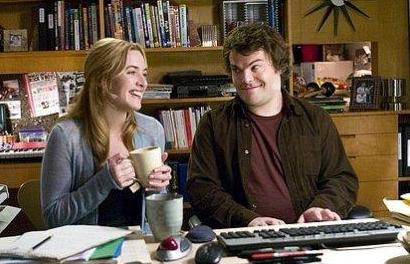
A series of short vignettes introduce us to the four main characters. Amanda (Cameron Diaz) owns a Los Angeles company making movie trailers and has recently broken up with her two-timing boyfriend (Ed Burns, briefly). On the other side of the Atlantic we meet lovelorn London journalist Iris (Kate Winslet), finally getting over her unrequited love, the caddish Jasper (Rufus Sewell). It’s Christmas, and neither woman can face being alone, so they decide, during the course of a quick internet exchange, to swap houses for two weeks. Now, you’ll stop me there. Isn’t that Tara Road? Yes, it is.

Enter the men, Jude Law and Jack Black; a singleton London book editor and a piano-playing soundtrack composer respectively. The unholy coming together of the two couples is arranged in a series of ‘meet cutes’. Meyers later wheels out the great Eli Wallach as an elderly Hollywood writer, to explain what she means, and have a pop at the current state of studio cinema while he’s at it. There’s a heartbreaking irony in this turn of events. Wallach’s character makes a tear-jerking speech at a Writers Guild of America function arranged in his honour, the same Guild that met in arbitration to discuss the authorship of The Holiday. The WGA eventually gave the credit to Meyers, although both Maeve Binchy and Helen Fielding’s names must have come up at some stage.

Diaz, who is lovely to look at, is insufferable to watch; playing a dizzy, air-headed blonde without a screed of plausibility, shrill and clumsy and wooden. Her disastrous performance aside, the chatter she is asked to express is choice. Detailing her urgent need for a vacation she trills the line, “I want to eat carbs without wanting to kill myself”. If you are the kind of woman to whom this magazine-article line rings true, you really need to talk to somebody. Winslet comes out the better of the two female leads, but there’s only a hair between them. She bears the contrivances well enough, and certainly perks up later on, but it is sad to see such talent wasted. Jude Law plays Jude Law, but with extra mischievous twinkle and later, a whole heap of blubbing pathos. He has never been more irritating. Jack Black, whose appearance as a romantic lead initially gives hope to something out of the ordinary, ruins it by doing that terrible improvised singing thing he does. By the third time he opened his gurning yap, pap-skip-skap-skoodly-doo, I was half way out of my seat, until some greater power, call it a sense of duty or ingrained masochism, forced me to stay put.

The film’s pretence that it shares a heritage with the classic Hollywood screwball comedies of the Golden Age is as inappropriate as it is desperate. Meyer’s approach to sparkling wordplay is to have one character jabber on for two incomprehensible minutes, then have the other character say something pithy, like ‘Exactly!” Failing that, there’s always a reaction shot from a dog. It is pure drivel. The director’s plotting is even less sophisticated, with every well-forecasted, painstakingly arranged plot point driven home as if at the head of a sledgehammer. Deathly bland and false, The Holiday is as bad a film as I have seen all year. Whether it works as a romance or not is a matter of individual taste, but it cannot be a comedy unless it contains jokes. Actual gags, not the exhausted Black or the dippy Diaz routine. A special mention is reserved for Hans Zimmer’s outrageously syrupy score, a constant meander of plinking piano designed to reinforce emotions the cast are simply unable to muster themselves. Like everything else on display, it is nauseating.

Write On

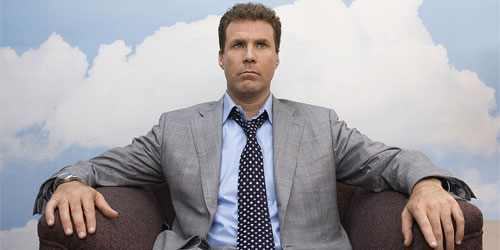
Breathless comic Will Ferrell plays it mostly straight in Marc Forster’s enchanting modern-day fable Stranger Than Fiction, a brilliantly realised story of an ordinary man caught up in an inexplicable fantasy. Ferrell plays Harold Crick, a quiet, isolated US government tax inspector who wakes up one morning hearing a mysterious voice in his head. The female voice, clipped and plummy, isn’t talking to him, it’s talking about him, describing his mundane actions and predictable moods in a precise narration, like a voice over in a movie. Harold, who shows worrying signs of obsessive compulsion, an odd world-view beautifully explained by the director with on-screen graphics showing Harold’s continuously compiled internal calculations, is naturally perturbed at the intrusion, especially when the voice tells him, in a matter of fact way, that he is about to die.

Just at the point where Harold believes himself to be going mad, he seeks advice from a psychiatrist, (played with a squint of suspicion by Linda Hunt), who listens patiently to his ravings and refers him on to a professor of literature, Dr Jules Hilbert (Dustin Hoffman), a man as spontaneous and emotional and strung out on caffeine as Harold is ordered and subdued. Hilbert also listens, while slurping constantly from his coffee mug, explaining to Harold that whatever story he believes himself to be a part of can only be resolved through one of a number of standard literary archetypes. Patient questioning comes up with a handul of names of authors who could be transcribing his life, eventually leading the duo to one writer, Kay Eiffel (Emma Thompson), simply because all of her published novels end in the death of the main character.

It’s a good deduction, Eiffel is indeed the writer, a fact confirmed when Harold hears her speaking on an old television show, but she has problems of her own. She hasn’t published anything in a decade, and is terminally blocked, writing and rewriting the last couple of chapters of Harold’s life without being able to find a way to conclude her story satisfactorily. To that end, her publishers have sent her an assistant (played with restraint by Queen Latifah), a no-nonsense woman who quickly takes the neurotic, chain-smoking, suicidal author in hand and attaches her to a routine. Meanwhile, something extraordinary has happened to Harold. His apartment has been destroyed in an accident, forcing him to move in with his only friend Dave (played by Tony Hale from Arrested Development). While dealing with this spur of disorder, he goes to meet a woman who has misfiled her tax return, and falls in love with her. Ana, a free-spirited, heavily tattooed baker (played with a heartbreaking sincerity by Maggie Gyllenhaal) initially despises this government enforcer, rifling through her papers in an effort to prosecute her, but gradually softens, until a point where the two stand before one another, mutually smitten, and suddenly alive again. But the voice is telling Harold his time is running out, with his life being taken from him just at the point where it has become worth living.

Zach Helm’s script, his debut, appears at first to follow the trendy, labyrinthine path of Charlie Kaufmann, but the film most closely matches The Truman Show in uncovering the individual decisions that these characters make in order to fulfil a destiny they are secretly terrified of. Director Marc Foster tells the story beautifully and intelligently, adopting a low-key mood and having his talented cast unquestioningly accept the magic that has come into their lives. Crucially, he never attempts to explain it all, adding immeasurably to the satisfaction, even as his characters arrange a compromise ending to the story we are watching. The acting performances are flawless, funny and touching and deliberate. The picture looks terrific, and boasts an outstanding, delicately used soundtrack.