Wednesday, May 31, 2006

United 93

As everybody knows, on the morning of the 11th of September, 2001, four American airplanes were hijacked by al-Qaeda operatives, two of which crashed into the World Trade Centre towers in Manhattan, one into the Pentagon in Washington DC and the other into a field outside Pennsylvania. Paul Greengrass’ harrowing United 93 is the story of what happened to the last plane and is one of the films of the year.

It is a bleak experience, not to be undertaken lightly. Shot with cheap cameras in a documentary style and using the facts of the tragedy as its script, this masterfully balanced and authentic film opens amid the routine of Newark International Airport, where Flight 93 is being prepared for a flight to San Francisco. Five of the passengers are Islamic terrorists, determined to take over the plane and crash it into the White House. The film unfolds in two intertwined strands of story, what happened on the ground and what happened in the air. After establishing the terrorist’s intentions, the first half of the film depicts the gradual awareness in the air traffic control system that something is wrong, and the unpreparedness of the US Air Force chain of command. After a couple of nerve-wracking false starts, once the hijackers wrest control of the plane from the pilots, the film stays on the plane. As the frantic passengers become aware of the situation in Manhattan, a dreadful panic arrives in the film and never leaves. Although they try to take the plane back, improvising weapons and charging the cockpit, we know that this is a death ride and there is no redemption.

Much as he did in 2001’s Bloody Sunday, Greengrass sticks to the facts, allowing the film to unfold in its own horrific way without using any kind of flourish to embellish the story for drama or impact. As he did in Derry, and later in Omagh (which he produced) Greengrass worked closely with the families of the dead to ensure their loved ones were depicted honestly and fairly. The film is absolutely without sensationalism or affectation. Other than an opening fly-by of the Manhattan skyline, there is not a single shot in the film that could not come from the point of view of someone in the scene. No one event is selected as a midpoint of the drama, as modern cinema grammar dictates, and no one hero emerges. We never cut to an exterior shot of the plane falling from the sky, or see it careen from the ground. Events unfold here in real-time, which is exhausting. There is no clipped relief from the editor to bring us in and out of the action. There is no montage to spare us; we have to live it like they did.

The actors were carefully chosen from the ranks of character professionals that populate network cop shows and sit-coms. They look like us, talk like us, re-act like us. They are not drawn as heroes, they are not burdened with dramatic arcs to fulfil. There are no unthinking acts of selfless courage and no wittily scripted banter. Even the line "let's roll", taken up by the media as a banner of heroism in the days following the attacks, is delivered here as an off-camera aside. United 93 is absolutely honest in portraying the people that died on that day as ordinary people in an extraordinary situation, making the passengers gradual realisation of the dire situation facing them as convincing and affecting as if you were facing it yourself. We already know what happens, which makes the passengers desperate attempts to wrest control of the plane back from the terrorists all the more distressing. In these last scenes, Greengrass increases the movement of his cameras and the tempo of the editing to create a dreadful bedlam of noise and colour that contrasts powerfully with his previously meticulous ordering of time and place.

Although the immediate military response to the hijackings is hopelessly muddled and bureaucratic there is no attempt to moralise here. Beyond offering catharsis, Greengrass brave film offers no particular message about terrorism; the evil events speak for themselves. He similarly resists waving a patriotic flag and does not provide either a background to the terrorist’s actions or an explanation as to how the hijackings birthed the war on terror and created the shambles in Iraq.

If the film is anything, it is a memorial, a hewn-granite mausoleum of fear and futility, an eye-witness sketch of the face of death. It offers no comfort and neither should it. It is galvanising in its stark depiction of horror, unnervingly ordinary and arbitrary and empty. It only takes on meaning when viewed dispassionately as a collected sequence of events and the observer bears witness. But I’m warning you, it’s a tough job.

Thursday, May 25, 2006

The Final Insult

With original director Bryan Singer jumping ship to make Superman Returns, the once-noble X-Men franchise has been handed to second-tier talent Brett Ratner to ruin, and in The Last Stand, ruin it he most emphatically does. You know you’re watching a Ratner when the transfatty acids in the popcorn franchise outing don't sit well when sprinkled with the hundreds and thousands of the After The Sunset director’s failings.

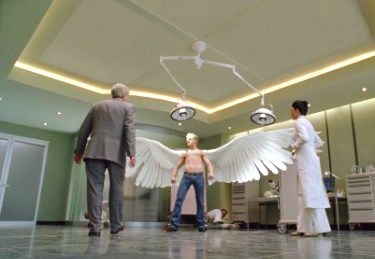
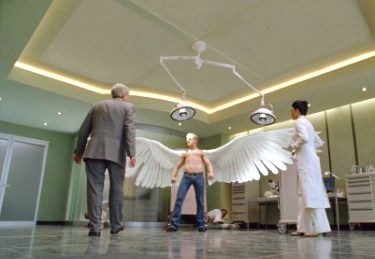
Driven by millionaire industrialist Warren Worthington's (Michael Murphy) desire to 'cure' his own son, Warren Junior (Ben Foster), who has grown a fine pair of angel’s wings, a drug that reverses the X-gene mutation, the source of all the superheroes (and supervillains) powers, is developed. With the President opening clinics to allow mass vaccinations, and plenty of mutants wanting to become ‘normal’, a strained political situation spills over into war.

On one side Magneto (Ian McKellen) gathers a ragtag army of discontent cyberpunk mutants who think that destroying all non-mutants to stop the President enforcing a medical threat to their existence. On the other side, the head of the X-Men school Prof. Charles Xavier (Patrick Stewart), with the help of political animal (literally) Dr. Hank McCoy (Kelsey Grammer) search desperately for a diplomatic solution.

Then there’s the one in the middle that causes all the trouble, resurrected super-vixen Jean Grey (Famke Janssen), who returns as a fire-breathing, omnipotent angel of death, to find the third way, the pyrotechnic realpolitik of blockbuster Armageddon. Her policy of turning those who conspire to tick her off into beautifully rendered dust doesn’t deter the mutton-chopped Wolverine (Hugh Jackman), who is desperate to rekindle his love for her. Or kill her. Or maybe it’s rekindle while killing. He looks as confused about it as anybody. Nevertheless, the battle lines have been drawn more or less, and there’s a hefty chunk of special-effects budget to get through, so it all kicks off.

Ironically there’s a returning character, Rogue (Anna Paquin, just about) who cannot touch people or she’ll suck the life out of them. Ratner should have squeezed into her skin-tight costume himself. His carnival style, flashy and nausea-inducing, pushes character and story way into the background while mechanically executing enormous stunt set-ups that quickly become repetitive. When you’ve seen one magnetically-propelled station-wagon doused with flames, turning it into an impromptu weapon, you’d imagine you’d seen them all. Ratner will repeat the trick thirteen times, regardless. You get to wondering if he hadn’t finished working it all out with Dinkies and a Zippo on the carpet of his Winnebago before the knock on the door came to call him to the set.

This flashy longueur comes at just the wrong point, smack bang in the middle of the ultimate battle; the final stand-off between good and evil mutants that loyal fans have waited three long movies for. The franchise is known for its variety of characters, interlocking stories and grand themes, or rather, it was. Here we have a great start and a muddled middle that has only one place to go. When it gets there, an odd thing happens. The X-Men go out in a unique way, with a very loud, percussive whimper rather than the anticipated bang.

The new characters are given a couple of short scenes to do their various party-pieces. Trailer Park Boys fans will spot Ellen Page as Kitty, the teenager who can walk through walls with the same facility as she can steal boyfriends. Later she battles Vinnie Jones (I know, tsk) as Juggernaut, a strong-man, in a race through a long building inspired by an old Levi’s commercial. At least they get a go. Foster as Angel is anonymous, except in long-shot and mid-flight. Magneto’s new recruits, a porcupine guy and a very quick woman among them, get an introduction and a blurry fight scene and goodnight.

Whole sections of The Last Stand eluded me, being either so thinly sketched as to be subliminal, like Olivia William’s turn as a bespectacled Scottish doctor, or so lumpen that you have to crane your neck to see around them; like the deaths of major characters or the whole ‘Learn To Love The Mutant Inside” thing. The big moments arrive on cue, some more effectively used than others. We are treated to Ratner’s take on the motorway convoy pile-up, following the lead set by the Wakowski Brothers and Michael Bay before him, which is well handled without being extraordinary. Later, the fine idea of shifting the Golden Gate Bridge in San Francisco to form an impromptu passage to Alcatraz and the final battle gets mired in shabby, over-used stunt work and ho-hum special effects. More does not always mean better, but at least they’ve promised there won’t be another one.

Or have they? The studio rep at the screening urged us, the seat-flipping critical press, to wait until after the credits for an extra scene. It’ll be worth it, we were told. After staring diligently at a five minute scrawl of special-effects personnel and stunt-people, there is indeed a 'hidden' scene. It is not an apology from Stan Lee.

Thursday, May 18, 2006

Code Unknown

In keeping with the source book’s air of intrigue (although the deepest mystery remains how any one of those 60 million readers stuck with it to the end) there was an elaborate hoo-ha made about The Da Vinci Code’s eventual release, with Sony deciding to delay screening the film to critics until the very last minute. You have to wonder why. The calls from the pulpit to boycott the movie, angry Christians picketing cinemas around the world, a high-profile plagiarism court case and the simple fact that the book and film enjoy almost 100% audience awareness all combine to give The Da Vinci Code the kind of publicity that money can’t buy. More than that, they have the effect of making the film critic-proof. There is nothing I can say that would make someone who wants to see the movie stay at home instead and likewise, what words would convert an unbeliever? The only question remains, can the thing live up to the hype?

In short; no, it can’t (how could it?) but it does live up to its pulpy source material pretty well. The book, driven purely by plot and coincidence, is designed to keep you turning the page. Unsurprisingly then, the movie is relentlessly paced and breathlessly told. Taking place over 24 hours, we first meet the famed Harvard professor of Symbology Robert Langdon (Tom Hanks) as he delivers a lecture to impassioned Parisian students about the origins of religious symbols. Soon after, he is called to the Louvre by the slit-eyed police captain Bezu Fache (Jean Reno) to assist in the investigations into the strange death of an esteemed curator, whose body is covered in arcane markings and nonsense verse. There he meets police cryptologist Sophie Neveu (Audrey Tautou), who tells him that Captain Fache, a badge-wearing member of Opus Dei, thinks Langdon is the killer and he must flee with her to clear his name. With the mad albino monk Silas (Paul Bettany), who is working on behalf of the evil Bishop Aringarosa (Alfred Molina) on their trail, Together the duo unveil a series of long-lost secrets that were hidden in the works of Leonardo Da Vinci, which when taken together lead to the discovery of a secret religious society dedicated to guarding an ancient secret that has remained hidden for 2000 years - Jesus was an ordinary man, who married Mary Magdalene and had a family whose bloodline still survives today.

Director Ron Howard and his screenwriter Akiva Goldsman stick as closely to the novel’s rushed intricacies as the very generous 2 hour 20 minute running time allows, resisting the temptation to trim for logic and patience of the audience. Goldsman does tweak some of Dan Brown’s flat prose and reams of chatty exposition in a vain attempt to tighten the tension and give some meaning to the frenzied chasing about. But he never adds any dramatic compulsion to his paper-thin characters. Why are they doing this, for instance? Langdon in particular is a completely unreasonable character. Why would an innocent man with a watertight alibi flee the police? How many people have to die in front of him before he asks himself what he's doing? Nevermind, perhaps it's better that we discover almost nothing about either of the principals, save that they share scars from childhood traumas that have coloured their adult lives. She never got over the death of her parents in a car accident when she was a child and he cannot cope with the claustrophobia resulting from having once been trapped down a well.

Much like he did in A Beautiful Mind, Howard relies on digital effects to communicate Langdon’s ability to solve the visual and verbal puzzles the story throws his way. Whether or not these sequences work depends on your ability to keep up with him, but it’s difficult to see where the director could have improved his approach. It works well enough as a dramatic device, but it doesn’t transcend the zeros and ones to become something more profound than a trick. The director’s most original touch is his sparing use of washed-out, blue-tinted flashbacks based on disproven or disputed accounts (or unabashed gobbledegook) that as supposed to reconnect the historical dots, but crucially for the movie we return forward again with no greater understanding.

Worse still for the story, Hanks and Tautou have the shared ability to turn their hands to everything the plot throws at them, finding they somehow possess the skills to fix everything, without ever being truly tested. When they are stuck and require a push, an unseen hand emerges from the wings to put them back on track. Curiously, given her second-billing, it is Tautou that leads the way here, her wide eyes and sweet smile allowing some emotional connection. Hanks is aloof and remote, reacting to each twist in the plot with the same expression of dumb surprise, and desperately reaching for connections. There is a distinct absence of any chemistry between the two; their partnership is never developed into a single whole because it only exists to sustain the plot. Howard cannot avoid making them appear stiff and uncomfortable because they are there to run and find, not to be. When they talk, it is about the plot.

The plot is driven not by character or dialogue but by a strict regime of solving puzzles, a bit like a Countdown omnibus. Although this might work in written fiction, and there is no denying the book's success, the po-faced, chaptered nature of the drama puts the brakes on any sustained sensation of discovery or compelling interest. Hanks’ character suffers from repetitions in action and dialogue, finding the answers are “right in front of his nose” once to often to sustain a suspended disbelief. Tautou's eventual awareness of her connection to the day's madcap events, and the line of dialogue that greets it, is completely deflating and raised an irrisistible ripple of laughter across the cinema.

Although he too is fixated on forward momentum, the introduction of Ian McKellen as Sir Leigh Teabing, about an hour into the running time, gives some humour and humanity to all the dusty old conjectures. A wealthy Grail enthusiast, Teabing also serves to explain the films central thesis that the role of women in the Church has been suppressed, and that, far from being a prostitute, Mary Magdalene was actually Jesus’ wife and that they had a daughter together whose bloodline remains. For his part, McKellen seems to enjoy the ripe language and daft situations, playing the crippled scholar with a relish unique in the cast. Hanks, all bluster and brow-wrinkling, gives one of his least involving performances as the harried professor, whose motivations for getting involved in this dangerous game remain as deep a mystery as any.

It’s safe to say that the Church and Opus Dei in particular don’t come off well here, but only somebody looking to be offended would take this cartoon seriously. It would be difficult, however, to put any kind of positive spin on the cilice, a spiked garter that Bettany’s character wears on the flesh of the thigh. It looks agonising, as does the mad monk’s thrice daily round of flogging himself naked in front of a crucifix until he draws blood. Howard makes much of these scenes of religious torture and body mortification, but there is nothing spiritual about them. In fact, there is almost nothing spiritual or philosophical about any aspect of the film. Its frantic protagonists, beset by deceptions and double-crosses, could be chasing anything. The fact that it’s the Holy Grail is as close to a joke as Brown’s clumsy writing allows, the McGuffin to end all McGuffins.

Although you have to allow the Roman Catholic church to advise it’s congregation however it sees fit, getting hot under the collar over a popular novel and it’s subsequent visualisation seems to me to be entering an area of cultural criticism they are wholly unsuited to. The church, like the state, wouldn’t know art, even lowest of the low art like this, if it bit them on the arse. In fact, the movie, the book and the church have more in common than they know. They all sustain themselves by deepening the mystery and evading logic; once a thing is explained and classified it loses its attraction and can be filed away. Perhaps that goes some of the way towards explaining the increase in applications for Opus Dei membership the secretive organisation reported last week. That, or people feel they aren’t being whipped enough.

If you believe the film to be blasphemous in its intent, don’t go see it. If you similarly believe you have the right to advise other people on how they pass the time, tell them not to go either, if they’ll listen to you. Those of us prepared to see The Da Vinci Code for what it is, a mediocre entertainment built on cod-history and the tropes of the adventure thriller will emerge blinking from the cinema in no danger of being struck down by bolts of divine lightning. It’s slightly disappointing, actually, but fits the mood.

Tuesday, May 09, 2006

Straight To Message

Remember when you were twelve and the gang sat around swapping ghost stories on a warm summer’s evening in a field somewhere? The one about the escaped lunatic banging on the roof of the car with the husband’s head. How saying the Our Father backwards on Halloween night will summon demons or Bloody Mary, who is likewise available at any time to remove you from your senses if you say her name five times into a mirror. Nowadays they’re classified as urban legends and there are websites and books and PhD candidates devoted to them, but if, somehow, a handful of terrified twelve-year-olds were handed 30 odd million dollars and told to get cracking on a movie, this is the movie they would make.

Or rather, remake. Another Paramount exercise in eating it's own tail, culled from the dwindling herd of actually-not-that-great 1970s B-horrors, When A Stranger Calls is the one about the babysitter, terrified by a series of prank calls, who finds out that the escaped murderer is calling FROM INSIDE THE HOUSE! The 1979 version with Charles Durning dealt quickly with the messy business of the familiar set-up, turning the old campfire tale into a springboard for an empowering female revenge story. Years later, Wes Craven used the legend as an ironic wink for the manic opening of Scream but for Simon West, the yarn is the whole thing. After a foolish prologue that is just too stupid to describe here and adds nothing anyway, we meet pouty high-school student Jill Johnson (played by Camilla Belle), who has run up a huge bill on her mobile phone. To pay it off, she takes a job baby-sitting for a rich doctor and his wife, who live in an elaborate mansion on the outskirts of town, replete with high-end gadgetry, whole rainforests of polished wood and miles of glass. When Jill arrives, the kids are asleep and Rosa the Mexican maid (who lives in, but whose duties don’t include babysitting, apparently) is “somewhere out back”. The doctor’s pretty wife explains that the house lights are controlled by motion sensors, the alarm is on and there’s a list of emergency contact numbers on the fridge.
Shortly after they leave, and about twenty minutes into the movie, Jill gets a phone call. It is the first of many. Soon, she has trouble with everything, is being mercilessly taunted by an apparently all-knowing madman (played by Tommy Flanagan but voiced by Lance Henriksen) and is in mortal fear of her life.

Giving nothing away, the film has the girl pick up the phone, have a short, screamed conversation, hang up and then wait for it to ring again. Occasionally she does this while walking around the house, investigating various mysterious noises. The deep-breather keeps calling and she keeps screaming at him. She might talk to her bitchy friends, her two-timing boyfriend, even the restaurant where the doctor is eating. But she still picks up every time it rings. There are a couple of boo moments, a few squealing violins on the soundtrack and a lot of nonsense with technology, but that is essentially it. The company that looks after the alarm system gets in on the act, as do the cops, who advise her to keep the guy talking for at least 60 seconds, so they can trace the call. Oh dear. At least it gives her something to do. The children in her care have been sound asleep since before her arrival. Despite the bedlam raging throughout the house, they remain unseen and unheard until roused from slumber to provide the film with a conclusion.

Loud noises are a given in the genre but this deranged madman is the noisiest killer since they found a cure for whooping cough. All crash and bang but no wallop. There is a long sequence where Belle is screaming at dog-whistle pitch, the phone is ringing off the hook, the house alarm is going seven bells and West has his heavy hands flailing on the sound mixer. It’s not frightening, it’s not even worrying, but it is very annoying and doubly so when the next hour of the film alternates between one or the other or all three. Once we know the hook, that the calls are coming from inside the house, there is nothing else to know. For a while, Belle makes for an interesting heroine, but her performance falters desperately once she’s required to play opposite her co-star, the architecturally lavish location. The remainder of the story fails her completely; her dialogue consists of “Hello”, “I can hear you breathing”, “Who’s there?” and “Aaaargh”. Her stunt double does the rest. The lack of any real threat, to say nothing about the want of logic and the obscene amount of repetition, has the result of relegating all the squealing and chasing around to the level of choreography. And that’s not scary either.

This is West’s first film since 2001s Lara Croft: Tomb Raider. I’ll leave it at that for analysis, except to add that in a perverse way, his very public and costly failures (and those of his mentor Michael Bay) offer some hope for the future of American studio cinema. The fact that telling this stripped down, barely-there story doesn’t allow him to display his more exuberant directorial tendencies is a relief, but without his customary pyrotechnics to punctuate events, West hasn’t the skills to communicate his anaemically simple ideas. The film doesn’t work because the director has no concept of suspense, no notion of editing for tension and literally no story to tell. If indeed the British director does know how to construct a compelling thriller without the aid of gunplay or bombastic speeches, he chooses not to show it on this occasion. To be truly frightening, horror doesn’t always need graphic gore or chainsaws or monsters with big fangs but a hack-job with all the actual hacking taken out leaves us with what, exactly?